TL;DR: Trial reels get few views because Instagram shows them only to people who don't follow you, so they miss the early push your followers usually give a new Reel. Instagram's head says they'll get less reach than a normal Reel almost always. Wait 24 to 72 hours, compare each trial with your other trials, and read skip rate, watch time and shares before raw views.
You posted one of your trial reels, checked back an hour later, and it had 40 views. Your normal Reels pull hundreds or thousands. So what went wrong?
Usually nothing. Trials are built to start small, and reading them like a normal Reel is the fastest way to delete a winner.
This guide covers why trials get so few views, what a good result looks like, how to read the numbers Instagram gives you, and how to use trials to test hooks before your followers see them. If you sell a product and want to test messaging, our guide on how entrepreneurs use trial reels covers that angle. This one is about views and reading results.
Why Do Trial Reels Get So Few Views?
Trial reels get few views because Instagram shows them only to non-followers, so they skip the warm start your followers give a normal Reel. Every view has to come from a stranger Instagram chose to test it on. Instagram's own help text says trials may take longer to get views for exactly this reason.
When Instagram launched the feature in December 2024, Meta said trial reels go to non-followers first and stay off your grid and Reels tab unless you share them with everyone. Your followers won't see a trial in Feed or the Reels tab. One could still find it through a DM or an audio page, but that's rare.
That matters because followers are your head start. A normal Reel lands in front of people who already know you, and some of them watch right away. A trial gets none of that.
Adam Mosseri, the head of Instagram, has been blunt about it. In comments quoted by Buffer, he said trials will get less reach than regular Reels "almost always." He also said you can't fairly compare a trial with a normal Reel, since it isn't going to your followers. Instagram's help text, as quoted by Planoly, adds that trials can be slower to pick up views because the people seeing them don't follow you.
So a small number isn't a verdict on the video. It's the format doing what it was built to do.
How Long Should You Wait Before Judging a Trial?
Wait at least 24 hours before you read a trial, and give it up to 72 hours before you decide. Instagram releases trial insights about a day after posting. Its auto-share option judges a trial on the views it gets in the first 72 hours. Checking after one hour tells you almost nothing.
Instagram's creator blog explains that views, likes, comments and shares show up about 24 hours after you share a trial. The same post covers auto-share. You can let Instagram share a trial with your followers automatically if it performs well on views in its first 72 hours. Instagram hasn't published the exact cutoff.
That gives you a simple rhythm. Take an early look at 24 hours. Make your call at around 72 hours. Buffer's writer, who runs trials often, advises waiting at least a day, and longer if you can, before you share or delete one.
One more check if you schedule posts. Planoly notes that Instagram only decides whether an account can use trials at the moment the Reel publishes. A scheduled trial can fail, so confirm it actually went out as a trial before you worry about the views.
What Does a Good Trial Result Look Like?
A good trial result is one that beats your other trials, not your normal Reels. Instagram shows how each trial compares with your previous trials, and that's the benchmark that matters. There's no official "good" view count, because reach depends on your niche, your account and the video itself.
Mosseri's advice is simple: compare trials to trials. Instagram builds this into the product, since trial insights include a comparison against your previous trials.
Real numbers swing a lot. Buffer's writer saw her normal Reels land at about 1,500 to 5,000 views while her trials topped out around 180.
Kapwing saw the opposite in a small two-Reel test. A trend-based trial got 2,258 views against 949 for the same video posted normally. A product-focused trial got 802 views against 836. One Kapwing trial later passed a million views.
Those are two accounts and a handful of videos. Don't treat either as a benchmark. Here's a better way to define "good" for your own account:
- Above your trial median. Line up your last 5 to 10 trials. A winner sits clearly above the middle one.
- Strong watch time. Average watch time at or above your other trials means strangers stayed.
- Shares. A stranger sharing a video from someone they don't follow is a strong signal.
- Low skip rate. Fewer people swiping away in the first 3 seconds than on your past trials.
Kapwing also found its trials reached more people but earned fewer likes per view than the regular posts. So don't expect follower-level engagement from strangers. Judge trials on whether people watched and shared.
How to Read the Numbers in Your Trial Insights
Buffer lays out where to find them: go to your profile, open the Reels tab, then open your drafts and trials and tap "View reel insights" on the one you want. You'll see views, reach, likes, comments, shares, saves and watch time.
Mosseri has named the three signals that matter most for ranking: watch time, likes and sends (shares by DM). He told creators to track average watch time, likes per reach and sends per reach. He also said sends matter a bit more for content shown to non-followers, which is exactly who sees a trial.
Read your numbers in this order:
-
Skip rate. In August 2025 Instagram added a retention chart and skip rate to Reels insights. It's the share of views where people swiped away in the first 3 seconds, so a high number on a trial means the opening isn't stopping strangers. Our guide to fixing a high skip rate shows how to repair the first frame.
-
Average watch time. Compare it with your other trials, not your normal Reels.
-
Sends per reach. Divide shares by accounts reached (6 shares on 300 accounts is 2%).
-
Likes per reach. Expect it to run lower than on follower posts.
-
Views last. They're the result of everything above.
Rates beat totals. A trial with 150 views and strong watch time can be a better test result than one with 400 views and a high skip rate. For more on which numbers predict reach, see our breakdown of Reels metrics that matter.
How Do You Use Trial Reels to Test Hooks Before Your Followers See Them?
Use trial reels to test one change at a time, usually the hook. Post two versions that are the same except for the first few seconds, compare them after 24 to 72 hours, and share only the winner with your followers. Keep the caption, audio and tags the same so the hook is the only difference.
This is what Instagram built trials for. At launch, an Instagram product lead told TechCrunch that creators held back on experiments because they didn't want to lose their current audience. Trials let you experiment with strangers first.
Here's a simple hook test:
-
Pick one question, such as whether a question hook beats a bold claim. Buffer's writer found a trial with no clear question taught her nothing.
-
Change only the hook. Keep the caption, audio, location and hashtags identical (Buffer had to rerun one test over a missing location tag).
-
Post both as trials close together, so timing isn't the difference.
-
Wait 24 to 72 hours.
-
Compare skip rate and watch time first, then shares.
-
Share the winner with everyone, or let auto-share do it.
Use new footage for each test, because Instagram warns, per Planoly, that a trial may get limited reach if it detects you've shared the same content before.
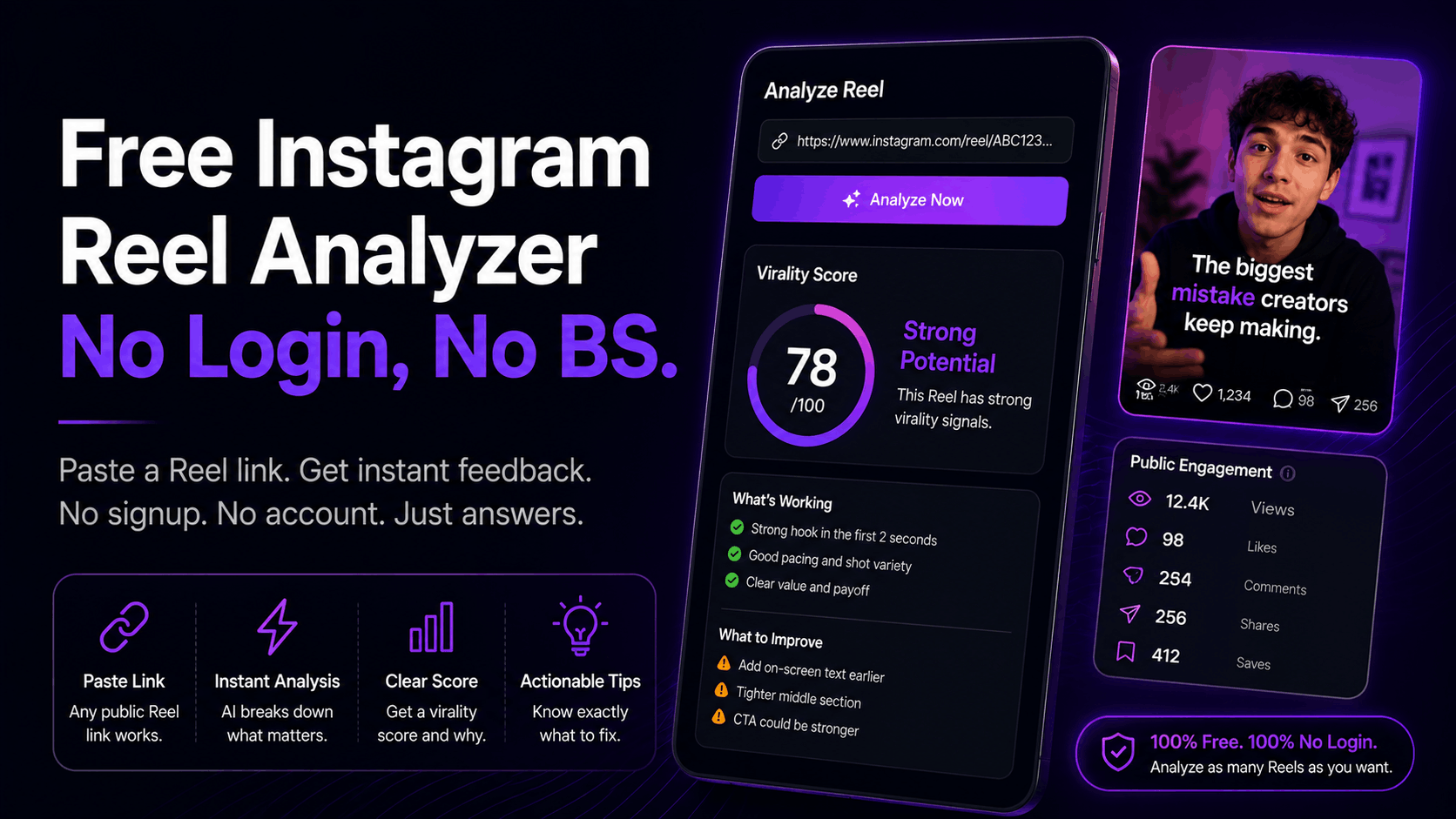
Before you film, it helps to study what a strong opening looks like. Paste any public Reel link, yours or a competitor's, into our free video analyzer with no account needed. You'll get a Vision Score plus sub-scores for hook, pacing and four other areas, so you can see how an opening holds up before you build your two versions.
Need hook ideas to test? Start with our list of 100 social media hooks. For a fuller testing plan, including how many trials you need, see how to A/B test your Reels.
When a Trial Flops: A Quick Checklist
If a trial is still near zero after 24 to 72 hours, work through this list:
- Is your account eligible? Instagram's help text, as Planoly quotes it, says an account that can't be recommended to non-followers also loses trial access. Check Account Status in your settings.
- Do you meet the current rules? These have changed. Trials launched for professional accounts in December 2024, and in July 2025 Social Media Today reported that any public account with 1,000 or more followers could use them. Check Instagram's Help Center for today's rules.
- Did it post as a trial? Metricool notes that a scheduled trial fails if Instagram hasn't turned the feature on for your account.
- Is it new content? Reposts may get limited reach.
- Is the hook built for strangers? Openers like "as I said yesterday" lose people who've never seen you.
- Are you comparing the right things? Trial against trial, never trial against your best normal Reel.
If your normal Reels are dropping too, the problem may be bigger than trials. Our guide on why Reels stop getting views walks through the seven common causes.
Conclusion
Few views on a trial is normal. Trials go only to strangers, they skip your follower head start, and Instagram itself says they'll usually reach fewer people than a regular Reel. The number on its own isn't the verdict.
The real read comes from comparing trials with trials, waiting a full day or three, and checking skip rate, watch time and shares before views. Use that, test one hook at a time, and share only what wins.
If you want to see how your Reels score on hook, pacing and reach in one place, start free, no card needed. Your Vision Score shows where each video holds viewers and where it loses them.
Frequently asked questions
Why are my trial reels getting zero views?
Trials only go to non-followers, so they can take longer to pick up views than a normal Reel. Give it at least 24 hours, since Instagram releases trial insights about a day after posting. If it's still at zero, check that your account is eligible for recommendations in Account Status and that the Reel actually posted as a trial.
Do trial reels hurt your reach?
Instagram hasn't said that trials hurt your normal Reels. They're shown to non-followers and kept off your grid and Reels tab unless you share them with everyone. Expect the trial itself to reach fewer people, which Instagram's head says happens almost always.
How long should I leave a trial reel up before deciding?
Read it at 24 hours and decide at around 72 hours. Instagram's auto-share option judges a trial on the views it gets in its first 72 hours, so that window is a sensible line for your own call too.
What is a good number of views for a trial reel?
There's no official number. Compare each trial with your previous trials, which Instagram shows in trial insights, rather than with your normal Reels. A trial that beats your trial average on watch time and shares is a good result even if its views look small.
Can I test two hooks with trial reels?
Yes. Post two versions that are identical except for the hook, with the same caption, audio, location and hashtags. Compare skip rate and average watch time after 24 to 72 hours, then share the winner with your followers.