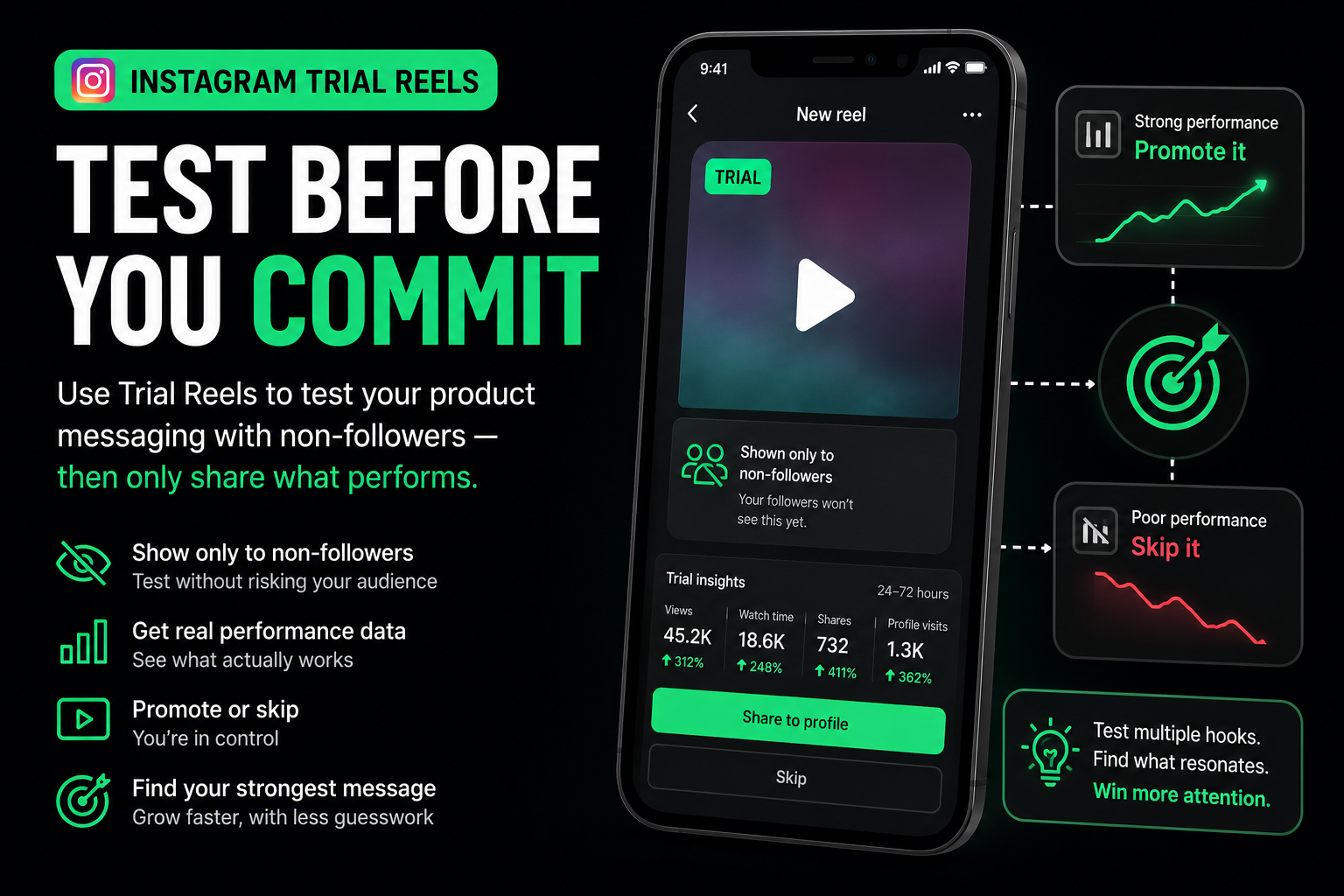
TL;DR: Instagram Trial Reels let you test content with non-followers before it ever touches your main feed or existing audience. For entrepreneurs, this isn't just a content feature — it's a free product messaging lab. You can test five different ways to explain your product, find out which hook actually stops the scroll, and only commit the winning version to your profile. This guide covers exactly how the feature works, why it matters specifically for product-based businesses and founders, and how to build a systematic testing process around it.
Most entrepreneurs treat Instagram like a bet. You spend an hour scripting, filming, and editing a Reel about your product. You post it. You watch it either perform or quietly die. And if it dies, you're left guessing: was it the hook? The messaging angle? The format? The timing?
Trial Reels change that entire dynamic.
Trial Reels are a feature Meta rolled out in December 2024 and continued expanding through 2026, designed specifically to let business and creator accounts test content with non-followers before showing it to their existing audience. When you post a Trial Reel, your followers don't see it. It goes only to people who don't already follow you. You get 24 to 72 hours of real performance data from a cold audience, and then you decide: promote it to your main feed, or learn from it and move on.
For a creator testing entertainment content, this is useful. For an entrepreneur testing product messaging, it's genuinely powerful. Here's why and how to use it properly.
What Are Instagram Trial Reels?
Instagram Trial Reels are a testing feature that lets creators and businesses post Reels exclusively to non-followers before deciding whether to publish them to their full audience and profile grid. The Reel is shown in the Reels feed and on the Explore page to people who don't follow you, but it does not appear on your profile grid, in your followers' feeds, or in the Reels tab of your profile unless you explicitly choose to share it after reviewing the results.
After the trial period, Instagram shows you performance metrics including views, watch time, likes, comments, and shares. You then make a deliberate decision: share it to your profile if it performed well, or discard it if it didn't. Instagram also offers an auto-promote option that will automatically share a Trial Reel to your main feed if it hits a certain performance threshold within 24 hours.
To access Trial Reels, you need a public Professional Account (either Creator or Business) with over 1,000 followers. When you're on the final sharing screen before posting a Reel, a "Trial" toggle appears. Switch it on and the Reel enters trial mode instead of posting normally.
The key thing to understand: every post without Trial Reels is permanent. A Reel that flops sits on your profile, drags down your average engagement, and sends a negative signal history to the algorithm. Trial Reels remove that risk entirely.
Why Trial Reels Matter More for Entrepreneurs Than for Creators
Most Trial Reels guides are written for content creators testing entertainment formats. The advice is useful but misses the specific use case where Trial Reels are arguably most valuable: entrepreneurs testing how to explain and position a product to people who have never heard of it.
Here's the distinction. A creator testing a Trial Reel is asking "does this video format entertain people?" An entrepreneur testing a Trial Reel is asking "does this message make someone who has never seen my product understand why they need it?"
These are fundamentally different questions, and the answers have very different stakes. A creator who discovers a format doesn't work loses one video. An entrepreneur who discovers their product positioning doesn't resonate after running paid ads, building a landing page, and investing months into a content strategy has lost significantly more.
Trial Reels are top-of-funnel discovery tools. They reach cold audiences, people who don't know your brand, haven't seen your product, and have no prior relationship with you. That's the exact audience your product messaging needs to work on. Your existing followers already understand what you do. The real test of whether your message is clear and compelling is how a stranger responds to it in the first three seconds.
Kapwing, a SaaS video editing tool, used a viral Trial Reel to generate 1.4 million views, 130 new followers, 8,600 profile visits, and 290 external link clicks. The mechanism that made that work wasn't luck it was testing messaging with a cold audience before committing. Entrepreneurs who build this kind of testing loop into their content process consistently find their strongest positioning faster than those posting to their main feed and hoping.
The Product Messaging Test: How to Run It
The highest-leverage way for entrepreneurs to use Trial Reels is to run a systematic messaging test across multiple angles for the same product concept. Here's the exact process.
Step 1: Identify the three angles you want to test.
Most products have multiple valid positioning angles. A social media analytics tool, for example, could be positioned as: (a) the tool that predicts whether your content will perform before you post it, (b) the tool that shows you why your past content underperformed, or (c) the tool that replaces guesswork with data for creators who are tired of hitting a ceiling.
Each of these is a different emotional entry point for a different type of buyer. You probably have instincts about which one is strongest. Trial Reels let you test those instincts against a real cold audience instead of guessing.
Step 2: Film the same core concept with three different hooks.
Same product, same general topic, three different opening lines. One leads with the problem ("if your Reels keep hitting 200 views no matter what you post..."). One leads with a surprising fact ("most creators don't know there's a metric that predicts reach before you publish"). One leads with the transformation ("this is how creators stopped guessing and started growing").
Test different hooks, formats, and messaging in large batches. The more variations you put out for the algorithm to test with a cold audience, the faster you find the angle that actually converts.
Step 3: Post each as a Trial Reel and wait 72 hours.
Don't post all three on the same day. Space them out by 24 to 48 hours so the algorithm has time to distribute each one before the next goes live. After 72 hours, review the metrics for each.
Step 4: Compare the right metrics.
For entrepreneurs testing product messaging, the metrics that matter most are: watch time and completion rate (did the message hold attention?), profile visits (did it make people curious enough to investigate further?), and external link clicks if you've added a link. Views alone don't tell you whether the message worked. A Reel with 2,000 views and 40 profile visits outperforms one with 8,000 views and 12 profile visits for a founder trying to drive trial signups.
Step 5: Promote the winner and iterate on the loser.
Once you identify the strongest performing angle, promote it to your main feed with one tap. Then use what you learned from the lower performers to understand what didn't resonate and why. The hook that failed teaches you as much as the hook that landed.
For tracking which Trial Reels are generating the right downstream signals across your content history, Wave Vision's cross-platform analytics surfaces profile visit rate and engagement velocity alongside the standard metrics, giving you a clearer read on which trial content is actually moving people toward action rather than just accumulating passive views.
What to Test Beyond Hooks
Hooks are the most obvious variable to test with Trial Reels, but entrepreneurs can extract significantly more value by testing other dimensions of their product messaging.
Pain point framing. The same product solves different problems for different types of buyers. A social media analytics tool solves "I don't know why my content isn't growing" for a creator, and "I can't prove ROI on our social spend" for a marketing manager. Test whether your content performs better when you lead with the creator pain or the business pain. The answer tells you which audience the algorithm can reach more effectively for your specific product.
Product demo vs. outcome story. Some audiences respond to seeing the product in action. Others respond to hearing a transformation story first and then seeing the tool. Trial Reels are the perfect format for testing whether your product-focused Reels tend to underperform trend-based ones in raw reach, but outperform in the quality of the downstream signals they generate. Knowing which format your specific audience responds to saves you months of guessing.
Short vs. long. Trial Reels let you test whether a 15-second product hook drives more profile visits than a 45-second explanation. The answer varies by product complexity and audience, and you won't know yours without testing. A 10-second Reel with 80% retention consistently outperforms a 60-second Reel with 30% retention for algorithmic distribution, but the right length for your specific message is something data reveals faster than instinct does.
Direct CTA vs. soft CTA. Test whether telling people explicitly what to do next ("link in bio for a free trial") outperforms a softer close ("follow for more on how to stop guessing with your content"). Entrepreneurs often assume direct CTAs feel pushy to cold audiences, but Trial Reel data regularly shows the opposite.
How to Read Trial Reel Results Like an Entrepreneur
The metrics Instagram provides after a Trial Reel are useful, but they need to be read with an entrepreneur's lens rather than a creator's lens.
Trial Reels typically underperform compared to regular Reels in raw reach because they lack your existing audience's engagement boost. This is important context. Don't compare Trial Reel view counts to your standard post view counts. Compare Trial Reels against other Trial Reels, and focus on the ratios that predict buyer intent rather than the absolute numbers.
The ratio that matters most for product messaging is profile visits divided by views. If 1% of people who saw your Trial Reel visited your profile, that's a meaningful signal that the content created genuine curiosity about what you do. If 5% visited your profile, you've found a message that's working very well with cold audiences and that's worth building a whole content series around.
DM shares are the other signal worth tracking closely. Instagram's algorithm in 2026 weights DM shares three to five times higher than likes for Reels distribution. A Trial Reel that gets sent from person to person in DMs is doing something extremely valuable: it's generating word-of-mouth referrals from a cold audience. That's the strongest possible validation that your product messaging is landing.
For a deeper breakdown of how to use these engagement signals to make better content decisions over time, the guide to analyzing social media performance covers the full diagnostic framework.
Building a Systematic Trial Reel Testing Process
The mistake most entrepreneurs make with Trial Reels is treating them as a one-off experiment rather than a repeatable system. The value compounds when you run trials consistently and track what you learn across iterations.
A simple system that works: dedicate one content session per week to filming two to three Trial Reels testing different angles of your current product messaging or content strategy. Post them across the week. After 72 hours on each, log the key metrics (completion rate, profile visit rate, DM shares) in a simple spreadsheet. After four to six weeks, you'll have clear patterns: which angles your cold audience responds to, which hook formats hold attention, which CTAs drive action.
This pattern data becomes your product messaging playbook. Not what you think your product message should be, but what a cold audience actually responds to. For founders who have been close to their product for months, that outside-in feedback from strangers who've never heard of you is often the most clarifying data you can get.
Instagram reported that 40% of creators who used Trial Reels ended up posting more often as a result, because the low-stakes testing environment removed the anxiety of posting to their main feed. For entrepreneurs, the benefit is even more specific: you post more confidently because the content you're putting on your profile has already been validated by the audience you're trying to reach.
Wave Vision helps you close the loop on that testing process by surfacing how your promoted Trial Reels perform over time compared to your overall content history, so you can see whether the messaging angles that won in trial are actually compounding into follower growth, profile visits, and link clicks on your main feed.
Conclusion
Trial Reels are one of the most underused tools available to entrepreneurs on Instagram right now. Not because they're hard to use, but because most people treat them as a safety net for risky content rather than as a systematic product messaging laboratory.
The entrepreneurs getting the most value from this feature are running structured tests: multiple hooks for the same product concept, multiple pain point angles, multiple CTAs. They're reading the results like researchers rather than creators, tracking profile visit rate and DM shares rather than raw view counts. And they're building a messaging playbook from what they learn.
Start with one test this week. Film two versions of the same product concept with different hooks. Post both as Trial Reels 24 hours apart. Check the profile visit rate on each after 72 hours. The difference in that single data point will tell you more about your product messaging than months of posting and hoping.
Wave Vision's 30-day $1 trial gives you the analytics to track how your best-performing Trial Reels compound on your main feed over time. Connect your Instagram account and start building the feedback loop today.
Frequently Asked Questions
**What are Instagram Trial Reels and how do they work?**Instagram Trial Reels are a feature that lets creator and business accounts post Reels exclusively to non-followers before deciding whether to publish them to their full audience. When you toggle "Trial" on before posting, the Reel is shown in the Reels feed and on the Explore page to people who don't follow you, but does not appear on your profile grid or in your followers' feeds. After 24 to 72 hours, Instagram provides performance metrics and you decide whether to promote it to your main feed or discard it.
**Why are Trial Reels useful for entrepreneurs specifically?**Trial Reels let entrepreneurs test product messaging with cold audiences — people who have never seen their brand before — without affecting their main feed, follower experience, or average engagement metrics. This makes it possible to test multiple positioning angles, hook formats, and CTAs for the same product and let real audience data determine which version is clearest and most compelling, before committing that messaging to a paid campaign or main content strategy.
**What should entrepreneurs measure in their Trial Reel results?**For entrepreneurs testing product messaging, the most important metrics are profile visit rate (profile visits divided by views), DM share rate, and completion rate. Views alone measure reach but not intent. A high profile visit rate indicates the content created genuine curiosity about your product. A high DM share rate indicates your messaging was compelling enough that people wanted to recommend it to someone specific, which is the strongest possible cold-audience validation signal.
**How many Trial Reels should I post to get useful data?**Testing two to three variations of the same product concept per week gives you enough data to spot meaningful patterns within four to six weeks. Test the same core message with different hooks, different pain point framings, and different CTAs. The goal is to identify which combination consistently drives the highest profile visit rate and DM share rate from cold audiences. One or two trials won't give you statistically useful patterns — a consistent weekly testing cadence will.
**Can Trial Reels help me grow my Instagram following as an entrepreneur?**Yes, but with an important caveat. Trial Reels reach exclusively non-followers, which means any engagement they generate comes from people who didn't know your brand before. If the messaging resonates and those viewers visit your profile and follow you, the growth is genuinely cold-audience growth. Instagram reported that 40% of creators who used Trial Reels posted more often as a result, and many found Trial Reels to be their primary driver of organic audience growth in 2026.