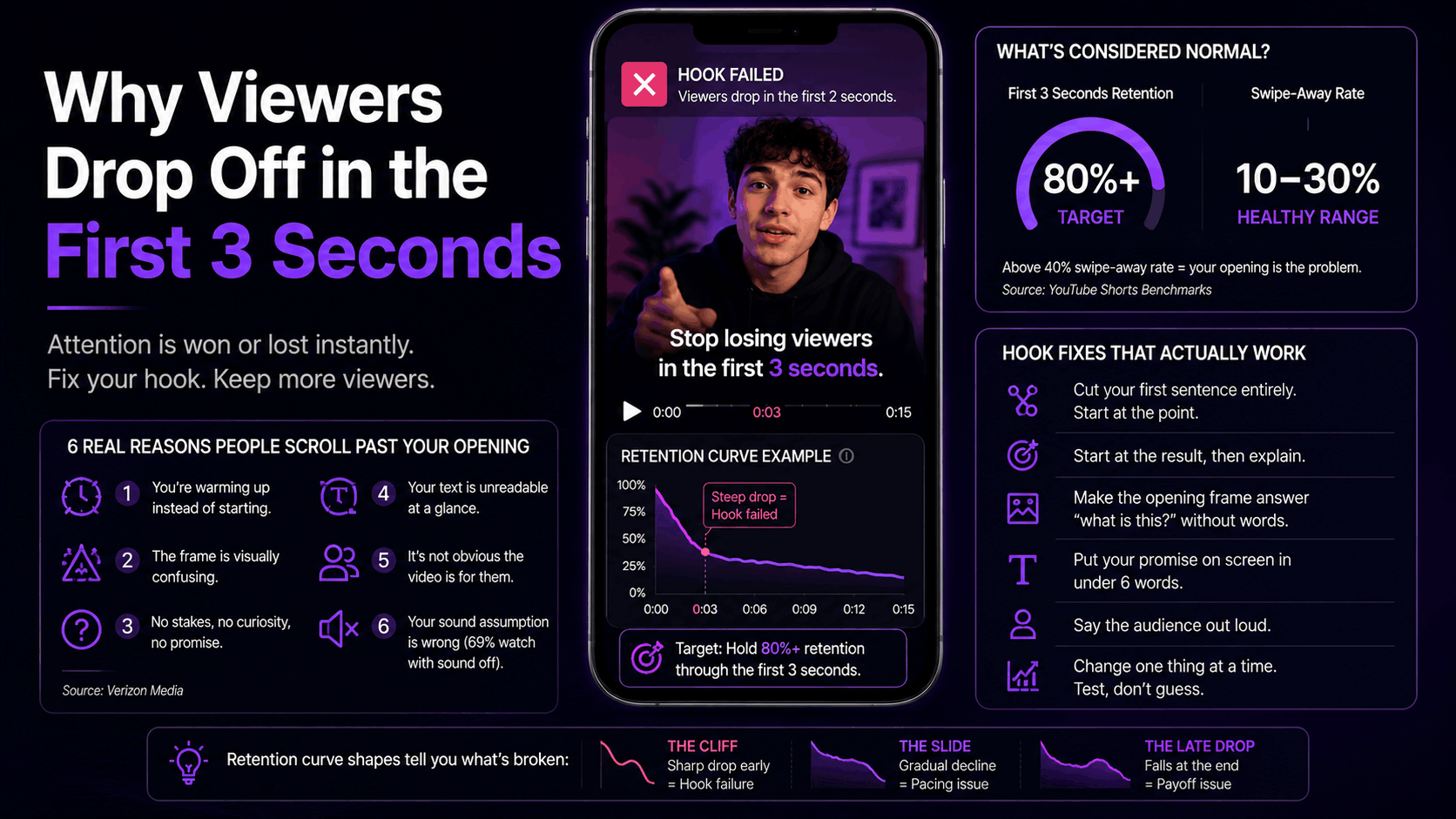
TL;DR: Viewers drop off in the first 3 seconds because your opening didn't answer the only question they're asking: is this worth my time? The decision happens in milliseconds, before your first sentence finishes. Most openings fail for six specific reasons, and all six are fixable. Check your retention curve to find which one is costing you.
You spent two hours on a video. Someone watched it for two seconds and swiped.
That's the part that stings. Not that people disliked it, but that they never saw it. Viewers drop off in the first 3 seconds more than at any other point in a video, and when they do, the algorithm reads that as a verdict on your content and stops showing it around.
The good news: this is the most fixable problem in short-form video. The first three seconds are three seconds. You can rebuild them in ten minutes. Compare that to reshooting a whole video.
The bad news: most creators fix the wrong thing. They add a louder sound effect or a flashier text overlay, watch nothing change, and conclude the algorithm hates them. If your Reels stopped getting views and you're not sure whether the hook is to blame, this is the diagnosis.
Here's what's actually happening in those three seconds, how to tell if your opening is the problem, and the six causes worth checking.
Why Do Viewers Drop Off in the First 3 Seconds?
Viewers drop off in the first 3 seconds because they're deciding whether the video is worth their time, and nothing in your opening gave them a reason to stay. They're not judging quality. They're scanning for relevance, curiosity, or payoff. If none of those three land almost instantly, the thumb moves.
This is worth sitting with, because it reframes the whole problem. Your viewer isn't rejecting your video. They're not engaged enough to reject anything. They're in a scroll state, moving fast, and your opening has to interrupt that state before it can do anything else.
Everything else you worry about, production value, lighting, editing polish, only matters after that interruption succeeds. Instagram's own leadership has said as much repeatedly, and Hootsuite's breakdown of the Instagram algorithm covers how heavily that opening window weighs on whether your video gets pushed beyond your existing followers.
The Decision Happens Faster Than Three Seconds
Three seconds is actually a generous framing. The real decision window is much shorter.
Research from MIT found the human brain can identify an image seen for as little as 13 milliseconds. That's roughly a hundredth of a second. Long before your first word finishes, your viewer's brain has already categorized your frame: familiar, boring, confusing, or interesting.
So when we say "the first three seconds," we're really describing two separate moments:
Frame zero, the first instant. Pure visual. What does the opening frame look like? Who's in it, what's the setting, is there text, is it visually cluttered? This gets judged before any conscious thought.
Seconds one to three, the first idea. Now they're processing meaning. What is this about? Does it concern me? Is something going to happen?
Two failures, two different fixes. A video can nail the visual and lose people on the idea, or grab attention with a wild opening frame that has nothing to do with the content and lose them the second they realize it.
What Counts as a Normal Drop-Off Rate?
Some drop-off is normal and unavoidable. On YouTube Shorts, holding above 80% retention through the first three seconds is the target, and a swipe-away rate between 10% and 30% sits in the healthy range. Above 40% swipe-away means your opening frame or packaging is the problem, not your content.
Those YouTube Shorts retention benchmarks give you something concrete to measure against, which most creators are missing. The same source notes that an average percentage viewed below 50% points to a structural problem rather than a bad-luck post.
Instagram works on similar logic. Retention benchmarks for Reels put a good rate for videos under 15 seconds at 65% or higher, with 75% counting as strong.
Your niche moves these numbers too. Comedy and entertainment run above 70% on short videos. Education sits closer to 50%. Finance and business content is doing fine around 40%. A 45% retention rate is a win for one creator and an emergency for another.
TikTok runs on the same principle, and the TikTok retention benchmarks break down similarly by video length. Whichever platform you're on, the metric underneath it all is average watch time divided by video length, which Databox defines as reel average watch time in its metric library.
Losing a fifth of your viewers in the opening isn't a failure. Losing half of them is. If you want the wider view of which numbers deserve your attention, we broke down which Reels metrics matter separately.
The 6 Real Reasons People Scroll Past Your Opening
Most weak openings fail for one of these reasons. Be honest about which one is yours.
1. You're warming up instead of starting. "Hey guys, so today I wanted to talk about something that's been on my mind." That's three seconds of nothing. Your video actually starts at second four, and nobody made it there. This is the single most common cause and the easiest to fix.
2. The frame is visually confusing. Too much happening, unclear subject, text covering the interesting part, or a shot that takes a beat to parse. Confusion costs you the milliseconds you can't spare.
3. No stakes, no curiosity, no promise. Nothing in your opening suggests something is coming. There's no question raised, no tension, no visible result to wait for. Just a person talking.
4. Your text is unreadable at a glance. Long sentences, small font, low contrast against the background. If your on-screen text takes two seconds to read, it's not a hook, it's homework.
5. It's not obvious the video is for them. Viewers scan for self-relevance fast. Content that doesn't signal its audience in the opening gets skipped by people who would have loved it.
6. Your sound assumption is wrong. A hook that only lands with audio is a hook most people never hear. Verizon Media found 69% of consumers watch video with the sound off in public settings. If your opening depends on a punchline you can only hear, you've lost a big chunk of viewers before you started. Captions aren't just an accessibility feature either, since research collected by 3Play Media links them to better focus and comprehension on video content.
How Do You Know If Your Hook Is Actually the Problem?
Look at the shape of your retention curve, not just the final number. A steep cliff in the first two seconds means the hook failed. A gradual slide through the middle means pacing failed. A curve that holds strong then drops at the end means the payoff failed. Same low retention number, three completely different problems.
This distinction saves you weeks. Creators rewrite hooks over and over when their actual problem was a slow middle, and nothing improves because they were fixing a healthy part of the video.
Here's how to read the three shapes:
The cliff. Sharp vertical drop in the first two or three seconds, then it flattens out. Classic hook failure. The people who stayed are enjoying it fine, there just aren't many of them.
The slide. Steady decline all the way through. Pacing problem. Your video is probably too long for what it delivers, and every second is losing a few more people.
The late drop. Strong retention, then a sudden fall near the end. When we analyzed 1,000 videos to find what separates the ones that travel, this shape came up constantly on videos creators swore were their best work. Your payoff didn't land, or you kept talking after the interesting part finished.
Your hook rate is the number that isolates the first case specifically, which is why it's worth tracking separately from overall retention. And if you want to know which pattern you're dealing with without squinting at graphs, you can run a free analysis on a video that underperformed and see the breakdown directly. Comparing a flop against something that worked usually makes the difference obvious in about a minute.
Fixes That Actually Move the First 3 Seconds
Ordered by how much they typically change things.
Cut your first sentence entirely. Not shorten. Delete. Then watch it back. Nine times out of ten the video is better, because the thing you deleted was throat-clearing. This one fix has saved more videos than any other on this list.
Start at the result, then explain. Show the finished thing, the reaction, the transformation, the number. Then back up and explain how. Payoff first, process second.
Make the opening frame answer "what is this?" without words. If someone paused your video at frame one with no sound, could they tell what they were looking at? If not, restage the shot.
Put your promise on screen in under six words. Short, high contrast, readable in one glance. Not a title. A promise. "I tested this for 30 days" beats "My 30 Day Experiment."
Say the audience out loud. Naming who it's for costs a second and buys you the right viewers. "If you post Reels and get stuck at 200 views" is a filter, and filters increase retention because the wrong people leave immediately, which is fine.
Change one thing at a time. If you rewrite the hook, shorten the video, and swap the audio in the same post, you learn nothing from the result. We covered how to A/B test your Reels properly if you want the structured version.
How Long Should a Hook Actually Be?
Your hook should be finished by second three, which usually means one sentence or one visual beat. It isn't a section of your video, it's the doorway. The goal is narrow: give the viewer one reason to still be there at second four. Anything beyond that belongs in the body.
A useful test is to write the hook as a single line of text before you film. If it doesn't fit on one line, it's not a hook yet, it's an introduction. Introductions are the thing we're trying to delete.
Also worth knowing: hooks and topics fail differently. A great hook on a topic nobody cares about gets high three-second retention and a terrible completion rate. That's still useful information. It tells you the packaging works and the substance doesn't, which is a much better problem to have than the reverse.
Why Fixing the Hook Doesn't Always Fix the Video
Sometimes the hook is fine and the video still flops. If your retention curve looks healthy but your reach stayed low, the problem is distribution, not attention. Fixing an opening that already works just wastes effort and makes you distrust advice that isn't wrong.
This is the honest caveat most hook advice leaves out. Retention is one signal among several. Saves and shares carry real weight too, and research on hidden engagement metrics points to both as things the algorithm leans on harder than likes.
If your videos hold attention but almost nobody sees them, you're looking at a different diagnosis, and being stuck in 200 view jail is a good description of it. Worth checking before you rewrite another opening.
Three things to take with you. The decision happens in milliseconds, so your opening frame is doing work before your first word does. Some drop-off is normal, and losing 20% in the first three seconds is fine while losing half is not. And the shape of your retention curve tells you which part of the video actually broke, which is the difference between fixing the right thing and guessing.
Pick your last five videos, find the two that underperformed, and look at where exactly people left. The pattern is usually the same across both, and once you can name it you can fix it in one edit.
If you want the full breakdown across your whole back catalogue instead of one video at a time, start your $1 trial and you get 30 days with 50 analyses a day. That's enough to find your pattern rather than guess at it.
Frequently Asked Questions
Is a 50% drop-off in the first 3 seconds bad?
Yes, that's well outside the healthy range. On YouTube Shorts the target is holding above 80% through the first three seconds, with swipe-away between 10% and 30% considered normal. Losing half your viewers that fast points to a hook or opening frame problem rather than bad luck with the algorithm.
Does the 3 second rule apply to TikTok, Reels, and Shorts equally?
Broadly yes, since all three use retention as a core distribution signal and all three are scroll-based feeds. The benchmarks differ a little by platform and niche, but the principle holds everywhere: if people don't stay past the opening, the platform stops showing the video to new viewers.
Should I use a hook that has nothing to do with my video?
No. Misleading hooks lift your three-second retention and destroy everything after it. You get the click and lose the watch, which is a worse signal overall. A hook should create curiosity about the actual content, not bait attention away from it.
How do I find my drop-off point?
Instagram, TikTok, and YouTube all show retention data in their native analytics, though the detail varies and Instagram's reporting has real gaps. Look at the shape of the curve rather than the final percentage, since where people leave matters more than how many.
Can I fix drop-off without reshooting the whole video?
Usually, yes. Most opening problems are edit problems, not filming problems. Cutting your first sentence, changing the opening frame, or adding readable on-screen text can all be done in post. Reshooting is a last resort, not a first step.
Frequently asked questions
Is a 50% drop-off in the first 3 seconds bad?
Yes, that's well outside the healthy range. On YouTube Shorts the target is holding above 80% through the first three seconds, with swipe-away between 10% and 30% considered normal. Losing half your viewers that fast points to a hook or opening frame problem rather than bad luck with the algorithm.
Does the 3 second rule apply to TikTok, Reels, and Shorts equally?
Broadly yes, since all three use retention as a core distribution signal and all three are scroll-based feeds. The benchmarks differ a little by platform and niche, but the principle holds everywhere: if people don't stay past the opening, the platform stops showing the video to new viewers.
Should I use a hook that has nothing to do with my video?
No. Misleading hooks lift your three-second retention and destroy everything after it. You get the click and lose the watch, which is a worse signal overall. A hook should create curiosity about the actual content, not bait attention away from it.
How do I find my drop-off point?
Instagram, TikTok, and YouTube all show retention data in their native analytics, though the detail varies and Instagram's reporting has real gaps. Look at the shape of the curve rather than the final percentage, since where people leave matters more than how many.
Can I fix drop-off without reshooting the whole video?
Usually, yes. Most opening problems are edit problems, not filming problems. Cutting your first sentence, changing the opening frame, or adding readable on-screen text can all be done in post. Reshooting is a last resort, not a first step.