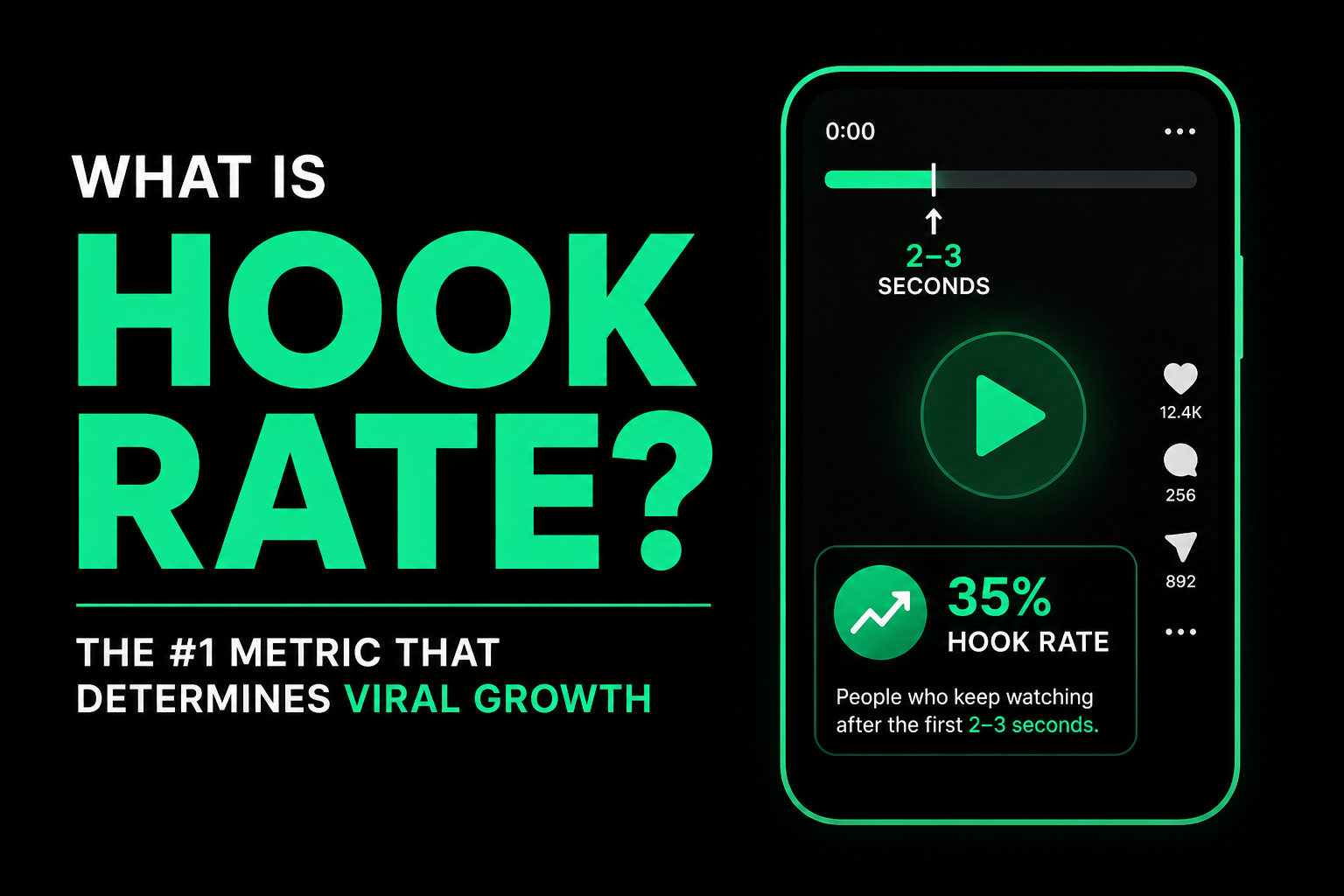
TL;DR: Hook rate is the percentage of people who keep watching your video after the first two to three seconds. It's the single most important metric for understanding whether your content will get distributed by the algorithm or quietly suppressed. A strong hook rate above 30% signals to TikTok, Instagram, and YouTube that your content is worth showing to more people. A weak one stops distribution cold before most of your audience ever sees it.
Most creators obsess over views, likes, and follower counts. These numbers feel important because they're the most visible. But they're often the last signal in the chain, not the first.
Hook rate is the first. And if it's weak, nothing else you do to your content matters.
Instagram head Adam Mosseri has confirmed repeatedly that the first three seconds of a Reel are the most critical window for determining whether the algorithm distributes your content beyond your existing audience. TikTok's own data shows the same pattern. The platforms are both asking the same question the moment someone sees your video: does this person keep watching, or do they scroll past?
Hook rate is how you measure the answer.
This guide covers exactly what hook rate is, how to calculate it on each platform, what good looks like in 2026, and the specific techniques that consistently improve it.
What Is Hook Rate?
Hook rate is the percentage of viewers who continue watching a video past the first two to three seconds after it begins playing. It measures how effectively the opening of your content stops someone mid-scroll and gives them a reason to keep watching.
Also called the thumb stop ratio or scroll stop rate, hook rate is calculated differently depending on the platform. On TikTok, hook rate is measured by dividing two-second video views by total impressions. On Meta platforms (Instagram and Facebook), the threshold is three seconds. The formula is the same: views past the threshold divided by total impressions, multiplied by 100 to get a percentage.
A high hook rate means a meaningful percentage of people who saw your video chose to keep watching past that initial moment. A low hook rate means most people scrolled past before your content had a chance to deliver its value. The algorithm reads both signals in real time and adjusts distribution accordingly.
Why Does Hook Rate Matter So Much for Organic Reach?
Hook rate matters because every platform uses it as an early signal to decide whether to push your content to a wider audience. It's the first gate your video passes through, and failing it stops distribution before any other metric gets a chance to matter.
Here's how it works in practice. When you post a video, the algorithm shows it to a small initial test group, typically a subset of your followers. If a high percentage of that group watches past the first few seconds, the algorithm interprets that as a quality signal and expands distribution. If most of them scroll past immediately, distribution stops. Your video stays on your profile but never gets pushed to non-followers, to the For You Page, or to the Explore tab.
A 2025 algorithm audit confirmed TikTok amplifies content quickly within the first few exposures if viewers don't scroll away, and some studies argue hook rate is the foundational metric that lowers cost per mille and elevates organic reach. The same principle applies on Instagram. Strong creators achieve 70% or higher intro retention by opening with compelling visuals, surprising statements, or immediate value delivery.
Hook rate doesn't just predict whether a single video performs. It predicts the trajectory of your whole account. An account with consistently strong hook rates tells the algorithm it produces content worth distributing. That reputation compounds over time.
How to Calculate Hook Rate
Hook rate uses a simple formula that applies across platforms, with minor differences in the time threshold each platform uses.
The formula:
Hook Rate = (Views past the threshold second ÷ Total impressions) × 100
By platform:
On TikTok, the threshold is 2 seconds. Pull your 2-second video views from TikTok Analytics under the Content tab, then divide by total impressions for that video.
On Instagram, Meta defines the threshold at 3 seconds. You'll find 3-second video views inside Instagram Insights under each Reel's performance breakdown. Divide by reach (not impressions, since reach counts unique viewers) for the most useful version of the metric.
On YouTube Shorts, the equivalent metric is intro retention percentage, which YouTube Studio shows as part of the audience retention report. It represents the percentage of viewers who make it past the first few seconds of the video.
The calculation itself is fast. The harder part is knowing what the number means once you have it.
What Is a Good Hook Rate in 2026?
A good hook rate depends on the platform and whether you're measuring organic content or paid ads, but the benchmarks used by performance marketers in 2026 give a clear picture of where you stand.
For TikTok, across multiple ad accounts, the average hook rate lands around 30.7%, while top-quartile creatives reach 40-45%. For organic content, the benchmark is similar. A hook rate below 25% suggests the opening needs significant work. 25-35% is solid. Above 40% is strong and puts your content in the range that consistently gets pushed to broader audiences.
For Instagram Reels, Meta's benchmarks put 20-25% as a solid baseline, with top performers pushing past 30%. Anything below 20% is a signal that your opening frame or first line isn't stopping the scroll effectively.
One important caveat: the most reliable benchmark is your own 30 to 60-day baseline, not industry averages. Hook rate varies by video length, content category, and audience type. A 25% hook rate might be excellent for a 60-second explainer in a competitive niche and mediocre for a 15-second product clip in a highly visual category. Track your own numbers over time and measure improvement against your own history, not just external benchmarks.
Hook Rate vs. Hold Rate: What's the Difference?
Hook rate and hold rate are related but measure different things. Hook rate measures the percentage of viewers who watch past the first two to three seconds. Hold rate measures the percentage of viewers who continue watching beyond that initial window, usually calculated at the 25% or 50% mark of the total video length.
Think of them as two sequential gates. Hook rate is the first gate: did the opening stop the scroll? Hold rate is the second gate: did the content deliver enough value to keep viewers watching after the hook landed?
A video can have a strong hook rate and a weak hold rate. This usually means the hook was compelling enough to stop the scroll but the content didn't follow through on what the hook promised. The viewer stayed for two seconds and left at second eight when it became clear the payoff wasn't coming.
Hold rates below 20% are generally poor, 20-40% is average, 40-60% is good, and 60% or above is excellent. When both hook rate and hold rate are strong, the algorithm has everything it needs to push content to a large audience. When one is strong and the other is weak, diagnosing which gap to fix first is the fastest path to better distribution.
For a deeper breakdown of how retention metrics work alongside hook rate to determine overall content performance, the guide to analyzing social media performance covers the full diagnostic framework.
5 Proven Techniques to Improve Your Hook Rate
Improving hook rate comes down to one question: what happens in the first two to three seconds of your video that gives a specific viewer a reason to keep watching? Here are the five techniques that consistently move the number.
Start with the most visually striking frame. Your thumbnail and opening frame are the same thing on autoplay. The most successful content shows the hero shot, the strongest visual element, immediately and never opens with a logo or a brand intro. Whatever is most visually interesting about your content should appear in frame zero.
Use a pattern interrupt. The average social media feed is a stream of broadly similar content. Anything that breaks the visual pattern stops the scroll instinctively. An unexpected camera angle, a surprising text overlay appearing immediately, a visual that creates cognitive dissonance, all of these create a micro-moment of attention that hook rate captures.
Open with the specific pain or promise, not the setup. Most creators bury the hook. They spend the first ten seconds explaining context before getting to the reason someone should care. Flip it. Put the reason to keep watching in the first two seconds. "Here's why your Reels cap at 200 views" lands harder in frame one than "today I want to talk about Instagram analytics."
Lead with a curiosity gap. A curiosity gap is a statement that creates an open loop the viewer needs to close. "Most creators get this completely wrong" creates more tension than "here's how to grow on Instagram." The viewer stays to find out what the thing is that most creators get wrong. Engaging your audience in the first three seconds by starting with something surprising or unexpected consistently improves retention.
Test multiple hook variations for the same content. Don't assume your first hook idea is your best one. Testing different hooks consistently outperforms trying to perfect a single version. Use AI tools to generate five different opening lines for the same video concept, test them across posts, and measure which hook types produce the highest two-second retention on your specific account. The patterns you find apply to every piece of content you create going forward.
How to Track Hook Rate Across All Your Content
Tracking hook rate manually on each platform works for occasional audits but doesn't scale if you're posting consistently across Instagram, TikTok, and YouTube. You end up in three different analytics dashboards pulling numbers that aren't formatted the same way, trying to spot patterns across 30 posts without a unified view.
The more practical approach is to use a third-party analytics platform that aggregates hook rate and retention data across platforms in one place. Wave Vision connects to your Instagram, TikTok, and YouTube accounts and surfaces hook hold rate alongside retention drop-off by timestamp and DM share rate, the three signals that together predict whether a piece of content will get algorithmically distributed or suppressed.
The timestamp data is especially useful. Seeing that your hook hold rate is strong but retention drops sharply at second eight tells you something specific: your hook is working but the transition from hook to body is losing viewers. That's a different fix than a weak hook rate, and knowing which problem you actually have is what makes each iteration faster than the last.
For creators trying to understand why their Reels flatline despite posting consistently, the guide to the three structural fixes identified by AI covers exactly how hook rate fits into the broader picture of content distribution.
Conclusion
Hook rate is the metric that controls everything else. It's the first question the algorithm asks about your content, and a weak answer means the rest of your video never gets seen no matter how good it is.
The good news is that hook rate is one of the most fixable metrics available. It depends almost entirely on what happens in the first two to three seconds of your video, which is a small, specific, testable thing. Change the opening frame. Lead with the promise instead of the setup. Create a curiosity gap. Test multiple versions.
Track the number consistently and let the data show you what's actually working. Accounts that improve their hook rate systematically grow faster than accounts that post more frequently without understanding why some content distributes and some doesn't.
Wave Vision's 30-day $1 trial gives you the hook hold rate, retention, and share data across all your platforms in one place. Start your audit today and find out exactly what's happening in the first three seconds of your content.
Frequently Asked Questions
**What is hook rate in social media?**Hook rate is the percentage of viewers who continue watching a video past the first two to three seconds after it starts playing. It is calculated by dividing the number of views past the threshold second by total impressions, then multiplying by 100. On TikTok the threshold is two seconds. On Instagram and Facebook it is three seconds. A strong hook rate signals to the algorithm that your content is worth distributing to a wider audience.
**What is a good hook rate on TikTok and Instagram in 2026?**On TikTok, an average hook rate across multiple ad accounts lands around 30.7%, while top-performing creatives reach 40-45%. On Instagram, a solid baseline is 20-25%, with top performers exceeding 30%. Anything below 25% on TikTok or below 20% on Instagram suggests the opening of your content needs significant improvement. The most useful benchmark is your own 30 to 60-day baseline rather than industry averages, because hook rate varies by content category, video length, and audience type.
**What is the difference between hook rate and hold rate?**Hook rate measures the percentage of viewers who watch past the first two to three seconds of a video. Hold rate measures the percentage of viewers who continue watching beyond that initial window, typically calculated at the 25% or 50% mark of the total video length. Hook rate is the first gate: did the opening stop the scroll? Hold rate is the second gate: did the content deliver enough value to keep viewers watching after the hook landed? Both metrics matter, and a video can have a strong hook rate and a weak hold rate if the content doesn't follow through on what the opening promised.
**How do I improve my hook rate on Instagram Reels?**The five techniques that consistently improve hook rate are: opening with your most visually striking frame rather than a logo or intro, using a pattern interrupt that breaks the visual sameness of the feed, leading with the specific pain or promise in the first two seconds instead of context or setup, creating a curiosity gap with a statement that makes viewers need to see how it resolves, and testing multiple hook variations for the same content rather than assuming your first version is your best. According to Instagram's head Adam Mosseri, engaging the audience in the first three seconds is the most critical variable in Reels distribution.
**How is hook rate calculated?**Hook rate is calculated using this formula: hook rate equals views past the threshold second divided by total impressions, multiplied by 100. On TikTok, divide your two-second video views by total impressions. On Instagram, divide your three-second video views by total reach. The result is a percentage representing how effectively your opening stopped viewers from scrolling past. Track this number over time across your content to identify which hook formats, topics, and opening styles produce the strongest results for your specific audience.