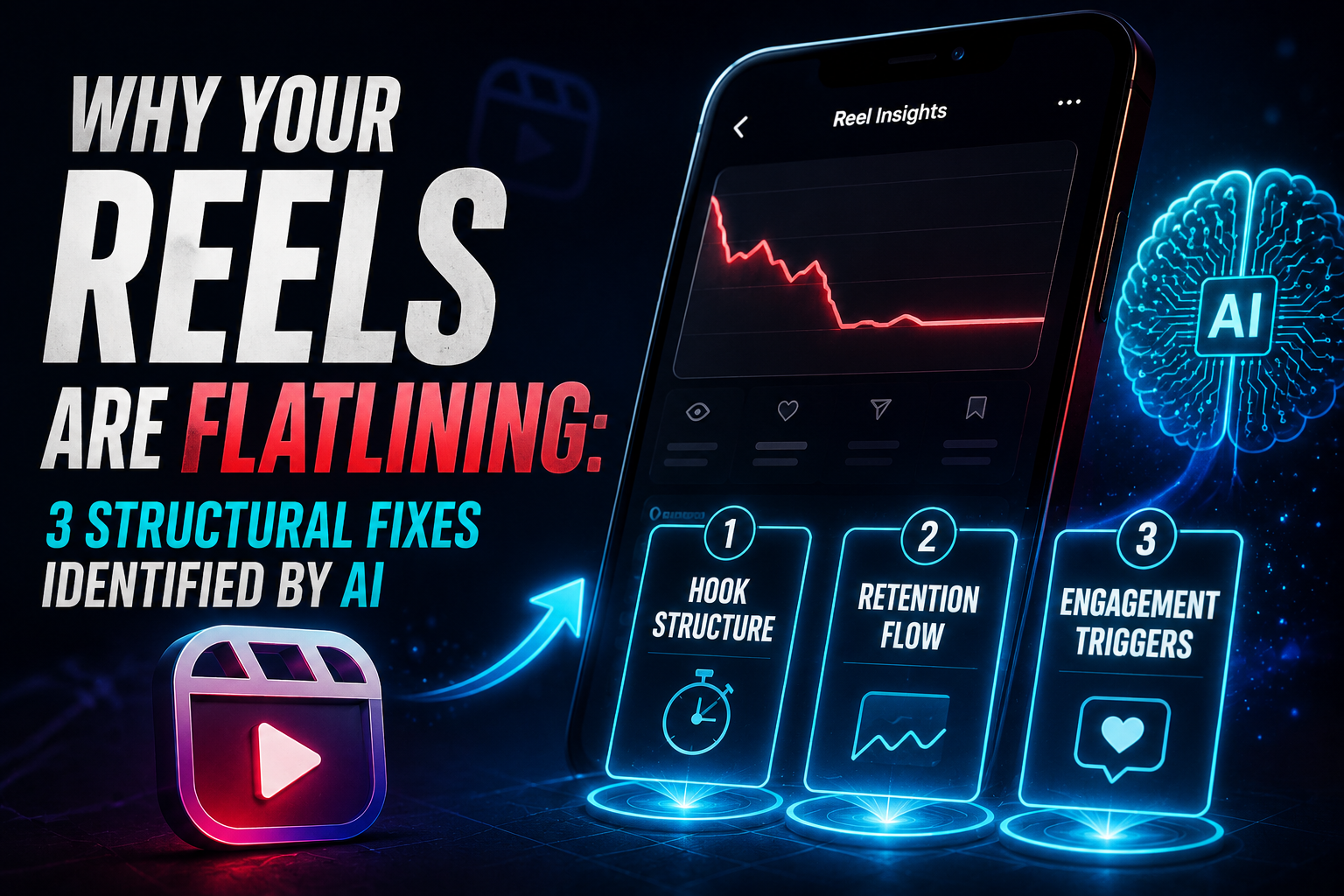
TL;DR: If your Reels keep hitting a ceiling no matter what you try, the problem isn't your content, your niche, or your follower count. It's almost always one of three structural problems that kill distribution before your video gets a real chance. This post breaks down exactly what those three problems are, how AI identifies them in your data, and what to fix first so your next Reel actually gets pushed.
You've done everything right. Trending audio. Strong visuals. Consistent posting schedule. And your Reels are still flatlining at the same number every single time.
Here's what most creators don't realize: Instagram's algorithm treats every Reel like a mini-TV episode. It shows your content to a small test group, measures how they respond in real time, and makes a distribution decision within the first few hours. If your content doesn't pass that test, reach stops cold. The Reel stays on your profile but never gets pushed further.
The frustrating part is that most creators try to fix the wrong thing. They switch niches, change their editing style, or post more frequently — all without diagnosing the actual structural problem first.
AI changes that. With access to your retention curve, skip rate, and engagement patterns, AI tools can now pinpoint exactly which structural failure is suppressing your reach. According to Instagram's own "What Impacts Your Views" breakdown released in early 2026, skip rate is the top-weighted factor in Reels distribution. But skip rate is just a symptom. The structural problems underneath it are what actually need fixing.
Here are the three most common ones — and how to fix each one.
Fix 1: Your Hook Makes a Promise Your Content Doesn't Keep
The single most common structural problem killing Reels in 2026 is a mismatch between what the hook promises and what the content actually delivers. It's called a weak promise-to-payoff ratio, and it's more destructive than a bad hook because it creates a specific drop-off pattern the algorithm penalizes hard.
Here's how it works. Your hook is strong enough to stop the scroll. Viewers watch the first three seconds and think "okay, I want to see where this goes." Then the content doesn't deliver what the hook set up. Viewers bail at the 40–60% mark, and your completion rate collapses.
Data from multiple studies shows that Reels with strong 3-second hold rates above 60% outperform those with weak holds by 5–10x in total reach. But hold rate alone isn't the problem here. The algorithm is also watching what happens after second three. A Reel that hooks well but loses viewers in the middle sends a specific signal: this content bait-and-switched its audience.
The fix is to audit your hook against your actual content before you post. Ask one question: if someone only reads my hook, do they know exactly what they're going to get? If the answer is no, rewrite the hook to match the content — not the other way around.
Effective hooks in 2026 show the outcome immediately, promise one clear value, and avoid exaggerated clickbait. "I tried 30 different posting times so you don't have to" is a strong hook because the payoff is obvious and specific. "You won't believe what happened when I posted this" is a weak hook because the payoff is vague and the content rarely lives up to it.
AI tools make this diagnosis fast. When you run your past Reels through an analytics platform like Wave Vision, the retention data shows you precisely where viewers drop off. A sharp drop at the 40–60% mark almost always means a promise-payoff mismatch. A sharp drop in the first two seconds means the hook itself isn't working. The timestamp tells you which problem you actually have.
Fix 2: Your Middle Section Has Dead Pacing
Most creators spend all their energy on the first three seconds and the final CTA, and completely neglect what happens in between. The middle of your Reel is where distribution is won or lost for anything over 20 seconds long.
Dead pacing happens when the content slows down, repeats itself, or delivers information without any forward momentum. Viewers don't consciously decide to leave. The brain just stops finding a reason to stay. The scroll happens automatically.
Instagram's algorithm in 2026 tracks what happens between seconds four and the end of your video just as heavily as the opening. The retention chart inside Instagram Insights — which became available in 2025 — shows you the exact second viewers start dropping. A gradual decline is normal. A cliff at a specific timestamp is a pacing problem.
Three techniques consistently fix dead middle sections:
Pattern interrupts keep the brain engaged by introducing something new every few seconds. This doesn't mean chaotic editing — it means a text overlay appearing, a camera angle change, a new visual element. Quick cuts, zooms, and on-screen text appearing every few seconds signal to the eye that something is changing, and the brain keeps watching.
Open loops are probably the most underused retention tool available. You set up a question or promise early in the Reel — "the third tip is the one most creators miss" — and only deliver it near the end. Viewers stay to close the loop. The tension between the setup and the payoff is what keeps the watch time alive through the middle.
Front-loaded value with a back-loaded reveal is the structure that works best for educational content. Give real value early so viewers feel the Reel is worth their time, then tease something specific that only gets revealed at the end. This creates replay potential too, which the algorithm in 2026 weights heavily as a repeatability signal.
To diagnose your pacing problem specifically, pull up the retention chart for your last five Reels in Instagram Insights. Look for the timestamp where the curve drops sharply. That's your dead zone. Recut that section and test again. For a broader view of which content types hold attention best across your whole account, Wave Vision's cross-platform analytics surfaces patterns across all your posts simultaneously instead of making you audit each Reel manually.
What Does "Structural" Actually Mean for a Reel?
A structural problem in a Reel is any issue with how information is arranged, paced, or delivered that causes viewers to disengage before the content ends. It's different from a content problem (wrong topic, wrong niche) or a distribution problem (posted at the wrong time). Structure is about the internal architecture of the video itself.
The three structural layers of every Reel are: the hook (seconds 0–3), the body (everything in between), and the close (the final CTA or payoff). When all three are working, the retention curve stays relatively flat until near the end and the completion rate is high. When any one layer has a problem, the retention curve shows a specific drop pattern at that layer's timestamp. That pattern is what AI tools read to diagnose which structural fix you actually need.
Fix 3: Your Captions Aren't Sending Topic Signals
The third structural fix is one most creators overlook completely because it happens outside the video itself. Your caption is a structural component of your Reel, and in 2026 it's more important than it's ever been.
In December 2025, Instagram launched its "Your Algorithm" feature, which lets users explicitly tell Instagram which topics they care about. Users can pin specific interest labels to their recommendation feed. The algorithm then serves them content that matches those exact topic labels — even from accounts they've never followed.
This changes everything about how captions work. A Reel about Instagram growth that has a caption like "POV: you finally figured it out 😭" sends no topic signal at all. The algorithm can't map it to any user's interest profile. A caption that starts with "Here's why your Instagram Reels keep flatlining even when your hook is strong" gives the algorithm three clear topic signals in one sentence.
Keyword-rich captions are no longer optional for creators who want to reach new audiences. They're the mechanism by which the algorithm decides whether to show your Reel to people who don't already follow you. Without clear topic signals, your content stays inside your existing follower bubble regardless of how strong the video itself is.
The structural fix here is simple. Before you finalize any caption, check: does the first line include the specific topic this Reel covers, in plain language a real person would type into a search bar? If not, rewrite the first line. Keep the personality. Keep the voice. Just make sure the topic is unmistakable.
For a deeper look at how Instagram's algorithm uses these signals to decide who sees your content, the guide to predicting Instagram story views covers the same signal logic that applies across Reels, Stories, and the Explore page.
How to Use AI to Diagnose Which Fix You Need First
The three structural fixes above solve three different problems. The fastest way to know which one you need is to run an AI-powered audit on your last 10–15 Reels before you change anything.
Here's the diagnostic framework:
If your skip rate is high but your average watch time is decent: your hook isn't stopping the scroll. Fix 1 (promise-payoff alignment) is your priority.
If your hook hold rate is above 60% but completion drops in the middle: your pacing has a dead zone. Fix 2 (middle section structure) is your priority.
If your watch time is solid but reach stays low and new followers aren't coming: your captions aren't sending topic signals. Fix 3 (caption structure) is your priority.
Most creators have a combination of all three, but one is almost always the primary bottleneck. AI analytics tools can pinpoint where viewers drop off and help you refine your storytelling without guessing. Fixing the primary bottleneck first gives you a clean signal on whether the fix is working instead of changing three things at once and not knowing which one moved the needle.
Wave Vision surfaces all three diagnostic signals — skip rate, retention curve by timestamp, and reach-to-follower ratios — across your Instagram, TikTok, and YouTube content in one dashboard. Run your audit, identify your primary structural fix, make one change, and measure. That's the process that actually compounds over time.
If you've been stuck in the same view range for more than a few weeks, the answer is almost certainly in your data. You just need the right tool to read it.
Conclusion
Flatlining Reels aren't a creativity problem. They're a structure problem. And structure problems are fixable once you know which one you're actually dealing with.
The three fixes that move the needle most: aligning your hook with your actual payoff so completion rate holds, engineering your middle section so the retention curve stays flat, and writing captions that send clear topic signals to Instagram's recommendation AI.
None of these require more content, more followers, or more time. They require better diagnosis. And in 2026, AI tools give you the data to diagnose fast.
Start your 30-day $1 trial at Wave Vision and run your first structural audit today. Most creators identify their primary fix within the first session.
Frequently Asked Questions
**Why do my Instagram Reels keep getting the same low view count every time?**Consistent low view counts almost always mean your Reels are failing Instagram's cold-start distribution test. The algorithm shows your content to a small initial group and measures skip rate, watch time, and shares. If those signals don't hit the threshold, distribution stops. The cause is usually one of three structural problems: a promise-payoff mismatch in your hook, dead pacing in the middle section, or captions that don't send clear topic signals to Instagram's recommendation system.
**What is a "structural fix" for Instagram Reels?**A structural fix is a change to how your Reel is built internally rather than what it's about. Structure refers to the hook, the middle section pacing, and the caption signal — the three layers that determine whether viewers keep watching and whether the algorithm can categorize and distribute your content. Structural problems are distinct from content problems (wrong topic) or timing problems (wrong posting time) and require different fixes.
**How do I know if my Reel's hook is the problem or the middle section?**Check your retention curve inside Instagram Insights, which became available in 2025. A sharp drop in the first two seconds means your hook isn't stopping the scroll. A gradual hold through the first few seconds followed by a cliff at a specific timestamp in the middle means your pacing has a dead zone. The timestamp tells you exactly which structural layer needs fixing.
**Does my Instagram caption actually affect Reel reach?**Yes, significantly. Since Instagram launched its "Your Algorithm" feature in December 2025, users can explicitly tell the platform which topics they want to see. The algorithm matches content to those topic preferences using signals from captions. Reels with vague or emoji-heavy captions that don't include clear topic language get mapped to fewer user interest profiles and stay inside existing follower audiences. Keyword-rich captions that name the specific topic covered are now a core part of Reels distribution strategy.
**How can AI help identify why my Reels are underperforming?**AI analytics tools analyze your retention curve, skip rate, watch time, and reach data across your content history to surface patterns you'd miss manually. Instead of guessing why one Reel flopped, AI can identify that your drop-off consistently happens at a specific timestamp, that your highest-reach posts share a specific caption structure, or that your hook hold rate is below the threshold needed to trigger wider distribution. Tools like Wave Vision run this analysis across Instagram, TikTok, and YouTube simultaneously so you're not auditing each platform separately.