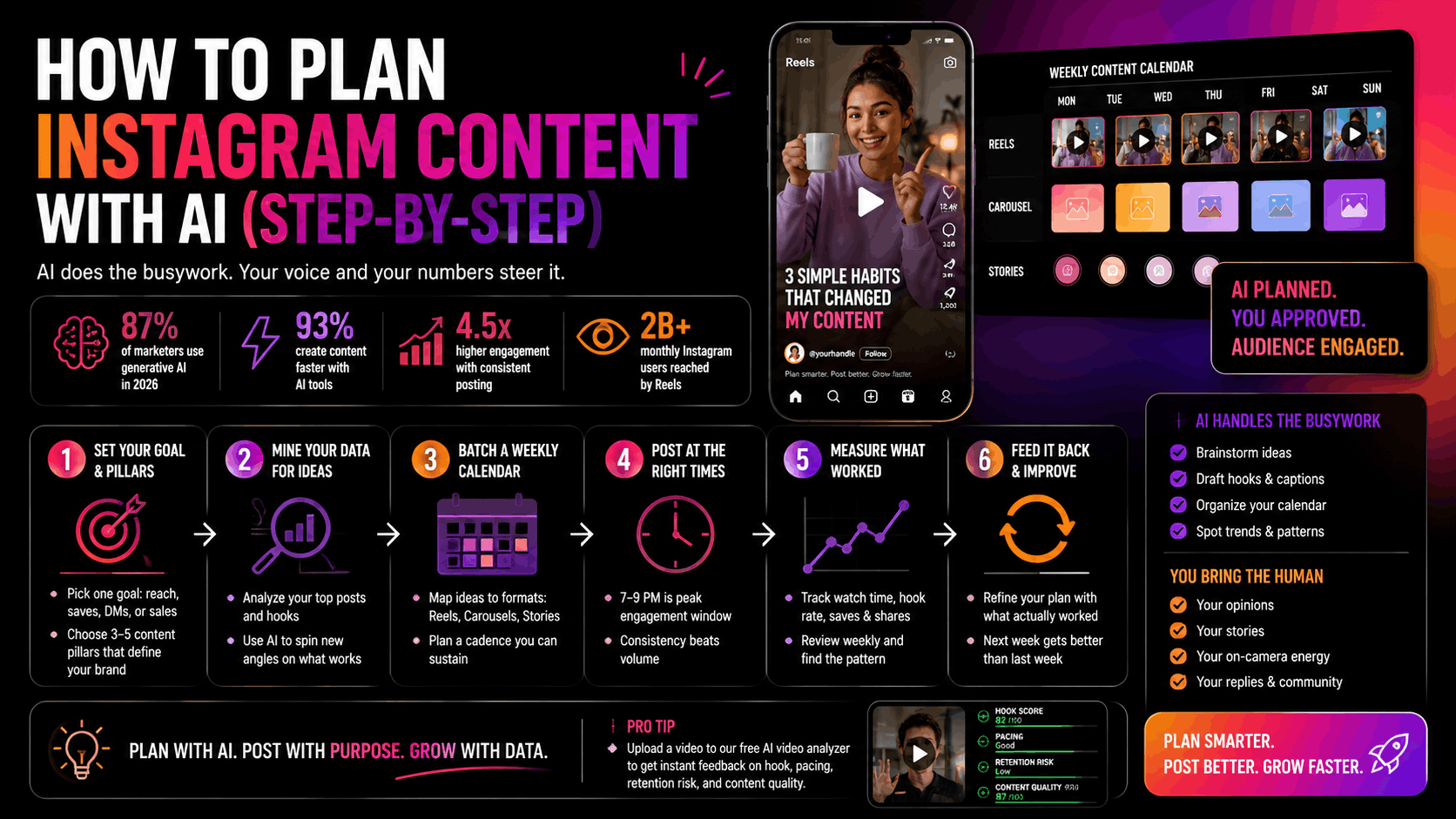
TL;DR: AI can plan a month of Instagram content in the time it used to take to plan a week, if you give it the right inputs. This guide walks the full workflow: set your pillars, mine your own data for ideas, batch a weekly calendar, post at the right times, then measure what worked and feed it back in. AI handles the busywork. Your voice and your numbers steer it.
Most creators don't have a content problem. They have a planning problem. You sit down to batch a week of Reels, stare at a blank calendar, post three things in a rush, then go quiet for five days. AI content planning fixes that loop. Used well, it turns a blank week into a full, on-brand Instagram calendar in an afternoon.
And it's not a fringe move anymore. 87% of marketers now use generative AI in at least one workflow, up from 51% in 2024. Instagram isn't fighting it either. The platform now rewards original, engaging content no matter how it was made.
The catch is that AI is only as good as what you feed it. Generic prompts give generic posts. This guide is the full workflow, from pillars to publishing to measuring, that keeps the output specific to you. Let's build it.
Before you plan a single post, know what your best content already does well. Upload a recent video to Wave Vision's free AI video analyzer and get a read on your hook, pacing, and retention. That baseline makes every step below sharper.
Button: Analyze a Video Free
What Is AI Content Planning for Instagram?
AI content planning for Instagram is the process of using AI tools to turn your goals and audience data into a ready-to-post content calendar. Instead of guessing what to make, you feed AI your niche, your best-performing posts, and your pillars, and it drafts ideas, hooks, captions, and a posting schedule you can refine and ship.
The shift is real. 93% of marketers say they create content faster with AI help, and the biggest gain is reclaiming the hours you used to lose to a blank page. Instagram supports this too. Metricool notes the platform now updates its algorithm to prioritize original content, so a plan built on your real ideas and data still wins. AI does the drafting and organizing. You bring the judgment.
Step 1: Lock Your Goal and Content Pillars
Every good plan starts with one goal and a few pillars. Pick a single goal first: reach, saves, DMs, or sales. One goal keeps the calendar focused instead of scattered.
Then choose three to five content pillars, the recurring themes your account is known for. Pillars are the difference between twelve connected posts and twelve random ones. The strongest accounts niche down hard. Metricool found that standout creators pick a very specific audience and topic and post well above their category averages.
Feed those pillars to your AI as context. Tell it your niche, your audience, your goal, and your five pillars in one setup prompt. Every idea it gives you after that stays on-brand instead of generic.
How Do You Use AI to Come Up With Ideas That Fit Your Niche?
To get niche-fit ideas from AI, give it your own data instead of a blank prompt. Paste in your top posts, your pillars, and what your competitors are doing, then ask for variations on what already works. AI is great at remixing proven patterns. It's weak at inventing your niche from scratch, so your inputs do the heavy lifting.
Start with what's already working. Look at your last 20 posts, find the three that outperformed, and ask AI to spin ten new angles on each. This is how tools that help you predict your next viral Reel work: pattern first, not guesswork.
Then widen the net. Watching rivals with competitor tracking for creators shows you which formats are heating up in your niche right now, so your AI ideas ride current momentum instead of last month's trend.
Step 3: Batch a Weekly Calendar With the Right Formats
Now turn ideas into a schedule. Ask AI to map your ideas across one week, matched to the format that fits each goal. The formats aren't interchangeable.
Reels are your reach engine. Metricool's 2026 study of 24.3 million posts found Reels drive over four times the interactions of single-image posts, with watch time doubling year over year. Carousels are your saves engine. The same study found carousels earn nine times more saves than single-image posts. Stories keep you present between the big swings.
So plan with intent: Reels to get discovered, carousels to get saved, Stories to stay in the feed. A simple, repeatable weekly shape, say three Reels, two carousels, and daily Stories, is far easier to sustain than a random burst. Start with a cadence you can actually keep, then let AI fill each slot from your idea list.
When Should You Post, and How Often?
Post when your audience is actually online, and post consistently. Across Instagram, engagement peaks in the evening, so the 7 to 9 PM window is a safe default until your own data says otherwise. Frequency matters less than rhythm: a steady schedule you can maintain beats a big week followed by silence.
Metricool's data, pulled straight from Instagram's API, points to 7 to 9 PM as the global peak engagement window on any day. Use that as a starting point, then let AI adjust it to your own audience once you have a few weeks of data.
Consistency is the real multiplier. Accounts that posted at least weekly for 20-plus straight weeks saw engagement roughly 4.5 times higher than accounts posting in bursts. That's the whole case for planning ahead: it keeps you posting when motivation dips. If you're not sure what counts as strong, here's what a good engagement rate looks like by account size.
How Do You Know if Your AI Content Plan Is Working?
You know your plan is working by closing the loop: track which posts hit, figure out why, and feed that back into the next batch. The metrics that matter most are watch time and shares, not just likes. A plan without a weekly review is just a guess that never gets corrected.
The single most useful number is your hook rate, the share of viewers who stay past your opening. It decides your reach, since 63% of top-performing videos hook viewers in the first three seconds. If your hook rate is low, that's your fix, no matter how good the idea was.
This is the step most creators skip, because doing it by hand across three platforms is tedious. Wave Vision is an AI social media analytics platform that reads the transcript and pacing of your posts across Instagram, TikTok, and YouTube, scores where attention drops, and sends a morning Daily Brief so you start each day knowing what to make next. Pair it with a hook analysis tool and your next batch is built on evidence, not vibes. You can start a $1 Wave Vision trial and run your first review this week.
Keep It Human: Where AI Helps and Where It Hurts
AI should speed up your plan, not write your personality. This matters more than it sounds. Surveys find that about half of people pull back when they can tell content is AI-generated. Your audience follows you for your take, not a model's.
So draw a clear line. Let AI handle the busywork: brainstorming angles, drafting captions, organizing the calendar, and spotting patterns in your data. Keep the human parts human: your opinions, your stories, your on-camera energy, and every reply in your comments.
The creators winning with AI aren't the ones who automate everything. They're the ones who use AI to move faster on the boring parts so they have more time for the parts only they can do.
Conclusion
AI content planning isn't about handing your account to a robot. It's a workflow: set your goal and pillars, mine your own data for ideas, batch a weekly calendar around the right formats, post consistently at the right times, then measure and feed it back.
Two things make or break it. Your inputs, since specific data beats generic prompts every time. And your review habit, because a plan you never check is just a guess. Get those right and AI turns planning from your biggest bottleneck into your fastest step.
Want to see what your best content already does well? Upload a video to Wave Vision's free AI video analyzer and get a breakdown of your hook, pacing, retention risk, and content quality. That's the baseline your whole plan should build on.
Button: Analyze a Video Free
Frequently Asked Questions
**Can you use AI to plan Instagram content without sounding robotic?**Yes. Use AI for the structure, so ideas, the calendar, and first-draft captions, but rewrite the words in your own voice and add your real opinions and stories. This matters because roughly half of viewers disengage when content feels AI-made, so the human layer is what protects your reach.
**How many content pillars should you have?**Most creators do best with three to five content pillars, the recurring themes your account is known for. Fewer than three feels repetitive, and more than five gets scattered. Pillars give your AI clear guardrails so every idea it suggests stays on-brand.
**How often should you post on Instagram in 2026?**Post at a cadence you can sustain, often three to five feed posts or Reels a week plus Stories. Consistency beats volume: accounts that post steadily for months see far higher engagement than those that post in bursts and go quiet. Plan ahead so you keep the rhythm when motivation dips.
**What's the best time to post on Instagram?**Instagram engagement generally peaks in the evening, with 7 to 9 PM a strong global default across days, based on Metricool's platform data. Treat it as a starting point, then adjust to when your own audience is most active once you have a few weeks of numbers.
**Which metrics should you track to improve your content plan?**Focus on watch time, hook rate, saves, and shares over raw likes, since Instagram weights attention and sharing most heavily. Review your top posts each week, find the pattern behind them, and feed that pattern into your next batch of ideas.
Frequently asked questions
Can you use AI to plan Instagram content without sounding robotic?
Yes. Use AI for the structure, so ideas, the calendar, and first-draft captions, but rewrite the words in your own voice and add your real opinions and stories. This matters because roughly half of viewers disengage when content feels AI-made, so the human layer is what protects your reach.
How many content pillars should you have?
Most creators do best with three to five content pillars, the recurring themes your account is known for. Fewer than three feels repetitive, and more than five gets scattered. Pillars give your AI clear guardrails so every idea it suggests stays on-brand.
How often should you post on Instagram in 2026?
Post at a cadence you can sustain, often three to five feed posts or Reels a week plus Stories. Consistency beats volume: accounts that post steadily for months see far higher engagement than those that post in bursts and go quiet. Plan ahead so you keep the rhythm when motivation dips.
What's the best time to post on Instagram?
Instagram engagement generally peaks in the evening, with 7 to 9 PM a strong global default across days, based on Metricool's platform data. Treat it as a starting point, then adjust to when your own audience is most active once you have a few weeks of numbers.
Which metrics should you track to improve your content plan?
Focus on watch time, hook rate, saves, and shares over raw likes, since Instagram weights attention and sharing most heavily. Review your top posts each week, find the pattern behind them, and feed that pattern into your next batch of ideas.