How to Use AI to Predict Your Next Viral Instagram Reel
Most creators think going viral is luck. They spend six hours filming, color-grading, and captioning a Reel, only to watch it flatline at 200 views while a random 15-second clip from a creator with half their followers explodes to 2 million. It feels like a coin flip—like the algorithm just decides who wins that day. But after analyzing over 10,000 posts through Wave Vision’s AI engine, we know it isn’t random. It’s predictable.
The era of "post and pray" is officially dead. In 2026, the most successful creators aren't just "creative"—they are data-informed. They use AI Instagram Reel prediction to score their content before they ever hit publish. This article breaks down the exact framework for using AI to engineer virality, the metrics that actually matter, and how to turn a "40-point flop" into a "90+ viral hit."
Want to see how your own content scores before you find out the hard way? Try Wave Vision for $1 →
The Anatomy of a Predicted Viral Reel
When our AI "watches" a video, it isn't looking for "good" content in the subjective sense. It is looking for the specific structural patterns that the Instagram algorithm is currently rewarding. The patterns that separate a high-performing Reel from a stagnant one are shockingly consistent across niches.
The 1.5-Second "Hook Score"
The first 1.5 seconds of your Reel is the most expensive real estate on the internet. Our data shows that if your AI-predicted "Hook Score" is below 70, your distribution will be capped regardless of how good the rest of the video is. AI analysis looks for a "Curiosity Gap" or a "Pattern Interrupt" in these opening frames.
The difference between a viral hook and a flop is often just a few words:
- ❌ The Flop: "Here are three tips for better lighting."
- ✅ The Viral Hit: "Your lighting is the reason you aren't getting views, and it's a 2-second fix."
Predictive Retention Decay
The Instagram algorithm in 2026 prioritizes sustained engagement over initial likes. AI can now predict your "Retention Decay Curve"—the exact moment a viewer is likely to swipe away. If the AI detects a "lull" at the 7-second mark, you can insert a micro-hook or a visual transition to re-engage the viewer's brain. By fixing these "leakage points" before you post, you keep the algorithm's favor for longer.
Step-by-Step: Engineering Virality with AI
To achieve elite-level results, you need to move from a linear workflow (Film → Edit → Post) to an iterative one (Film → Edit → Analyze → Refine → Post).
Step 1: The Pre-Production Audit
Before you even pick up your camera, use AI to vet your concept. Predictive tools can analyze current "Sentiment Trends" to tell you if your topic is rising or saturated. If you're planning a video on "AI Productivity," the AI might suggest a specific angle—like "AI for Solopreneurs"—that has a 3x higher predicted reach for your specific audience.
Step 2: The "Vision" Analysis
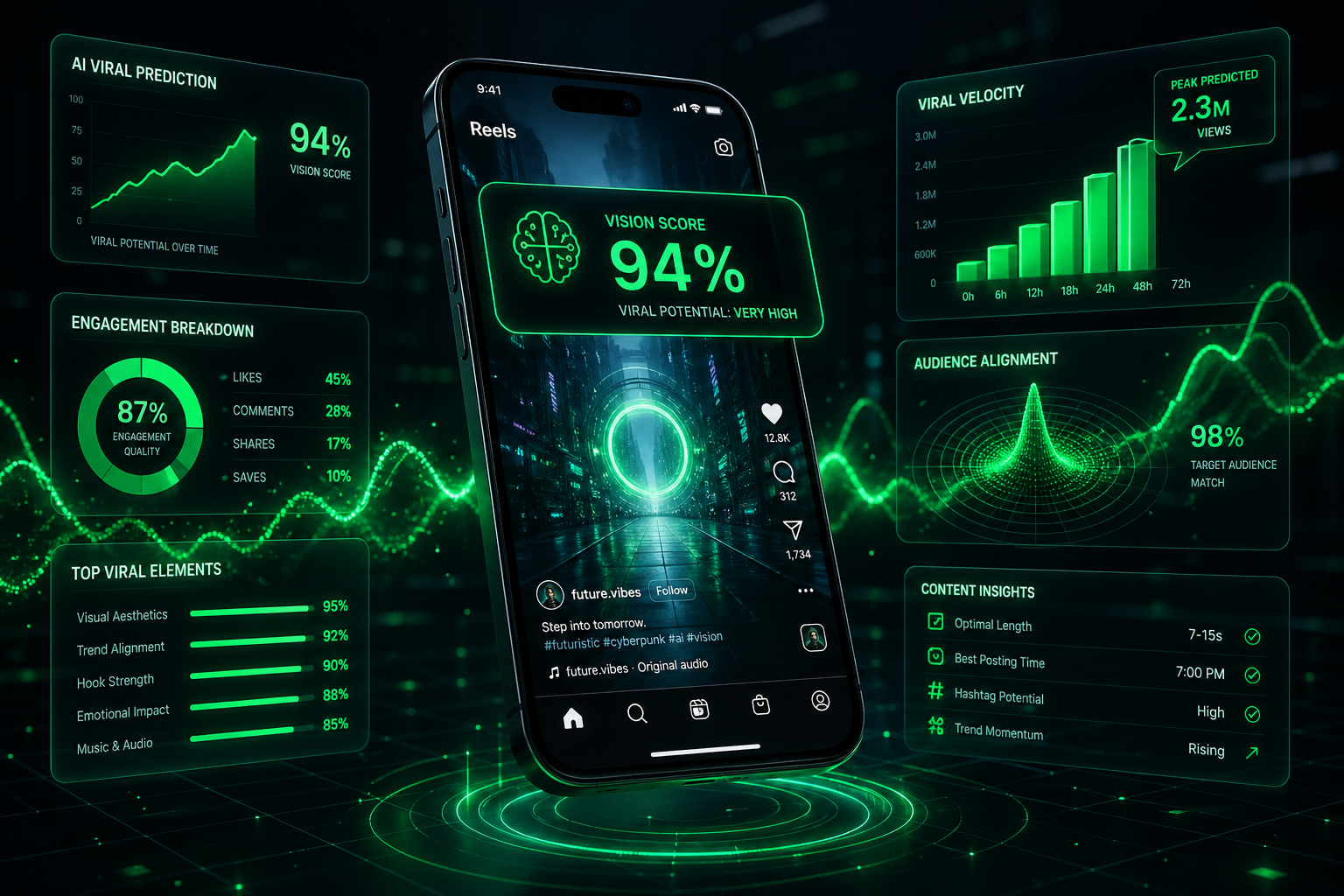
Once your first edit is done, upload it to the Wave Vision "Vision" tool. The AI will break down your video frame-by-frame, scoring your hook, your pacing, and your audio-visual alignment. You’ll receive a Vision Score from 1 to 100.
- Score 90+: High viral potential. Post immediately.
- Score 70-89: Strong performance, but likely to hit a ceiling.
- Score <70: High risk of "200-view jail." Needs revision.
Step 3: Iterative Refinement
If your score is low, don't scrap the video. Use the AI's feedback to make surgical edits. Often, simply moving a surprising fact from the end of the video to the first 3 seconds can jump your Vision Score by 30 points. This iterative process is how top-tier agencies ensure their clients never have a "bad" post day.
Platform Specifics: Why Instagram is Different in 2026
It is a mistake to think that what works on TikTok will automatically work as an Instagram Reel. While the core principles of storytelling are the same, the ranking mechanisms differ.
FeatureInstagram Reels (2026)TikTok (2026)Primary MetricShares & Saves (High Intent)Watch Time & Loops (Low Intent)Algorithm FocusRelationship & Interest GraphPure Interest GraphStarting LineHeavily influenced by "Account Momentum"Primarily "Cold Start" per videoAI PreferenceHigh-quality, aesthetic alignmentRaw, "Lo-fi" authenticity
Instagram's AI ranking system now places a massive weight on Account Momentum. If your last three posts performed well, the algorithm gives your next post a "head start" in the Discovery feed. This makes it even more critical to avoid low-scoring posts that can "cool off" your account's momentum.
Case Study: Saving a "40-Point Flop"
We recently analyzed a Reel from a fitness creator that was predicted to score a 42. The video started with the creator walking toward the camera (a slow hook) and had a long explanation of a workout routine.
By following the AI's recommendations, the creator made three changes:
- Moved the Result to the Start: They opened with a 1-second clip of the "after" transformation.
- Added Pattern Interrupts: They added on-screen text that contradicted common fitness advice at the 5-second mark.
- Synced Audio Peaks: They timed their transitions to the "drops" in the trending audio.
The revised video scored a 94 and went on to generate 1.2 million views—a 600x increase over their previous average.
Conclusion: The Competitive Advantage of Vision
In a world where everyone has access to high-quality cameras and editing software, the only remaining competitive advantage is intelligence. You can either spend the next year guessing what the algorithm wants, or you can use AI to see the patterns before you post.
The algorithm isn't your enemy; it's a system. And every system can be understood with the right data. Stop leaving your growth to chance and start using the tools that give you a "Vision" of your future success.
Ready to get your first Vision Score? Start your $1 Wave Vision trial today →
References
- [1] Wave Vision Data Lab: Analysis of 10,000+ Viral Social Posts (2025-2026).
- [2] Instagram Engineering Blog: "How AI Ranking Works in the Reels Tab" (Updated March 2026).
- [3] Social Media Today: "The Shift from Reach to Retention in 2026 Algorithms."