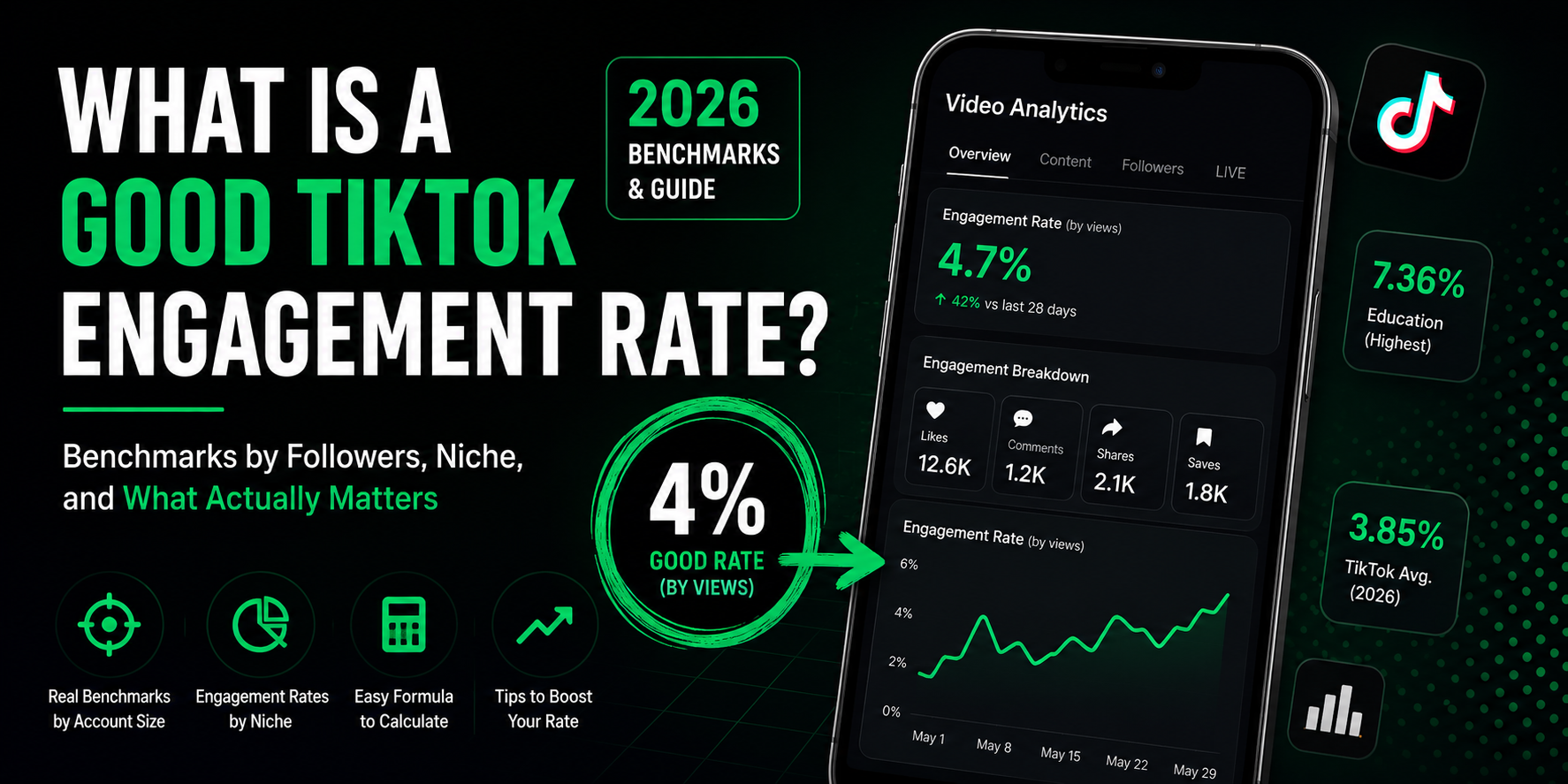
TL;DR: A good TikTok engagement rate in 2026 is anything above 4% when measured by views. Anything below 2% is underperforming. Between 2% and 4% is average. Between 4% and 7% is strong. Above 7% is exceptional. But those numbers only tell part of the story. Your follower count and content niche change the benchmark entirely. A 4% rate for a 500K-follower account is crushing it. That same 4% for a 5K-follower account is a red flag.
You posted a TikTok. It got views. Now you're staring at a percentage in your analytics wondering: is this good?
It's one of the most common questions creators ask, and most articles give you a single number and call it a day. That's not actually useful. A "good" TikTok engagement rate depends heavily on your follower count, your niche, and which formula you're even using to calculate it.
This guide gives you the real benchmarks, broken down by account size and content category, plus the exact formula to calculate your own rate right now.
TikTok's engagement rate jumped 49% year-over-year in 2026, making it the highest-engagement platform on the internet by a significant margin. Understanding where you stand against current benchmarks is one of the fastest ways to diagnose what's working and what isn't in your content strategy.
How Do You Calculate Your TikTok Engagement Rate?
TikTok engagement rate is calculated by dividing your total interactions by either your views or your follower count, then multiplying by 100. There are two formulas, and they serve different purposes.
Formula 1: By Views (best for individual video performance)
(Likes + Comments + Shares + Saves) ÷ Views × 100
Formula 2: By Followers (best for comparing accounts)
(Likes + Comments + Shares + Saves) ÷ Followers × 100
For TikTok specifically, the views-based formula is generally more accurate for measuring content quality. TikTok's For You Page algorithm regularly pushes videos to non-followers, so a creator with 10,000 followers can easily pull 500,000 views on a single video. Using followers as the denominator in that scenario would wildly inflate your rate and make it meaningless.
Use the views-based formula to understand how your content is actually performing. Use the follower-based formula when comparing your account against a competitor.
**Quick example:**A video gets 50,000 views, 3,000 likes, 200 comments, 500 shares, and 100 saves.
Total interactions: 3,800Views-based ER: (3,800 ÷ 50,000) × 100 = 7.6%
What Is a Good TikTok Engagement Rate by Account Size?
This is where most benchmark articles get it wrong. They give you one number for every creator, regardless of whether you have 500 followers or 5 million. The reality is that engagement rates naturally decline as accounts grow. Here are the current benchmarks by follower tier.
Nano creators (1K to 10K followers)
- Exceptional: 12%+
- Strong: 6% to 12%
- Average: 4% to 6%
- Below average: Under 4%
The top quarter of nano creators hits 12%+ engagement. TikTok's algorithm aggressively pushes small creators' content, which inflates engagement rates at this tier. Don't expect to maintain 12% as you grow.
Micro creators (10K to 100K followers)
- Exceptional: 8%+
- Strong: 5% to 8%
- Average: 3.5% to 5%
- Below average: Under 2.5%
This is where the algorithm starts giving you less proportional reach per follower. Breaking 8% here puts you in the top 25%, which is pitch-worthy data for your media kit.
Mid-tier creators (100K to 1M followers)
- Exceptional: 6%+
- Strong: 3.5% to 6%
- Average: 2.5% to 3.5%
- Below average: Under 2%
Macro creators (1M+ followers)
- Exceptional: 4%+
- Strong: 2.5% to 4%
- Average: 1.5% to 2.5%
- Below average: Under 1.5%
Mega accounts have massive audiences that are inherently harder to engage proportionally. At this scale, a 2% rate is solid. Don't compare yourself to nano creators and panic.
What Is a Good TikTok Engagement Rate by Niche?
Your content category matters as much as your follower count. A finance creator with 3% engagement is likely performing above average for their niche. A comedy creator with 3% engagement is probably underperforming. Here are the 2026 benchmarks by content niche.
High-engagement niches:
- Education: 7.36%
- Food and drink: 6.8%
- Animals and pets: 6.5%
- Arts and creative: 5.8%
- Sports: 5.6%
- Health and fitness: 5.5%
Mid-range niches:
- Design: 5.2%
- Travel: 5.0%
- Entertainment: 4.9%
- Technology: 4.8%
- Beauty: 4.5%
Lower-engagement niches (but still strong compared to other platforms):
- Finance: 4.2%
- Fashion: 3.8%
Sources: CreatiCalc 2026 niche benchmarks, Influencer Marketing Factory 2026 Creator Economy Report
The takeaway: always benchmark within your niche. If you're a finance creator hitting 4.5%, you're outperforming the category average. If you're a pet account hitting 4.5%, you're below where you should be.
TikTok Engagement Rate vs. Other Platforms
One of the most important things to understand is just how far ahead TikTok is compared to every other major platform. This context matters when you're deciding where to spend your time as a creator.
TikTok's average engagement rate of 3.85% to 4.1% is nearly 8 times higher than Instagram's 0.45%. Put differently: a TikTok post that feels average is almost certainly outperforming your best Instagram posts in terms of raw audience interaction.
PlatformAverage Engagement Rate (2026)TikTok3.7% to 4.9%YouTube Shorts3.0% to 4.5%Instagram Reels0.45%Instagram Feed0.30%Facebook0.15%
This is why cross-platform analytics matter. If you're only looking at each platform in isolation, you'll consistently underrate your TikTok performance and overrate everything else. Tools like Wave Vision show your TikTok, Instagram, and YouTube data side by side so you can see what's actually working across your whole content strategy, not just one feed.
Why TikTok Engagement Rates Vary So Much
Even when you know your tier and niche benchmarks, you'll still see wild swings between videos. Here's what's actually driving that.
The For You Page Effect
TikTok's algorithm doesn't distribute content based on who follows you. It distributes based on how content performs with a small initial test audience. If early viewers engage, it gets pushed to bigger audiences. If they don't, it stops. This means a single video can reach 10,000 people or 10 million people with the same follower count behind it, which is why individual video engagement rates vary so dramatically.
Posting Consistency
Accounts that posted four or more times per week had engagement rates 1.6 times higher than accounts posting once per week. The algorithm rewards momentum. If you go silent for two weeks, your first few comeback videos will get suppressed reach, which tanks your rate temporarily.
Niche Consistency
A creator posting fitness content Monday, cooking content Wednesday, and finance content Friday confuses the algorithm. It doesn't know which audience to show your content to. Picking a lane and staying in it lets the algorithm build an accurate model of who your content should reach, which improves both reach and engagement over time.
Engagement Quality
In 2026, the TikTok algorithm has learned to detect low-quality engagement signals. "Comment your zodiac sign" worked in 2023. Engagement bait that doesn't generate real conversation now gets far less algorithmic love than content that sparks genuine comments and shares.
Which TikTok Engagement Signals Matter Most?
Not all engagement is equal. Here's how TikTok's algorithm weights different interactions, from most to least valuable.
**Shares (highest weight)**Shares signal that your content is worth passing on. TikTok's 49% engagement jump in 2026 was driven largely by a 45% spike in shares per post. A share tells the algorithm your video hit hard enough that someone wanted their followers to see it too.
SavesSaves signal high-value content. They tell TikTok that someone wants to come back to this video later, which is a strong quality indicator. Saves in 2026 are increasingly weighted in TikTok's distribution decisions.
CommentsComments signal conversation. Videos that get people talking — especially genuine back-and-forth in the comments — get pushed harder than videos with lots of likes but empty comment sections.
LikesLikes still matter but carry the least algorithmic weight of the four signals. They're easy to tap and don't indicate much about whether a video is truly resonating.
Watch time and completion rateThese aren't technically "engagement" in the traditional sense, but they may be the most important metric of all. A video that gets watched to completion sends a powerful signal that the content was worth the viewer's time.
How to Improve Your TikTok Engagement Rate
Knowing your rate is the first step. Knowing how to move it is the second.
Hook in the first two seconds. TikTok's drop-off rate is brutal in the opening seconds. If your first frame doesn't grab attention, viewers scroll before they ever engage. Lead with movement, a surprising statement, or a visual payoff that makes stopping feel worth it.
Create content that earns shares. Ask yourself before posting: would a stranger share this with a friend? Content that's funny, genuinely useful, or emotionally resonant gets shared. Content that's just aesthetically nice usually doesn't.
Prompt comments with something genuinely interesting. The best comment-bait in 2026 is a controversial opinion, a counterintuitive take, or a question you actually don't know the answer to. Formulaic "comment below!" CTAs have stopped working.
Post consistently, not constantly. Posting four or more times per week is the threshold where the algorithmic benefit of consistency kicks in. But posting ten times per week with mediocre content will hurt your rate. Consistent quality beats raw volume.
Track your data, then act on it. Knowing your engagement rate is useful. Knowing which specific videos pull above your average, and understanding why, is what actually drives growth. That's the difference between watching numbers and using them. Wave Vision's AI analyzes your TikTok performance patterns and surfaces what's working in your specific content, so you're not guessing at what to post next.
Conclusion
A good TikTok engagement rate in 2026 is 4% or above when measured by views. But that number means something different depending on your follower tier and niche. A 4% rate for a nano creator is average. For a macro creator, it's strong. For a finance account, it's above benchmark. For an education account, it's below where you should be.
The most useful thing you can do is stop comparing yourself to a single platform-wide average and start tracking your own trends over time. Is your rate going up month over month? Are your shares increasing? Are your highest-engagement videos revealing a pattern you can replicate?
That's where real growth comes from. Not hitting a magic number, but understanding what's working and doing more of it.
Ready to see your TikTok engagement data alongside your Instagram and YouTube numbers in one dashboard?
Try Wave Vision free for 30 days ($1 trial)
For more on growing across platforms, check out our guides on the best TikTok analytics tools for creators and how social media analytics can help your business.
Frequently Asked Questions
What is a good TikTok engagement rate in 2026?
A good TikTok engagement rate in 2026 is anything above 4% when measured by views. The platform-wide average sits between 3.7% and 4.9% depending on the data source and calculation method. Anything below 2% is underperforming. Anything above 7% is exceptional. These benchmarks shift significantly based on your follower tier and content niche, so always compare yourself against creators at a similar account size in the same content category.
How is TikTok engagement rate calculated?
TikTok engagement rate is calculated using one of two formulas. For individual video performance, divide total interactions (likes plus comments plus shares plus saves) by total views, then multiply by 100. For comparing accounts, divide total interactions by total followers, then multiply by 100. The views-based formula is generally more accurate for TikTok because the For You Page algorithm distributes content far beyond a creator's follower base.
Why is my TikTok engagement rate dropping?
TikTok engagement rate drops most commonly because of posting inconsistency, niche drift, or relying on engagement bait that the algorithm no longer rewards. Accounts that go silent for two or more weeks typically see suppressed reach on their comeback videos. Creators who mix unrelated content categories confuse the algorithm about which audience to reach. And tactics like "comment your zodiac sign" have lost effectiveness as TikTok's algorithm has gotten better at identifying low-quality engagement signals.
Is TikTok engagement rate higher than Instagram?
Yes, significantly. TikTok's average engagement rate of 3.7% to 4.9% is roughly eight times higher than Instagram's average of 0.45% in 2026. This gap is driven by TikTok's For You Page algorithm, which distributes content based on performance rather than follower relationships, giving every video a chance to reach a large audience regardless of account size.
What engagement rate is good for brand deals on TikTok?
For brand deals on TikTok, most brands and agencies consider anything above 4% (by views) to be strong. Micro creators with engagement rates above 6% are particularly attractive to brands because their audiences are more niche and genuinely responsive. When pitching brands, include your engagement rate by views for your last 30 videos rather than a lifetime average, as recent performance is more relevant to a campaign outcome than historical data.