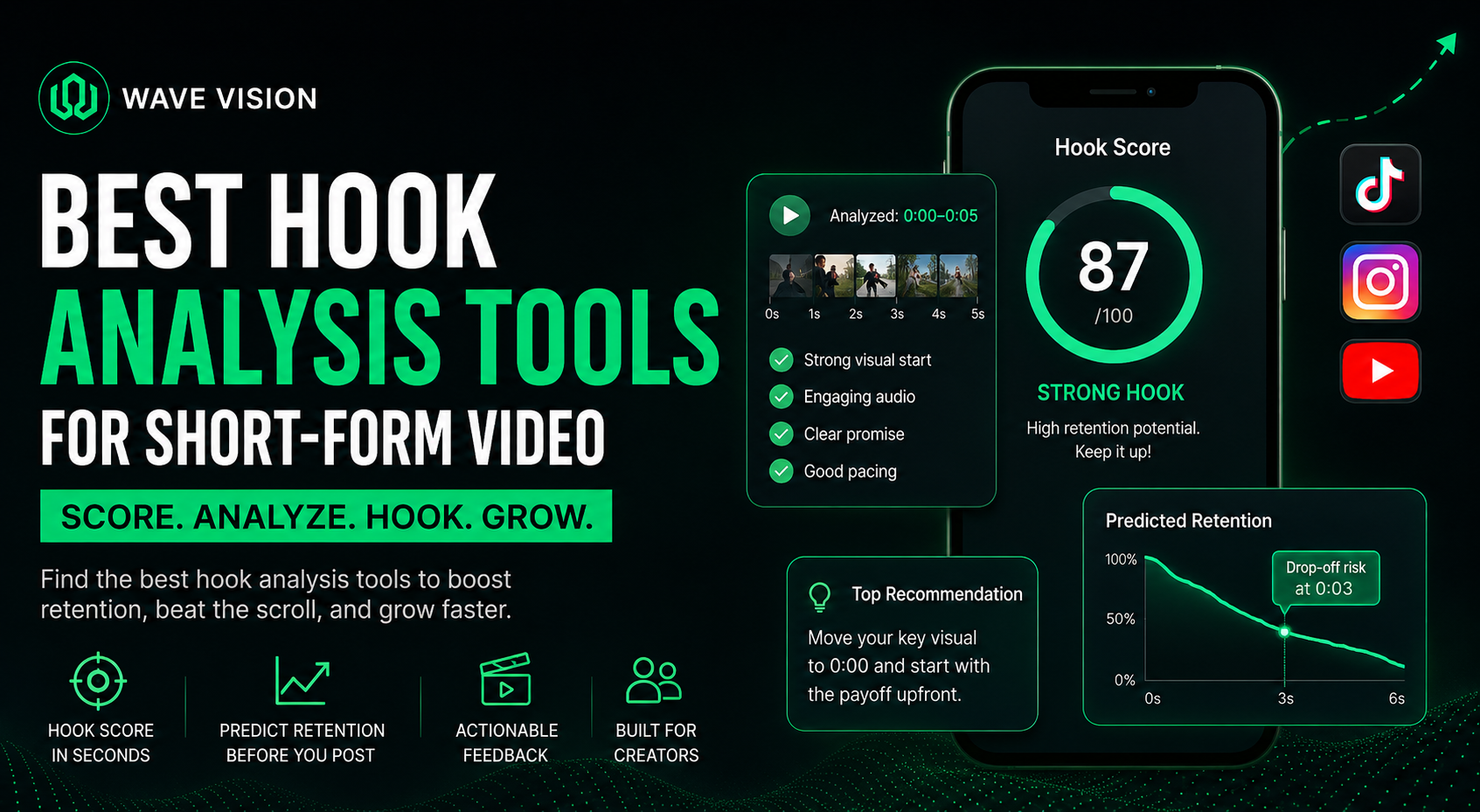
TL;DR: A hook analysis tool for short-form video scores the first 3 to 5 seconds of your TikTok, Reel, or Short, then tells you whether it will hold viewers or get scrolled past. The first three seconds decide most of your retention, and retention decides distribution. This post breaks down what these tools measure, compares the best ones on the market, and shows you how to read a hook score and fix a weak one before you post.
Why the First 3 Seconds Decide Everything
You've probably heard this before, but the numbers are more brutal than most creators realize. TikTok for Business has confirmed that 63% of its highest click-through videos hook viewers within the first three seconds. That's not a small edge. That's the difference between a video that gets tested to a wider audience and one that dies at 200 views.
Instagram works the same way. Adam Mosseri has said that viewers decide within about 1.7 seconds whether to keep watching a Reel, and watch time is still the single biggest ranking signal on the platform. Reels that hold at least 60% of viewers past the first three seconds can see 5 to 10 times more total reach than Reels with a weak hold.
Here's the part that trips people up: your hook isn't just the first line you say. It's the first frame, the first sound, the first piece of text on screen, and the promise you make before anyone has decided to trust you. A hook analysis tool exists to catch a weak version of all four before you waste a post finding out the hard way.
We wrote about this in more depth in our post on hook rate and why it controls your reach, but the short version is this: if your hook rate is weak, nothing else about your video matters. Not the editing, not the CTA, not the trending audio.
What Is a Hook Analysis Tool?
A hook analysis tool is software that scans the opening seconds of a short-form video and scores how likely it is to hold a viewer's attention. It compares your opening frame, pacing, audio, and on-screen text against patterns pulled from videos that already performed well, then gives you a score and specific feedback.
Most tools work the same basic way. You upload a video or paste a link from TikTok, Instagram Reels, or YouTube Shorts. The AI breaks down the first 3 to 5 seconds frame by frame, checking for motion, visual contrast, text timing, and whether the first spoken word delivers value or just throat-clears ("hey guys, so today..."). You get back a score, usually on a 0-100 or 1-10 scale, along with notes on what's working and what isn't.
The good tools go further than a single number. They show you a predicted retention curve, flag the exact second where interest is likely to drop, and suggest a fix, like moving your strongest visual to frame one instead of burying it after your logo animation.
What a Good Hook Analysis Tool Actually Measures
Not every "AI video analyzer" measures the same things, and that matters more than the marketing copy suggests. A hook analysis tool worth paying for should evaluate at least four things: the visual opening, the audio and pacing, the promise in your first line, and how your specific hook compares to what's currently winning in your niche.
Visual opening matters because about half of short-form video gets watched on mute, so your hook has to work as a silent image before it works as a sentence. Pacing matters because platforms reward pattern interrupts, meaning something changes on screen every 3 to 5 seconds to keep the brain from going into scroll-autopilot. And niche comparison matters because a hook that crushes in fitness content can flop in finance content. A generic "top 10 viral hooks" template ignores that entirely.
The Best Hook Analysis Tools for Short-Form Video in 2026
Here's how the current field breaks down, based on what each tool actually does well.
HookScan focuses purely on the opening. You paste a link or upload a clip up to 60 seconds, and it returns a Hook Score along with suggestions based on viral video patterns. It's fast and simple, which makes it a solid free option if you just want a gut check before posting.
HookMaster goes deeper with frame-by-frame feedback across the whole video, not just the hook, and ties every note to a timestamp so you know exactly what to cut. It also lets you drop in a competitor's viral video and reverse-engineer its pacing and structure.
Shorta checks four things at once: hook, retention, pacing, and clarity, and it works on unpublished drafts, so you can catch problems before you spend a post finding them.
Tikalyzer is a free, no-login option that breaks a video into a hook analyzer and a separate script analyzer, plus a full retention and drop-off breakdown.
Descript and OpusClip take a different approach. Instead of just scoring a finished video, they help you test hook variations before you commit to one. One creator who started systematically testing hooks this way reported their average watch time increased by 34% in the first month, which is the kind of compounding gain that's easy to underrate until you actually track it.
The common weakness across most of these tools: they analyze the hook in isolation from your account's actual performance data. They can tell you a hook resembles other viral hooks. They can't always tell you whether it will work for your specific audience, on your specific accounts, across the platforms you're actually posting to.
How Wave Vision's AI Video Analysis Fits In
This is exactly the gap we built Wave Vision to close. Instead of scoring a hook against a generic viral database, our Vision tool analyzes any video across your own linked TikTok, Instagram, and YouTube accounts, so the feedback is calibrated to what your specific audience already responds to, not a stranger's.
You link your accounts, then run AI Video Analysis on anything you've posted, or anything you're thinking about posting, and get a Vision Score back in seconds. It's built for creators who are already comparing performance across three apps and want one dashboard instead of three tabs open at once, which is a workflow we broke down in our guide to the best AI analytics tools for UGC creators on TikTok.
If you've ever felt stuck posting into a void with no idea why one video took off and the next one didn't, that pattern usually traces back to hook strength and account-specific signals that generic tools can't see. We wrote about the exact mechanics behind that stall in our post on getting out of 200 view jail on Instagram.
How to Read Your Hook Score and Fix a Weak Hook
A hook score only helps you if you know what to do with a low one. Most tools return a number plus a short list of flags, and the fix usually falls into one of three buckets: the visual, the pacing, or the promise.
If your score is low because of the visual, the fix is almost always the same: cut anything before the payoff. No logo animation, no "hey guys," no slow zoom-in. Drop the viewer directly into the most interesting frame of the video, then let the context catch up.
If your score is low because of pacing, look for any stretch longer than 3 to 5 seconds without a cut, camera change, or new piece of on-screen text. TikTok data on this is consistent: videos with strong hooks in the first second see 41% higher retention than videos that ease into their opening.
If your score is low because of the promise, that means your first line doesn't clearly tell the viewer what they're about to get. "This mistake killed my engagement" beats "hey guys, today I want to talk about" every time, because it starts at the payoff instead of the setup.
Common Hook Mistakes That Tank Retention
A few patterns show up again and again in low-scoring hooks, and most of them are fixable in under a minute of re-editing.
The biggest one is starting with a setup instead of a payoff. Viewers don't need to know who you are or why you're making the video before they see the point of it. Save the context for after you've earned the watch time.
The second is a static opening frame. If nothing moves, changes, or surprises the viewer in the first second, the algorithm reads that as low interest before a single word gets spoken. Face-centered, motion-heavy openings consistently outperform static ones by a wide margin.
The third is a hook that doesn't match the payoff later in the video. A curiosity gap that never gets resolved trains your audience to distrust your future hooks, which quietly kills retention on everything you post afterward.
Conclusion
The first three seconds of your video are doing more work than anything else you post. A hook analysis tool won't write your content for you, but it will catch a weak opening before it costs you a shot at real distribution, whether that's a free scan from HookScan or Tikalyzer, or an account-aware Vision Score inside Wave Vision that's calibrated to what's actually working on your channels.
If you're serious about fixing this systematically instead of guessing, start your $1 trial with Wave Vision and run your last five posts through AI Video Analysis. You'll usually spot the pattern in your weak hooks within the first two or three videos.
Frequently Asked Questions
**What is a hook analysis tool?**A hook analysis tool is AI software that scores the opening seconds of a short-form video, usually 3 to 5 seconds, and predicts how well it will hold viewer attention. It looks at your visual opening, pacing, on-screen text, and first spoken line, then returns a score and specific feedback.
**How long should a hook be for TikTok or Instagram Reels?**Most platforms weigh the first 3 seconds most heavily, though Instagram head Adam Mosseri has said the algorithm evaluates a Reel's ability to hold attention through the first 10 seconds. The safest approach is to front-load your strongest visual and clearest promise in the first 3 seconds, then keep delivering value without a lull through second 10.
**What's a good hook retention rate?**A strong hook retention rate is generally 70% or higher of viewers still watching past the first 3 seconds. Anything below 50% at that mark usually signals a weak opening frame or a slow, unclear first line.
**Can a hook analysis tool guarantee a video goes viral?**No. These tools predict how likely your opening is to hold attention based on patterns from high-performing content, but they can't account for timing, audience mood, or platform testing variance. Think of them as a pre-flight check, not a guarantee.
**Do I need a different hook for TikTok versus Instagram Reels?**Often, yes. TikTok's algorithm is more heavily retention-driven, while Instagram weighs watch time alongside DM shares and likes per reach. A hook that works for a TikTok-native audience may need a slightly different pace or promise to land the same way on Reels.