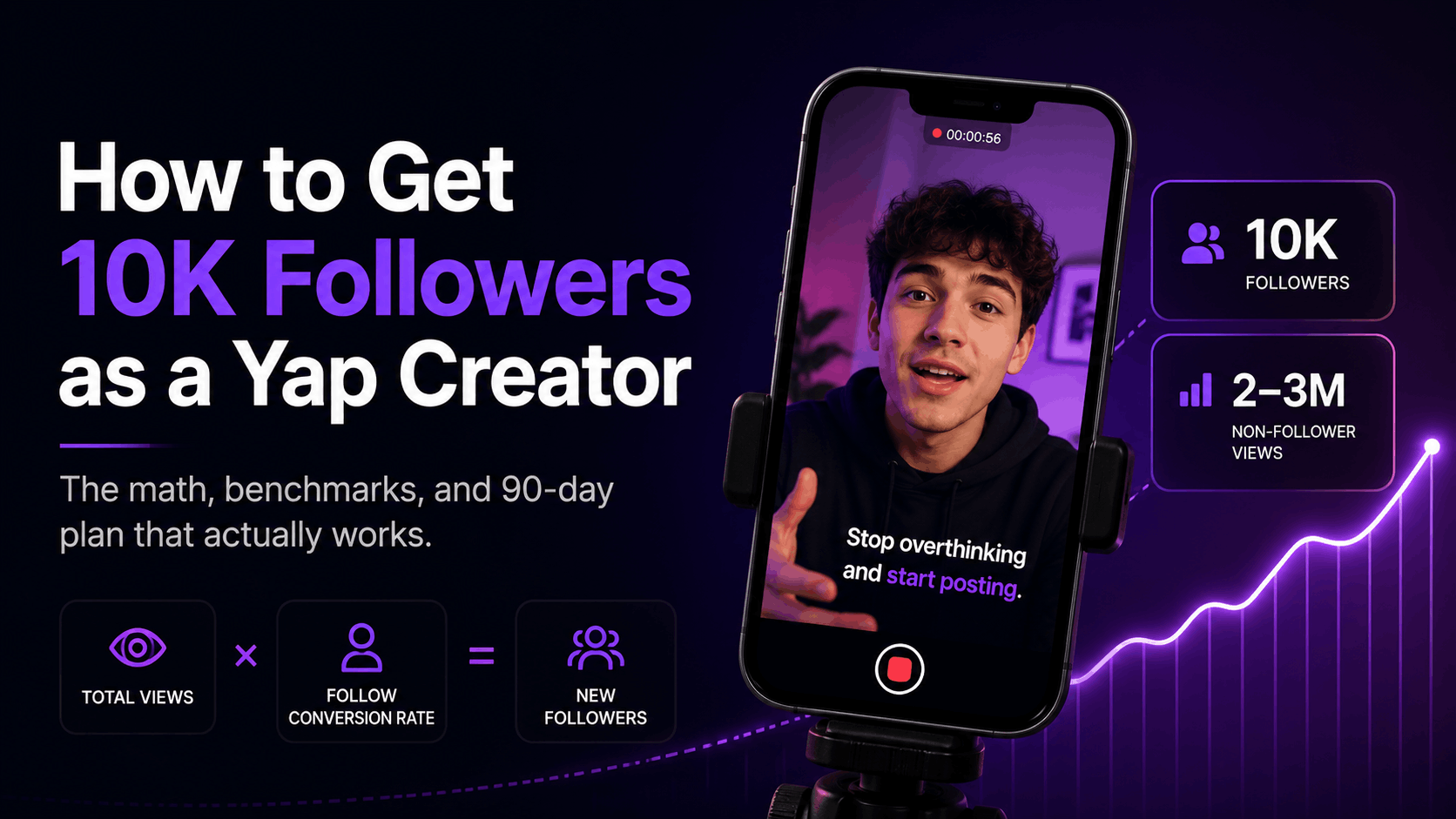
TL;DR: Yap content is raw, unscripted talking straight to camera, and it's the fastest-growing format on TikTok and Instagram right now. Getting to 10K followers isn't luck. It's math: total views multiplied by your follow conversion rate. This guide covers the retention benchmarks that unlock distribution, the arithmetic behind 10K, and a 90-day plan to get there.
Two creators post the same yap video on the same day. Same phone, same lighting, same topic. One gets 340 views. The other gets 34,000. If you want to grow to 10K followers as a yap content creator, the difference between those two videos is the only thing worth studying.
Most advice tells you to post more and be consistent. That's not wrong, it's just incomplete. Volume without direction gets you 300 videos and 900 followers. What actually moves you toward 10K is understanding two numbers: how many people see your videos, and what percentage of them hit follow.
The good news is that both numbers are measurable, and both respond to specific changes you can make this week. The yap format itself is already doing half the work for you. It's cheap to produce, it scales across three platforms, and audiences are actively rewarding it right now.
Here's the full breakdown, with real benchmarks instead of vibes.
What Is a Yap Content Creator?
A yap content creator makes unscripted, minimally edited selfie videos where they talk directly to camera about one idea. The format uses subtitles and a text headline as the hook, no fancy camera, and no scripted delivery. It grew popular because it feels like a video from a friend instead of a produced ad.
The format started on TikTok and moved to Instagram, where it's now one of the dominant styles on the platform. One business coach described yap videos as off-the-cuff selfie videos with minimal editing and a text hook, and noted that some of his Reels in that format cleared 800,000 views.
Why is it working so well? Two reasons. Audiences are tired of over-produced content, and they're increasingly suspicious of AI-generated video. Recent data shows that 46% of users are uncomfortable with brands using AI influencers and that raw yap videos are outperforming heavily produced content.
That said, don't confuse "unpolished" with "easy." Good yapping is a real skill. Holding attention through energy, rhythm, and tone is what separates a yap that spreads from one that dies at 200 views. The camera is simple. The communication isn't.
Why Does Hitting 10,000 Followers Actually Matter?
Ten thousand followers is a real monetization gate, not a vanity number. It's the minimum threshold for the TikTok Creator Rewards Program, it unlocks the TikTok Creator Marketplace for brand deal matching, and it's the point where most brands stop ignoring your DMs. Below 10K, you're building. Above it, you have options.
The exact requirements are worth knowing before you chase them. TikTok Creator Rewards asks for 10,000 followers plus 100,000 video views in the last 30 days, an account in good standing, and videos at least 60 seconds long to qualify for the higher-paying tier.
Here's the part most creators miss: the follower count is the easier half. The 100,000 views in 30 days requirement trips up more people, because it measures recent momentum rather than lifetime totals. An account that hit 10K a year ago and went quiet doesn't qualify.
Set your expectations on the money, too. TikTok monetization in 2026 runs across four separate programs with their own rules, and Creator Rewards RPM typically lands between $0.40 and $2.00 per thousand qualified views. At 100,000 views a month, that's real but modest. The bigger value of 10K is credibility and access, not ad revenue.
How Many Views Do You Need to Reach 10K Followers?
You need roughly 2 to 3 million non-follower views to gain 10,000 followers at a median follow conversion rate. Follow conversion rate is the percentage of new viewers who follow you after one video. On TikTok the median runs 0.30% to 0.55%, on Instagram Reels 0.18% to 0.35%, and on YouTube Shorts 0.15% to 0.25%.
Run the math and it gets uncomfortable fast. At a 0.40% conversion rate, 10,000 followers requires about 2.5 million views from people who don't already follow you. Spread across 90 daily videos, that's roughly 28,000 views per post, every day, for three months.
Now here's the useful part. That same research found the top performance decile clears 0.80% conversion. Double your conversion rate and you cut the view requirement in half. Suddenly you need 1.25 million views instead of 2.5 million, which is a completely different mountain.
So which lever should you pull? Conversion, almost always. Getting more views means beating the algorithm every single day. Improving conversion means fixing your content once and benefiting from it on every video after. This is the core idea behind what actually matters at your size, and it's why chasing raw view counts is usually the slower road.
What actually raises conversion? Giving a stranger a clear reason to expect a next video. That means a recognizable format, a specific topic you own, and a profile that immediately explains what they're signing up for.
The First Three Seconds Decide Whether Your Yap Gets Distribution
When you post, the platform shows your video to a small test audience and watches what happens. If they stay, distribution expands. If they swipe, it stops. That test happens in the first three seconds, and nothing you do at second 20 can save you from failing it.
The data on this is blunt. A study of 3.3 billion Shorts found that videos with a viewed-versus-swiped-away ratio of 70% to 90% performed best, while anything under 60% saw distribution collapse almost immediately. On TikTok, roughly 70% retention past three seconds signals potential for wider reach, and watch time plus completion is estimated to drive 40% to 50% of the entire ranking decision.
For yap content specifically, this means your first sentence is the whole ballgame. Three things to cut immediately:
Greetings. Opening with "hey guys" or "so in today's video" signals low-effort content. Videos with generic greetings average 23% lower retention than videos that open with actual content.
Setup. You don't need context before the point. Start at the point.
Overpromising. A hook that oversells creates a sharp drop when viewers realize the payoff isn't coming. The same research found 58% of users have unfollowed accounts over consistently misleading hooks, and platforms now track early exit as a negative signal.
A good yap hook makes one specific promise you can actually keep in the next 45 seconds. That's it. If you want a deeper look at scoring hooks before you post, here's how to predict which Reels will perform.
How Long Should a Yap Video Be?
Aim for 60 to 90 seconds. That length qualifies for TikTok's higher-paying Creator Rewards tier, sits inside Instagram's preferred Reels window, and carries no penalty on YouTube Shorts. One format, three platforms, maximum monetization. Under 60 seconds pays nothing from TikTok Creator Rewards.
Length is really a retention decision, though. Longer videos give you more room to build a point, but they also give viewers more chances to leave. The benchmarks by length in 2026 are: 60% to 80% view-through for 15-second Reels, and 40% to 60% for 60-second Reels. Calculate yours by dividing average watch time by total video length.
Across platforms, the current averages sit at 45% to 65% for Reels, 40% to 50% for TikTok, and 40% to 55% for Shorts. Worth noting: TikTok's average for sub-30-second videos climbed from about 45% to 50% year over year, which means the bar keeps rising. Content that performed fine last year may now fall below the threshold for broad distribution.
The rule is simple. Match the length to the value you can actually hold. Never pad past the point where viewers start dropping. If you have 40 seconds of substance, make a 40-second video and accept you're not earning Creator Rewards on it yet.
Other format variables matter less than length and hook, but they're not nothing. Audio choice in particular has a measurable effect, which is covered in how sound choice affects virality.
Build a Repeatable Format Instead of Chasing Trends
The creators who cross 10K fastest aren't the ones with the most viral videos. They're the ones a stranger can understand in four seconds. Repeatability is what converts a viewer into a follower, because following is a prediction about your next video, not a reaction to this one.
Three things to lock in:
One idea per video. Not three tips. One point, stated clearly, with a specific example. Yap content lives or dies on clarity, and two ideas in 60 seconds means neither one lands.
A recognizable series. Day-counting, recurring segments, and running narratives all work because they create an obvious reason to come back. I've been posting a daily documentation-style yap for close to 50 days straight, and the follows almost never come from the video itself. They come from people who realize there's a story with a next episode.
A profile that closes the loop. Your bio and pinned videos are the landing page for every yap that works. If someone watches, taps your profile, and can't tell what they'd be following, the conversion dies there.
On the production side, keep the barrier low. Same setup, same framing, same time of day. If scripting is the bottleneck, tools that rewrite your script in your own voice preserve how you actually talk instead of flattening it into generic AI copy, which defeats the entire point of the format.
And post everywhere. The same 60-second yap works on all three platforms, so there's no reason to leave two of them on the table. You'll want to track all three platforms in one dashboard once you're doing this daily, because manually checking three apps every morning gets old by week two.
How Do You Know Which Yaps Are Actually Working?
Track retention and follow conversion per post, not view counts. Views tell you a video got distributed. Retention tells you why. Follow conversion tells you whether the video introduced your account well. Two videos with 20,000 views each can have completely different value depending on those two numbers.
The cleanest way to test on Instagram is Trial Reels. Meta launched the feature for public accounts with at least 1,000 followers, and it shows your Reel only to non-followers, then reports back after about 24 hours. Your existing audience never sees it. As of February 2026 you can schedule them in advance, so you can batch a week of tests in one sitting.
The method that produces actual answers is one variable at a time. Run three versions of the same yap with different hooks, spaced at least 24 hours apart so they don't compete for the same non-follower pool. Compare watch time and shares. Take the winner to your main feed. Then test the next variable.
One thing that trips people up: engagement doesn't rescue bad retention. A video with thousands of likes but 35% average retention will still plateau quickly. Rewatches, on the other hand, are among the strongest quality signals available. If a yap is getting replayed, study exactly what it did differently.
If you want a fast read on a single video before you commit to a whole testing cycle, run it through the free video analyzer and see what the signal breakdown says.
The 90-Day Plan to 10K
Days 1 to 30: establish a baseline. Post one 60 to 90 second yap daily across all three platforms. Don't optimize yet. You need 30 data points before any pattern is real. At the end of the month, calculate your average retention and your follow conversion rate. Those two numbers are your starting line.
Days 31 to 60: test one variable per week. Week one, hooks. Week two, length. Week three, topic. Week four, opening visual. Use Trial Reels on Instagram to test without touching your main feed. Keep everything else identical so you know what caused the change.
Days 61 to 90: exploit what won. Take your top five videos by follow conversion, not by views. Find what they share. Make twenty more like them. This is where accounts break out, because you stop running experiments and start running a format that's already proven.
Realistically, will this get you to 10K in 90 days? Sometimes. More often it gets you to a repeatable system that hits 10K in month five or six instead of never. That's still the fast version.
Getting to 10K as a yap creator comes down to three things. Understand the math, so you know that doubling your follow conversion rate is worth more than doubling your posting volume. Win the first three seconds, because nothing after them matters if you lose the swipe test. And measure per post, so you're improving a format instead of buying lottery tickets.
The creators stuck at 800 followers usually aren't lacking effort. They're lacking visibility into which of their videos are actually working and why. You can't optimize a format you can't see.
Start your $1 trial with Wave Vision and get your TikTok, Instagram, and YouTube retention data side by side, with AI analysis on every video you post. Thirty days is exactly long enough to find your baseline and start fixing the right thing.
Frequently Asked Questions
How long does it take to get 10K followers as a yap content creator?
Most creators posting daily in a focused niche reach 10,000 followers somewhere between three and nine months. The range is wide because it depends almost entirely on follow conversion rate. At a median 0.40% conversion you need roughly 2.5 million non-follower views, but at 0.80% you only need about 1.25 million. Improving conversion shortens the timeline more than posting more often does.
Do you need good gear to make yap content?
No. The format is defined by being unpolished, and a phone camera with decent natural light is the standard setup. Audiences reward yap videos partly because they look like something a friend recorded. The one thing worth investing in is clean audio, since bad sound causes people to swipe faster than bad video does. Subtitles are also non-negotiable, because most viewers watch with sound off.
How often should you post yap content?
Once a day is the practical target if you're trying to reach 10K. Daily posting gives you enough data points to identify patterns within a month, and it keeps you moving toward TikTok's 100,000 views in 30 days requirement, which measures recent activity rather than lifetime totals. If daily isn't sustainable, four to five times a week with a consistent format beats seven inconsistent posts.
Why do my yap videos get stuck at a few hundred views?
Your videos are almost certainly failing the seed audience test. Platforms show each new post to a small group and expand distribution only if enough of them stay. Videos that lose more than 40% of viewers in the first three seconds typically see distribution collapse right there. Check whether your opening frame delivers the hook immediately, and cut any greeting, logo, or setup before the point.
Does the yap format work on YouTube Shorts too?
Yes, and 60 to 90 second yaps carry no length penalty on Shorts, which makes them efficient to cross-post. The main difference is that Shorts follow conversion tends to run lower than TikTok's, around 0.15% to 0.25%, so Shorts often functions better as a reach channel than a follower-acquisition channel. Rewatch rate is one of the strongest positive signals on the platform, so loop-friendly endings are worth testing.
Frequently asked questions
How long does it take to get 10K followers as a yap content creator?
Most creators posting daily in a focused niche reach 10,000 followers somewhere between three and nine months. The range is wide because it depends almost entirely on follow conversion rate. At a median 0.40% conversion you need roughly 2.5 million non-follower views, but at 0.80% you only need about 1.25 million. Improving conversion shortens the timeline more than posting more often does.
Do you need good gear to make yap content?
No. The format is defined by being unpolished, and a phone camera with decent natural light is the standard setup. Audiences reward yap videos partly because they look like something a friend recorded. The one thing worth investing in is clean audio, since bad sound causes people to swipe faster than bad video does. Subtitles are also non-negotiable, because most viewers watch with sound off.
How often should you post yap content?
Once a day is the practical target if you're trying to reach 10K. Daily posting gives you enough data points to identify patterns within a month, and it keeps you moving toward TikTok's 100,000 views in 30 days requirement, which measures recent activity rather than lifetime totals. If daily isn't sustainable, four to five times a week with a consistent format beats seven inconsistent posts.
Why do my yap videos get stuck at a few hundred views?
Your videos are almost certainly failing the seed audience test. Platforms show each new post to a small group and expand distribution only if enough of them stay. Videos that lose more than 40% of viewers in the first three seconds typically see distribution collapse right there. Check whether your opening frame delivers the hook immediately, and cut any greeting, logo, or setup before the point.
Does the yap format work on YouTube Shorts too?
Yes, and 60 to 90 second yaps carry no length penalty on Shorts, which makes them efficient to cross-post. The main difference is that Shorts follow conversion tends to run lower than TikTok's, around 0.15% to 0.25%, so Shorts often functions better as a reach channel than a follower-acquisition channel. Rewatch rate is one of the strongest positive signals on the platform, so loop-friendly endings are worth testing.