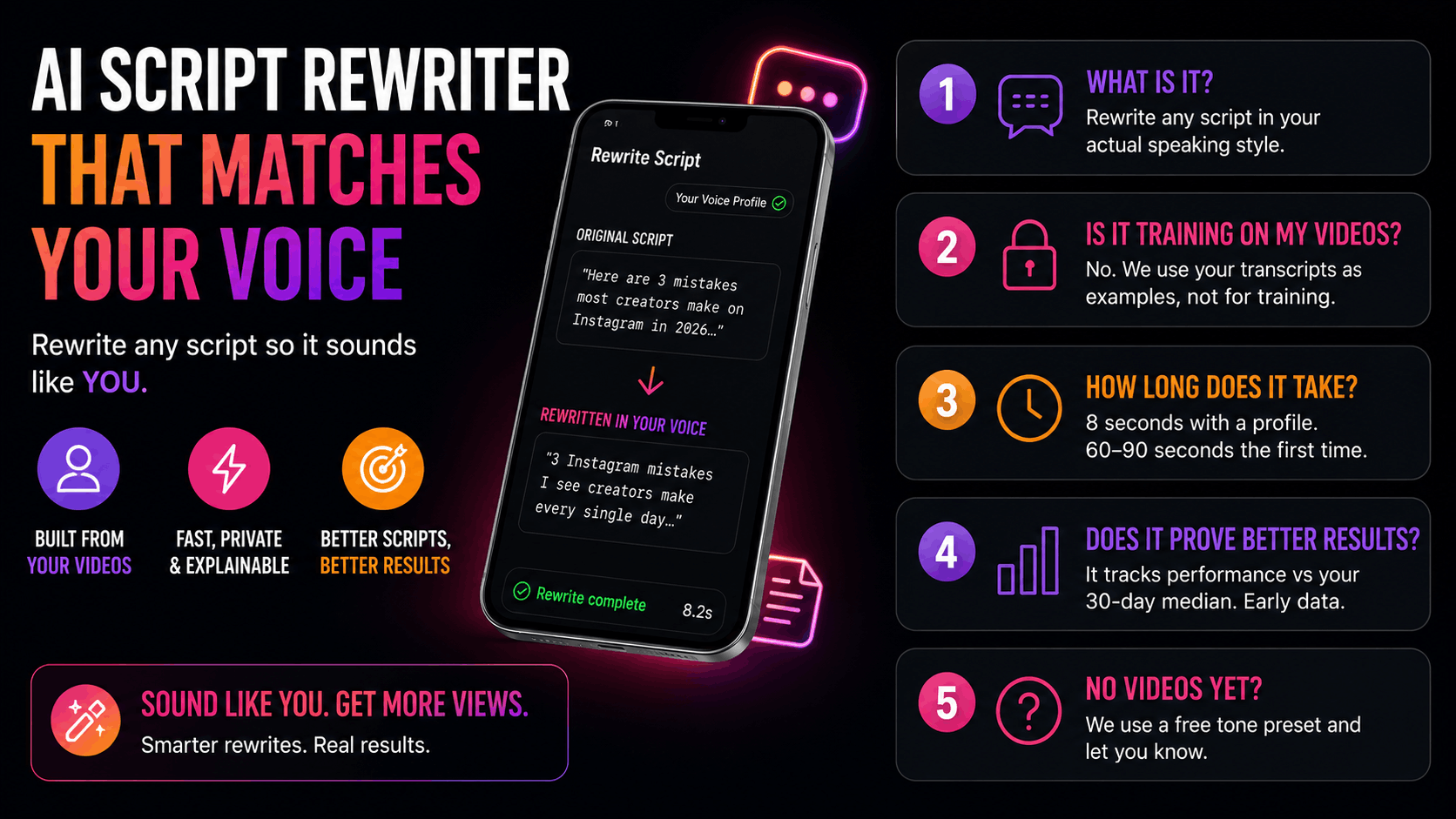
TL;DR: Most AI script rewriters ask you to pick a tone from a dropdown, then hand back something that sounds like every other AI script on the internet. Wave Vision's rewriter builds an actual voice profile from your own published videos, uses it to rewrite any script (yours or a competitor's), and tracks which of its rewrites you actually post so it can learn from the ones that worked.
Paste a link to any short-form video, a competitor's, a trend you want to try, or one of your own, and an AI script rewriter tool can hand you back a new version in seconds. That part isn't new. What most of these tools skip is the part that actually matters: does the output sound like a real person, or like an AI?
It's a real problem. Nearly 89% of creators using generic AI scriptwriting tools say their output sounds inauthentic, and viewers notice fast. One study found people can spot an AI-generated voice or script within three seconds, which is exactly the window where Instagram and TikTok decide whether to keep showing your content to anyone.
We built Wave Vision's script rewriter to fix the actual cause of that problem, not just the symptom. Instead of a tone dropdown, it builds a real profile of how you talk from your own transcripts, and it gets better at rewriting for you specifically as it learns which of its scripts you actually posted and how they performed.
Here's exactly how it works, including the parts we're not ready to oversell yet.
Try it yourself. Rewrite your first script for $1 →
What Is an AI Script Rewriter, and How Is This One Different?
An AI script rewriter takes an existing video script (yours or someone else's) and rewrites it, usually in a different tone or style. Most tools do this with a generic preset like "casual" or "professional." Wave Vision's version instead builds a written profile of your actual speaking style from your own transcripts, then uses that profile to rewrite any script so it sounds like you specifically, not a category of person.
You can feed it two kinds of source material. Paste a URL from TikTok, Instagram, or YouTube and it pulls the transcript only, without running a full performance analysis on that video. Or pick a video already in your Wave Vision library, and if it doesn't have a saved transcript yet, the tool fetches the captions or transcribes it on the spot, then keeps that transcript on file for free going forward. Both paths feed the same rewrite engine. The only difference is where the source script comes from.
The free version of this idea exists too: four tone presets (original, casual, high-energy, professional), rate-limited to three rewrites a minute. That's a fine starting point, but a preset is still a guess about how you sound. A voice profile is evidence.
How Does the Voice Profile Actually Learn How You Talk?
The voice profile is a 120 to 200 word description of your delivery, built by an AI model reading your own transcripts, plus two short excerpts pulled verbatim from your real videos so the model has actual samples of your voice to work from, not just a summary of it.
It covers things like your sentence rhythm, vocabulary level, filler words and catchphrases, how you open and close a video, whether you talk in first or second person, and how much slang or profanity you use. Notably, it never records what you talk about. The prompt that builds this profile is explicitly forbidden from mentioning your niche or any specific topic from your transcripts.
That restriction exists for a mechanical reason. The profile gets cached and reused on every rewrite for 30 days. If it picked up "talks about skincare," every future rewrite would quietly drift toward skincare regardless of what script you actually gave it. One contaminated profile would poison every rewrite built on top of it. The profile describes the instrument, not the song, and that's a deliberate limit. It also means the tool doesn't invent a topic for you. Feed it a script about budgeting and it keeps the topic, restyling only the delivery.
To build the profile, the system pulls up to 8 of your transcripts, ordered by view count, on the theory that your best-performing videos are the truest sample of you at your best.
The Cold Start Problem (And Why We Didn't Fake It)
Here's the part most products quietly cut a corner on. A creator trying this for the first time typically has zero saved transcripts, because Wave Vision only transcribes videos on demand, not in bulk ahead of time. The easy move would be defaulting that first-time user to a generic tone preset and calling it done.
Instead, if fewer than 3 usable transcripts exist, the system transcribes your top 5 videos by view count on the spot before it builds anything. That's the moment a new trial user is deciding whether the product actually works, so it's the wrong moment to hand them a fallback.
The tradeoff is speed. A rewrite takes about 8 seconds once your voice profile is cached, versus roughly 60 to 90 seconds cold, while five videos get transcribed for the first time. A separate status check runs before the rewrite request so the interface can show the right kind of loading state instead of leaving a returning user staring at a "learning how you talk" message on every single rewrite, which an earlier version of the product actually did.
Confidence scales with how much data exists. Three or more transcripts gets you a full voice profile. One or two gets you a profile too, but it's labeled as low confidence with a note that more videos will sharpen it. Zero transcripts, or a failed transcription, falls back to the free tone picker and says so directly. The tool never claims to have learned your voice without an actual profile behind that claim.
Why Didn't We Just Fine-Tune the Model?
We didn't fine-tune the underlying model on creator data. Instead, the system retrieves a creator's own proven-winning scripts and feeds them into the rewrite prompt as examples. Nothing about the model itself changes, and that was a deliberate choice, not a shortcut.
Fine-tuning has real costs that don't fit this problem. Most fine-tuning tasks need somewhere between 1,000 and 5,000 clean, well-labeled examples before they reliably improve anything, and a single confirmed hit from one creator is nowhere close to that. Retrieval works at N of 1. One winning script can improve the very next rewrite, while fine-tuning would need thousands of pairs to do anything at all.
There's also a noise problem. A video's performance depends on the algorithm, posting time, thumbnail, and follower count, not just the script. Training a model on a few hundred examples with that much confounding noise tends to make output worse and more generic, not better. Retrieval-based approaches also skip the infrastructure fine-tuning requires entirely, no GPUs, no labeled dataset, near-zero setup cost, which matters when the whole point is helping a solo creator, not running a training pipeline for every user on the platform.
The other benefit is that retrieval is explainable. We can show a creator exactly which of their videos the system is leaning on and how it performed. A fine-tuned model can't tell you that. It just outputs something different for reasons nobody can point to.
How the Rewrite Closes the Loop: Attribution and Grading
The tool doesn't just generate a script and move on. It tries to find out what happened to it. Every rewrite gets checked against your newly published videos using a similarity comparison (no AI call, so no added cost), and a probable match gets flagged for you to confirm with a simple yes or no, plus a manual "I used this" button if the automated match misses it.
Once a match is confirmed, the system waits 14 days, then compares that video's view velocity (views per day, not lifetime views) against your own 30-day median velocity, excluding the video being graded so a strong result doesn't inflate the bar it's being measured against. If it beats your median by 20% or more, it's marked a winner and becomes eligible to be fed back into future rewrites as a proven example.
Two guards keep this honest. An auto-matched video is never graded until a human confirms it, because a false match that gets graded would teach the system a permanently wrong lesson with no way to tell it apart from a real one later. And scripts you simply rated highly (without a confirmed outcome yet) are labeled in the prompt as reflecting your taste, not measured performance. The system won't tell itself a script "beat your baseline" unless it actually did.
This is also where honesty about timelines matters. Rating-based learning kicks in once you've rated two scripts 4 stars or higher, so it's live within your first few uses. Outcome-based learning is slower by nature: write, post, confirm, then wait 14 days to grade. It's a compounding advantage over weeks, not something that shows up on day one.
If you want to see how this fits into a broader analytics workflow rather than working in isolation, our comparison of Wave Vision against pure content-creation tools like Blort AI covers where a rewriter like this one fits next to prediction and performance tracking.
What Does the Tool Refuse to Claim?
It refuses to claim your videos performed better because of it, at least not yet with real numbers. As of publishing, this feature is genuinely early: the corpus behind it is still small, mostly internal testing, with real outcome data still accumulating as more creators use it and post the results. We'd rather say that plainly than dress up a small sample as proof.
It also won't tell you it's "trained on" your content, because it isn't. It retrieves your best examples and prompts with them. That's a meaningfully different (and cheaper, faster, more explainable) mechanism than training, and claiming otherwise would misrepresent how it actually works.
And it won't promise to understand your niche or expertise. By design, the voice profile captures how you deliver a script, not what you know about your subject. If you paste in a script about a topic you've never covered, it keeps that topic and adjusts only the delivery. That's a real limit, not a bug we're hiding.
How Do You Use It, and What Does It Cost?
Using it takes two steps: give it a source script (a URL or a video from your library), and it hands back a rewrite in your voice within seconds if your profile is already built, or about a minute if it's building one for the first time. You rate the result, confirm if you post it, and each confirmed post feeds the loop that makes future rewrites sharper.
The cost of building a voice profile is small on our end (a few tenths of a cent per profile), which is why we can offer new users a full trial of the tool for $1 instead of gating it behind a demo call or a sales pitch. The real cost is the one-time transcription of your first few videos, and after that, those transcripts are reused for free by the rewriter and everything else in Wave Vision that touches your content.
Conclusion
Most AI script rewriters ask you to describe your own voice with a dropdown menu. Wave Vision's version reads your actual transcripts, builds a real profile from them, and improves specifically for you as it learns which of its rewrites you posted and how they performed. It doesn't fine-tune a model, it doesn't claim results it hasn't earned yet, and it tells you plainly when it's guessing versus when it has real evidence behind a rewrite.
If you've been burned by AI scripts that technically work but don't sound like you, this is built around fixing exactly that gap.
See what it sounds like with your own videos. Try the script rewriter for $1 →
Frequently Asked Questions
What is an AI script rewriter and how does Wave Vision's version work?
An AI script rewriter takes an existing video script and rewrites it in a different style. Wave Vision's version builds a written profile of your actual speaking style from your own video transcripts, then uses that profile, plus real excerpts from your videos, to rewrite any script so it matches how you specifically talk.
Does the AI get trained on my videos?
No. The system retrieves your own transcripts and best-performing scripts and includes them as examples in the prompt it uses to generate a rewrite. Nothing about the underlying model is trained or changed, which keeps the process fast, explainable, and inexpensive compared to fine-tuning.
How long does it take to build my voice profile?
If you already have 3 or more saved transcripts, a rewrite using your voice profile takes about 8 seconds. If you're a first-time user with no saved transcripts, the system transcribes your top 5 videos by views on the spot, which takes roughly 60 to 90 seconds before your first rewrite comes back.
Does the tool prove my rewritten scripts actually perform better?
Not yet with hard numbers, and we're not claiming otherwise. The feature does track whether a rewrite gets posted and compares that video's view velocity against your own 30-day median 14 days later, but this outcome data is still early and accumulating as more creators use the tool.
What happens if I don't have any videos yet?
If you have fewer than 3 usable transcripts and transcription fails, or if you simply haven't published anything yet, the tool falls back to a free tone preset and tells you directly that it's doing so. It never claims to have learned your voice without an actual profile behind that claim.
Wave Vision is an AI-powered social media analytics and content platform for creators on Instagram, TikTok, and YouTube. Try the script rewriter for $1 at wavevision.com.
Frequently asked questions
What is an AI script rewriter and how does Wave Vision's version work?
An AI script rewriter takes an existing video script and rewrites it in a different style. Wave Vision's version builds a written profile of your actual speaking style from your own video transcripts, then uses that profile, plus real excerpts from your videos, to rewrite any script so it matches how you specifically talk.
Does the AI get trained on my videos?
No. The system retrieves your own transcripts and best-performing scripts and includes them as examples in the prompt it uses to generate a rewrite. Nothing about the underlying model is trained or changed, which keeps the process fast, explainable, and inexpensive compared to fine-tuning.
How long does it take to build my voice profile?
If you already have 3 or more saved transcripts, a rewrite using your voice profile takes about 8 seconds. If you're a first-time user with no saved transcripts, the system transcribes your top 5 videos by views on the spot, which takes roughly 60 to 90 seconds before your first rewrite comes back.
Does the tool prove my rewritten scripts actually perform better?
Not yet with hard numbers, and Wave Vision isn't claiming otherwise. The feature does track whether a rewrite gets posted and compares that video's view velocity against your own 30-day median 14 days later, but this outcome data is still early and accumulating as more creators use the tool.
What happens if I don't have any videos yet?
If you have fewer than 3 usable transcripts and transcription fails, or if you simply haven't published anything yet, the tool falls back to a free tone preset and tells you directly that it's doing so. It never claims to have learned your voice without an actual profile behind that claim.