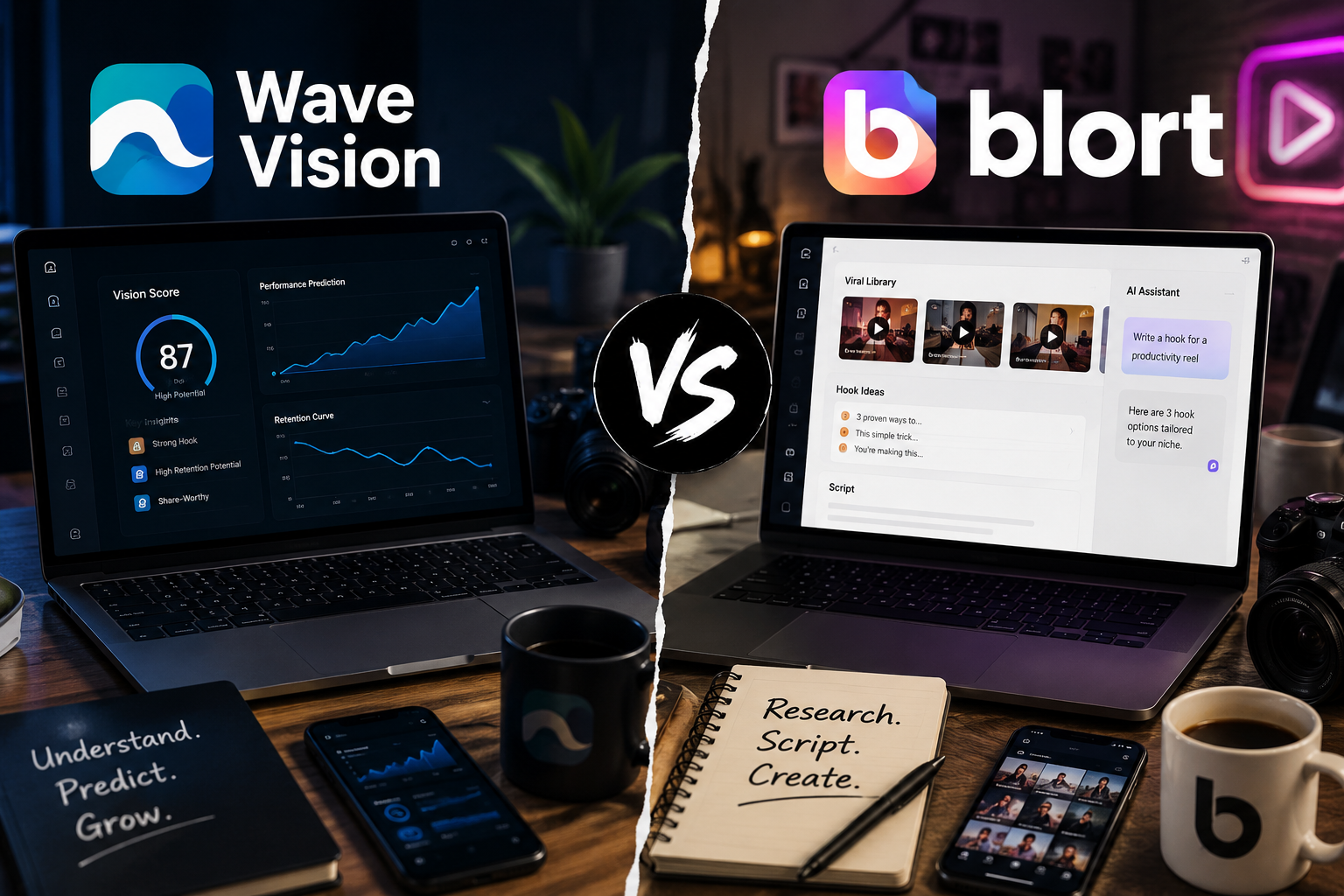
TL;DR: Wave Vision and Blort AI are two very different tools that often get compared because they both use AI for content growth. Blort AI helps you create and script content faster using competitor research and viral templates. Wave Vision tells you whether that content will actually perform before you post it. For small creators focused on growing their Instagram, TikTok, or YouTube, the right choice depends on where your biggest problem is: creating content or understanding why it's not working.
You've probably landed here because you're trying to figure out which tool is actually worth your money.
Both Wave Vision and Blort AI show up in the same conversations. Both promise to help small creators grow faster using AI. Both cost roughly the same amount per month. But they solve completely different problems, and picking the wrong one means paying for something that doesn't fix what's actually holding you back.
Here's the real issue most small creators face: they're not short on content ideas. They're short on clarity. They post consistently, try trending audio, follow all the advice, and still can't figure out why some videos get 10,000 views and others get 200. That's a data problem, not a creation problem.
This comparison breaks down exactly what each tool does, where each one wins, and which one makes more sense depending on where you are in your growth journey.
What Is Blort AI and What Does It Actually Do?
Blort AI is a content research and creation workspace built for short-form video creators. It lets you analyze any creator's top-performing posts, group their highest-performing formats, and use those patterns to script and create your own content faster.
The core of Blort is its visual whiteboard interface. You feed it competitor profiles, social posts, videos, or files, and it breaks down what made those pieces work. From there, you can generate hooks, scripts, and captions using multiple AI models (including ChatGPT, Claude, and Gemini) inside the same workspace. It's essentially a research lab that helps you stop guessing what works in your niche and start replicating proven formats.
Blort runs on a credit-based pricing model starting around $39/month, which is where some users run into friction. Reviews note that heavy users can burn through credits faster than expected, especially when generating video content. The tool is powerful for creators who produce high volumes of content and need research and scripting help at scale.
What Blort doesn't do is tell you how your specific content will perform with your specific audience. It helps you create based on what worked for other creators. That's valuable, but it's a different job than what Wave Vision does.
What Is Wave Vision and What Does It Actually Do?
Wave Vision is an AI-powered content analytics and prediction platform built for creators on Instagram, TikTok, and YouTube. Instead of helping you create content, it helps you understand which content will work before you post it, and shows you exactly why past content underperformed.
The core feature is the Vision Score: an AI-generated performance prediction that scores your content ideas and existing posts based on the signals that actually drive distribution. It pulls data from your connected accounts, identifies patterns across your top and bottom performers, and gives you specific, actionable feedback on what to change.
Where Wave Vision stands out for small creators is the cross-platform view. Most creators are posting on at least two platforms, and the patterns that work on TikTok don't always translate to Instagram Reels. Wave Vision surfaces those differences in one dashboard so you're not managing three separate analytics tools.
Pricing is $37/month with a 30-day $1 trial, which makes it accessible for creators who are still in growth mode and need to be careful with their budget.
Try Wave Vision For 30 Days For $1
What's the Core Difference Between the Two Tools?
Wave Vision and Blort AI solve problems at different stages of the content process. Blort AI is a pre-creation tool: it helps you research, script, and build content faster. Wave Vision is a post-creation and pre-publishing tool: it analyzes what you've built, predicts how it will perform, and tells you what to fix.
The simplest way to think about it: Blort helps you make more content. Wave Vision helps you make better content.
According to research from Influencer Marketing Hub, 73% of creators use third-party analytics tools specifically because they need data Instagram doesn't provide natively. The most valuable data they're missing isn't content templates — it's performance prediction. Knowing which content will hit before you commit your time to filming and editing is what separates creators who grow consistently from creators who grow randomly.
For small creators with limited time, that prediction layer is where the real leverage is.
How Do They Compare on the Features That Actually Matter?
For small creators specifically, four things matter most: price, ease of use, platform coverage, and whether the tool solves a real problem in your workflow. Here's how they stack up.
Price: Blort AI starts around $39/month on monthly plans, with a credit system that can feel restrictive if you're generating videos or images at volume. Wave Vision is $37/month flat with no credit limits on core analytics features, plus a $1 trial for the first 30 days.
Ease of use: Blort's whiteboard interface is powerful but has a steeper learning curve. It rewards creators who understand how to prompt AI tools and structure research workflows. Wave Vision is built for creators who don't want to become data analysts — the dashboard surfaces insights directly without requiring you to interpret raw numbers.
Platform coverage: Blort is primarily focused on short-form video research across TikTok and Reels. Wave Vision covers Instagram, TikTok, and YouTube in one dashboard, which matters if your content strategy spans multiple platforms.
Core value: Blort saves time on research and scripting. Wave Vision saves you from posting content that won't perform. If you've ever spent three hours filming and editing a Reel that got 200 views, you understand why predicting performance before you invest that time is worth paying for.
For a deeper breakdown of how Wave Vision compares to other analytics tools on the market, check out our best Instagram analytics tools for creators in 2026 guide.
Which Tool Should Small Creators Actually Choose?
The answer depends on which problem is actually slowing your growth right now.
If you're posting inconsistently because you run out of ideas or spend too much time scripting, Blort AI will genuinely help you. The viral library and competitor analysis features are real time-savers for creators who need to produce more content at a faster pace. AI-powered tools like Blort that help optimize hooks and timing can meaningfully improve engagement rates for creators who are already publishing regularly.
But if you're already posting consistently and still not growing, more content isn't the answer. The problem is almost certainly that you don't have clear visibility into why some posts work and others don't. You're flying blind, and posting more just means making the same mistakes faster.
That's the specific problem Wave Vision is built to fix. If you've ever wondered why one Reel got 8,000 views and the next one got 300 — using the same format, the same audio, the same posting time — that's a signal problem. The algorithm tested your content with a small initial audience, something in the early signals didn't pass the threshold, and distribution stopped. Wave Vision's analytics surface exactly which signals are failing so you can fix the right thing instead of guessing.
Most small creators who are stuck in a growth plateau are in the second group. They're not short on content. They're short on clarity about what's working. If that's you, Wave Vision solves a more urgent problem than a content creation tool does.
You can also use social media analytics to inform your broader content strategy rather than just tracking vanity metrics — which is where tools like Wave Vision genuinely separate themselves from basic dashboards.
Can You Use Both Tools Together?
Yes, and for creators who are serious about growth, combining them makes a lot of sense.
The workflow looks like this: use Blort AI to research what's working in your niche, generate scripts and hooks based on proven formats, and speed up your production process. Then use Wave Vision to score your content before publishing, track performance across platforms, and identify patterns in what's driving your best results over time.
The research and creation layer (Blort) feeds the prediction and optimization layer (Wave Vision). Each tool does one job well, and they don't overlap.
That said, if you can only afford one right now, be honest about your current bottleneck. If you have no idea why your content isn't growing, start with Wave Vision. If you already understand your performance data but struggle to produce enough content, start with Blort. Fix the most urgent problem first.
For more on understanding what drives your Instagram performance at a deeper level, the guide to predicting Instagram story views covers many of the same algorithm principles that apply to Reels performance.
Conclusion
Wave Vision and Blort AI are both legitimate tools for creators, and both do what they claim to do. The mistake is treating them as direct competitors when they actually solve different problems.
Blort AI is a content creation accelerator. It helps you research faster, script smarter, and produce more content without burning out. Wave Vision is a performance intelligence tool. It tells you what's working, what isn't, and why, so every post you publish is more likely to hit.
For small creators who want to stop guessing and start growing with data behind every decision, Wave Vision is the clearer choice. The $1 trial makes it risk-free to test. Run it against your last 30 days of content and you'll know within a week whether it's the missing piece in your growth strategy.
Start your 30-day trial for $1 at Wave Vision and see exactly what your analytics have been trying to tell you.
Frequently Asked Questions
**What is the main difference between Wave Vision and Blort AI?**Wave Vision is a predictive analytics tool that shows you how your content will perform before you post it and why past content underperformed. Blort AI is a content creation and research workspace that helps you script, generate, and repurpose content faster using competitor analysis and viral templates. They solve different problems at different stages of the content process.
**Is Wave Vision or Blort AI better for small creators on a budget?**Wave Vision starts at $37/month with a $1 trial for the first 30 days and no credit limits on core analytics features. Blort AI starts around $39/month on a credit-based system that can feel restrictive for creators generating high volumes of video content. For small creators, Wave Vision's flat pricing and trial offer make it more accessible to test without financial risk.
**Can you use Wave Vision and Blort AI at the same time?**Yes. Many creators use both tools in combination: Blort AI for content research and scripting, and Wave Vision for performance prediction and analytics. The tools complement each other because they work at different stages of the content workflow. If budget requires choosing one, identify your biggest current bottleneck first.
**Does Blort AI predict content performance like Wave Vision does?**No. Blort AI analyzes what has worked for other creators in your niche and helps you replicate those formats. Wave Vision uses predictive analytics to forecast how your specific content will perform with your specific audience before you post it. According to research on AI-powered analytics tools, the best predictive tools now forecast content performance with 70–80% accuracy.
**Which tool is better for Instagram growth specifically?**Wave Vision is purpose-built for Instagram, TikTok, and YouTube analytics with cross-platform performance tracking and a Vision Score that surfaces the specific signals Instagram's algorithm weighs most heavily, including watch time, DM shares, and originality scoring. Blort AI's research features are strong for short-form video creation broadly but don't provide platform-specific performance predictions for your own account data.
Frequently asked questions
What is the main difference between Wave Vision and Blort AI?
Wave Vision is a predictive analytics tool that shows you how your content will perform before you post it and why past content underperformed. Blort AI is a content creation and research workspace that helps you script, generate, and repurpose content faster using competitor analysis and viral templates. They solve different problems at different stages of the content process.
Is Wave Vision or Blort AI better for small creators on a budget?
Wave Vision starts at $37 per month with a $1 trial for the first 30 days and no credit limits on core analytics features. Blort AI starts around $39 per month on a credit-based system that can feel restrictive for creators generating high volumes of video content. For small creators, Wave Vision's flat pricing and trial offer make it more accessible to test without financial risk.
Can you use Wave Vision and Blort AI at the same time?
Yes. Many creators use both tools in combination: Blort AI for content research and scripting, and Wave Vision for performance prediction and analytics. The tools complement each other because they work at different stages of the content workflow. If budget requires choosing one, identify your biggest current bottleneck first.
Does Blort AI predict content performance like Wave Vision does?
No. Blort AI analyzes what has worked for other creators in your niche and helps you replicate those formats. Wave Vision uses predictive analytics to forecast how your specific content will perform with your specific audience before you post it. Research on AI-powered analytics tools shows the best predictive tools now forecast content performance with 70 to 80 percent accuracy.
Which tool is better for Instagram growth specifically?
Wave Vision is purpose-built for Instagram, TikTok, and YouTube analytics with cross-platform performance tracking and a Vision Score that surfaces the specific signals Instagram's algorithm weighs most heavily, including watch time, DM shares, and originality scoring. Blort AI's research features are strong for short-form video creation broadly but don't provide platform-specific performance predictions for your own account data.