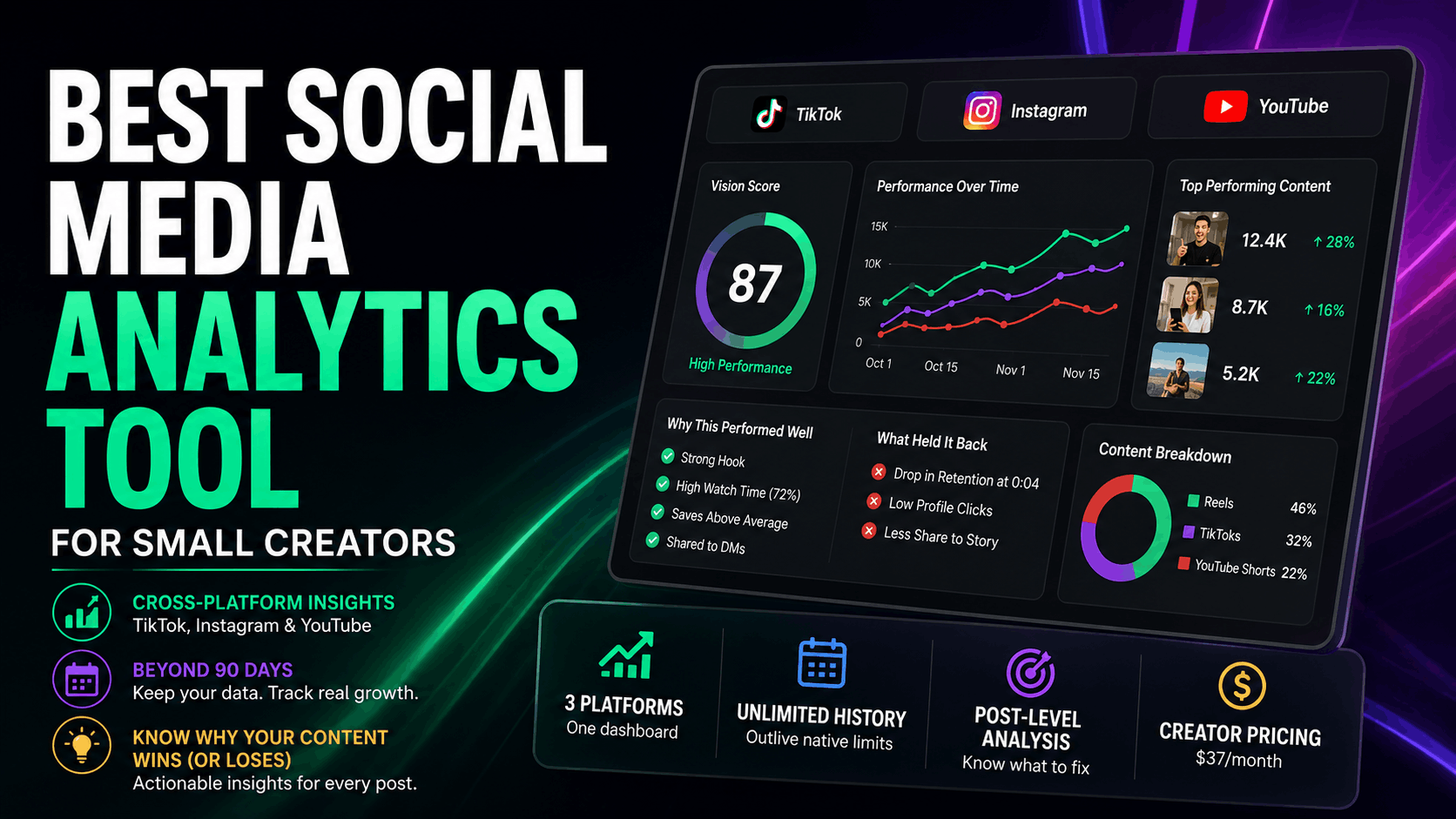
TL;DR: Most social media analytics tools are built for agencies and enterprise brands, priced at $99 to $500 per month for features small creators will never touch. What creators under 50K followers actually need is cross-platform data, history that outlives the native 90-day limit, and insight into why individual posts succeed or fail. Wave Vision covers TikTok, Instagram, and YouTube for $37/month with a $1 trial.
Search "best social media analytics tool" and you'll get a list of enterprise platforms. Sprinklr. Brandwatch. Sprout Social. Tools that monitor 100 million sources, run sentiment analysis, and tie social metrics to CRM data.
You don't need any of that. You need to know why one Reel got 12,000 views and the next one got 400.
The gap between what analytics tools sell and what small creators actually need is enormous, and it costs creators real money. Some guides even suggest that single-account creators under 10K followers should just stick with native analytics, which sounds reasonable until you hit the walls native tools have built in on purpose.
This guide covers what a social media analytics tool should actually do at your size, where the free options break down, and how to pick one without paying agency prices.
What Should a Social Media Analytics Tool Do for a Small Creator?
A social media analytics tool for small creators should do three things: show all your platforms in one place, keep your data longer than the platforms do, and explain why posts performed the way they did. Everything else, including sentiment analysis, social listening, and multi-touch attribution, is built for brands with marketing teams and ad budgets.
The distinction matters because most tools price around the features you won't use. You end up paying $99/month for a competitive benchmarking suite when what you really wanted was to understand why your engagement dropped last month.
At the creator level, the job is diagnosis. You're producing content constantly and getting inconsistent results, and you need to know which variable is responsible.
Why Aren't Native Platform Analytics Enough?
Native analytics delete your data. Instagram caps insights at 90 days and TikTok keeps only 60, so any question about seasonal patterns, year-over-year growth, or what changed six months ago is unanswerable. They also show one platform at a time, with no way to compare how the same content performed across apps.
That data expiry is the part most creators don't discover until it's too late. Instagram provides historical growth data for a maximum of 90 days with no custom date range options, and once that window passes, the data is gone. You can't export the follower graph. You can't compare this quarter to last year.
There's a second problem. Native dashboards show you numbers but not causes. Instagram Insights will tell you a Reel got 3,200 views. It won't tell you that your watch time collapsed at second four, which is why distribution stopped.
For a creator making decisions every single day about what to film next, that's the difference between improving and guessing.
What Metrics Actually Matter for Small Creators in 2026?
Follower count and likes have lost most of their weight. The signals that now determine distribution are shares (especially DM sends), saves, watch time, and profile clicks. If your analytics tool is still leading with follower growth and like counts, it's optimizing you for metrics the algorithms have already demoted.
Instagram has been unusually direct about this. Head of Instagram Adam Mosseri has publicly stated that shares are the strongest signal the platform has ever had, stronger than watch time, saves, or overall engagement rate, and that sends per reach is the metric creators should actually be tracking.
The engagement hierarchy runs roughly like this, from weakest to strongest: impression, view, like, comment, save, share to story, share to DM. A DM share is the only signal with real social cost attached, which is exactly why the algorithm weighs it so heavily.
This shift is also why so many creators feel stuck. They're producing content that gets likes and reading dashboards that celebrate likes, while distribution is being decided by a completely different set of numbers.
How Much Should a Small Creator Pay for Analytics?
Small creators should expect to pay between $0 and $40 per month for analytics. Most mid-market analytics tools land in the $49 to $100 per month range, which is priced for agencies managing client accounts, not for a solo creator tracking three of their own profiles.
Anything above that range is almost certainly selling you features designed for teams. Tools that hide pricing behind a demo call are a particularly clear signal, since that usually means enterprise contracts starting in the thousands per year.
The other thing worth watching is credit systems and per-channel pricing. A tool that looks affordable at $20/month can quietly triple once you add a second and third platform, which most creators do.
Flat pricing across your platforms is what you want at this stage.
What to Look For When Choosing a Tool
Four things separate a tool that helps small creators from one that just makes you feel productive.
Cross-platform coverage. If you post on TikTok, Instagram, and YouTube, a single-platform tool leaves you with a permanent blind spot. Hooks that work on TikTok routinely underperform on Reels, and you can only see that pattern if both are in the same view.
Data retention past the native limits. The whole point of paying for a third-party tool is escaping the 60-to-90-day memory wipe. Connect early, because most tools can only build history from the day you sign up.
Post-level diagnosis, not just dashboards. A wall of charts is not insight. You want something that tells you which specific signal failed on a specific post.
No learning curve. You're a creator, not a data analyst. If the tool requires you to interpret raw metrics and build your own conclusions, you'll stop opening it within two weeks.
Is Wave Vision a Good Fit for Small Creators?
Yes, and it was designed specifically around this problem. Wave Vision tracks TikTok, Instagram, and YouTube in one dashboard for $37/month with a $1 trial for the first 30 days, which puts it well below the typical mid-market pricing floor.
The core feature is the Vision Score, which scores your content against the signals that actually drive distribution rather than the vanity metrics native dashboards lead with. Instead of showing you that a post got 3,200 views, it identifies what in that post caused the algorithm to stop pushing it, and what to change next time.
It also runs competitor analysis and daily performance briefs, so you're not manually digging through three separate apps to figure out what happened this week.
If you want to see the output before paying anything, the free video analyzer will score a single post without an account.
Try Wave Vision For 30 Days For $1
Conclusion
The analytics market is built for enterprise buyers, which means small creators get pushed toward tools that are either too expensive or too shallow. Native analytics are free but delete your history and never explain causes. Enterprise tools explain everything but cost more per month than most creators earn from content.
What you actually need is narrow: all your platforms in one view, data that persists, and a clear answer to why a post did or didn't work. Focus on shares, saves, and watch time rather than follower count, and pick a tool priced for a creator rather than a marketing department.
Start your 30-day trial for $1 at Wave Vision and find out what your last 30 days of content have been telling you.
Frequently Asked Questions
**What is the best social media analytics tool for small creators?**The best tool for a small creator covers all the platforms you post on, retains data past the native 60-to-90-day limits, and explains why posts performed the way they did. Wave Vision covers TikTok, Instagram, and YouTube for $37/month with a $1 trial, which fits creator budgets better than mid-market tools starting near $99/month.
**Do small creators actually need a paid analytics tool?**It depends on how many platforms you're on. If you post to one platform casually, native analytics may be enough. If you post across two or more platforms, or you want to compare performance beyond the last 90 days, native tools will hit a hard wall you can't work around without exporting data manually every month.
**How long do Instagram and TikTok keep your analytics data?**Instagram retains insights for roughly 90 days and TikTok for around 60 days. After that, the data is deleted and can't be recovered, which is why creators who want long-term tracking need to connect a third-party tool early to start building history.
**What metrics should small creators track in 2026?**Shares (especially DM sends), saves, watch time, and profile clicks. Instagram has publicly confirmed shares are now its strongest ranking signal, while likes and follower count carry significantly less weight than they used to in determining distribution.
**How much should a small creator spend on social media analytics?**Between $0 and $40 per month is reasonable at the creator level. Tools priced at $99/month and above are generally built for agencies and brands managing multiple client accounts, and include features like social listening and multi-touch attribution that solo creators rarely use.
Frequently asked questions
What is the best social media analytics tool for small creators?
The best tool for a small creator covers all the platforms you post on, retains data past the native 60-to-90-day limits, and explains why posts performed the way they did. Wave Vision covers TikTok, Instagram, and YouTube for $37/month with a $1 trial, which fits creator budgets better than mid-market tools starting near $99/month.
Do small creators actually need a paid analytics tool?
It depends on how many platforms you're on. If you post to one platform casually, native analytics may be enough. If you post across two or more platforms, or you want to compare performance beyond the last 90 days, native tools will hit a hard wall you can't work around without exporting data manually every month.
How long do Instagram and TikTok keep your analytics data?
Instagram retains insights for roughly 90 days and TikTok for around 60 days. After that, the data is deleted and can't be recovered, which is why creators who want long-term tracking need to connect a third-party tool early to start building history.
What metrics should small creators track in 2026?
Shares (especially DM sends), saves, watch time, and profile clicks. Instagram has publicly confirmed shares are now its strongest ranking signal, while likes and follower count carry significantly less weight than they used to in determining distribution.
How much should a small creator spend on social media analytics?
Between $0 and $40 per month is reasonable at the creator level. Tools priced at $99/month and above are generally built for agencies and brands managing multiple client accounts, and include features like social listening and multi-touch attribution that solo creators rarely use.