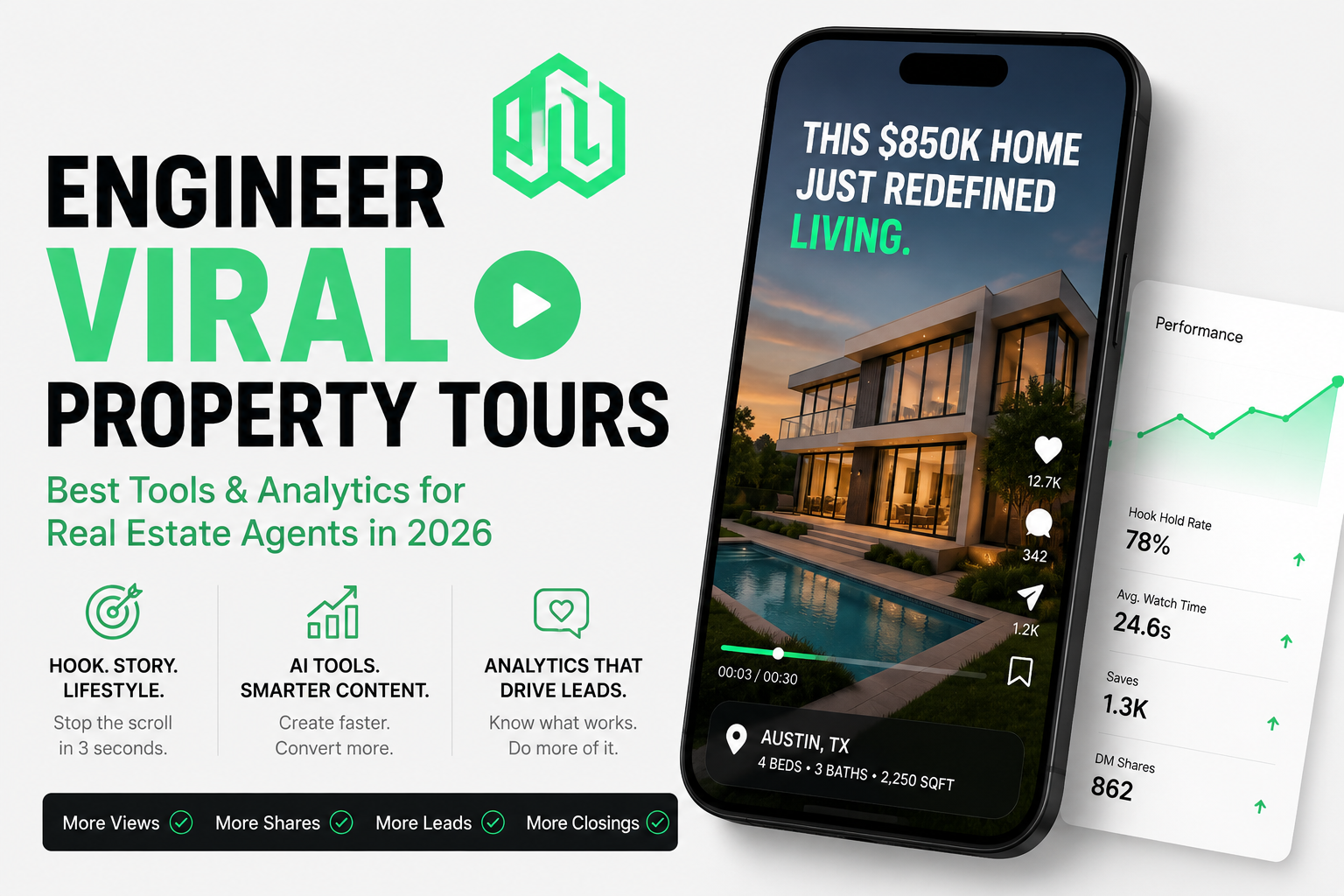
TL;DR: Most real estate agents film property tours the same way: room by room, feature by feature, ending with a price. That format doesn't work on social media. Viral property tours are engineered around lifestyle storytelling, a strong hero shot in the first three seconds, and data-driven optimization that shows you which parts of your tour hold attention and which parts lose buyers. This guide covers the exact framework, the best AI tools, and how analytics separates the agents getting leads from social from the ones getting views.
Most real estate agents know video works. Listings with video generate 403% more inquiries than listings without it, and 73% of homeowners say they're more likely to list with an agent who uses video marketing. The data has been saying the same thing for years.
And yet only 26% of agents consistently use video for every listing. The ones who do are capturing a disproportionate share of both buyer inquiries and seller listings, while the majority of agents keep posting static photos to platforms that increasingly suppress content without video entirely.
But here's the part most guides leave out: filming a property tour and engineering a viral property tour are completely different activities. A 3-minute room-by-room walkthrough posted to Instagram gets buried. A 30-second lifestyle-first short-form video built around the right hook gets shared, saved, and sent to people who are actively looking to buy.
In 2026, AI tools make it fast to create the latter. Analytics tools show you whether it's working. Here's how to combine both.
Why Do Most Property Tours Fail on Social Media?
Most property tours fail on social media because they open with the wrong thing. The agent starts with a wide shot of the exterior, announces the address and price, then walks through each room in order. By the time anything visually interesting appears on screen, the viewer has already scrolled past.
The algorithm doesn't care how beautiful the property is. The average social media user scrolls past content in under 1.7 seconds, and real estate videos with a strong hook in the first three seconds have a 65% higher completion rate than those with weak openings. The algorithm measures completion rate and skip rate to decide whether to push your tour to non-followers. If viewers skip within the first few seconds, distribution stops cold.
The second problem is that most property tours lead with specs instead of story. "4 beds, 3 baths, 2,200 square feet" is information. It's not a reason to keep watching. Buyers scrolling TikTok or Instagram aren't in spreadsheet mode. They're in discovery mode. They need to feel something before they'll engage with the details.
In 2026, luxury buyers and everyday homebuyers alike respond to narrative. The agents winning on social are selling a lifestyle, a neighborhood feeling, or a transformation — and letting the property serve as the evidence.
The Hook Framework That Stops the Scroll
The hook of a viral property tour is the single most important variable in whether your content gets distributed. Get it right and the algorithm does the rest. Get it wrong and the most beautiful property in your market sits at 200 views.
There are three hook formats that consistently outperform on TikTok and Instagram Reels for real estate content in 2026:
The hero shot open. This means showing the property's most visually striking feature in the first frame: a pool with a view, a double-height entryway, a kitchen that makes the viewer stop scrolling before they even decide to. The most successful tours show the hero shot immediately and never open with a logo or an agent introduction. The agent's name and brokerage can appear as a lower-third caption. The first second should be pure visual impact.
The curiosity gap open. This uses a text overlay or direct-to-camera line that creates a question the viewer needs to see answered. "This $650K house is making every buyer in this neighborhood rethink their budget" or "Most buyers walk past this listing. Here's what they're missing." The viewer stays because the hook created an open loop that only the rest of the video can close.
The local specificity open. This format targets people searching for specific neighborhoods or price points and consistently drives high-intent leads. "Stop scrolling if you're looking for a home under $800K in [neighborhood]" pre-qualifies your audience in the first two seconds. The viewers who keep watching are almost always actual buyers.
Real estate videos with strong hooks are 3.5 times more likely to be shared than videos with weak openings. That share behavior is the distribution signal that gets your content in front of buyers who don't already follow you.
How AI Tools Are Changing Property Tour Production
The production barrier is where most agents stall. Traditional property videography costs $300-$800 per shoot, takes days to turn around, and still requires a skilled editor to make it work on short-form platforms. That calculus doesn't work at volume, which is why most agents only produce video for premium listings and skip it for everything else.
AI tools have changed that math significantly.
Captions AI is the leading tool for agents creating talking-head social content. It handles automated editing, eye-contact correction (which makes phone-filmed content look professional), and auto-captions that display clearly for the 70% of viewers watching without sound. For agents filming quick 30-second property hooks directly to camera, it reduces editing time from 30 minutes to under 5.
CapCut handles the full short-form video editing workflow for property walkthroughs. Auto-captions, trending audio selection, template overlays, and direct export to Instagram and TikTok are all built in. The template library includes formats specifically designed for real estate content, which means you're not building each tour from scratch.
ChatGPT or Claude handles scripting. Instead of going into each shoot without a plan, prompt the AI with your property's three strongest features and your target buyer profile, then ask for five different 30-second hook scripts. The AI generates multiple angles in minutes: the lifestyle angle, the value angle, the curiosity gap angle. You pick the one that fits the property and film it.
For analytics across all your published content, Wave Vision connects to your Instagram, TikTok, and YouTube accounts and surfaces the exact signals that determine whether your property tours get distributed: hook hold rate, retention drop-off by timestamp, and DM share rate. This is the data layer most agents are completely missing. You find out that your hero shot opens hold 78% of viewers past the first three seconds, but your retention drops at second 12 when you start reading off specs. That tells you exactly what to cut and where to add more visual storytelling.
The Short-Form Property Tour Structure That Gets Shared
A viral short-form property tour follows a tight structure that takes a viewer from scroll-stop to share in under 45 seconds. Every second has a job.
Seconds 0-3: The hero shot or hook. This is non-negotiable. Show the property's strongest visual asset or deliver the hook line immediately. Do not open with your name, your brokerage, a wide shot of the street, or anything that delays the payoff.
Seconds 3-20: The lifestyle story. Don't list features. Paint the picture. "This is the kitchen you actually want to cook in" with a shot of the natural light hitting the counters. "The master suite feels like a hotel room you never have to check out of" with a slow pan across the view. The property's specs are in the caption. The video's job is to create desire, not deliver information.
Seconds 20-40: The reveal and context. Show 2-3 more strong visuals of the property, including one exterior shot if the curb appeal is strong. Add a price and location as a text overlay. Keep it brief. The viewer who needs more information will visit your profile or DM you.
Seconds 40-45: The CTA. One clear, specific action. "Link in bio for the full tour and floor plan." "Comment your budget and I'll send you five listings that fit." A question in the caption ("Would you buy this?") drives comments, which is an engagement signal the algorithm rewards.
Property videos under 60 seconds generate 2.5x more social shares than longer-form content, and vertical video performs even better on Instagram Reels and TikTok specifically. Keeping your tour under 45 seconds isn't cutting corners. It's the format that the platform rewards.
Turning One Property Tour Into a Multi-Platform Content System
The most efficient agents in 2026 don't create separate content for each platform. They film one strong walkthrough and systematically adapt it across every channel where their buyers are looking.
A single property shoot becomes: a 30-45 second Reel or TikTok with the hero shot hook for discovery, a 6-slide Instagram carousel breaking down the top features with individual photos for saves and engagement, a longer YouTube video or YouTube Short for buyers who are further along in their search and want more detail, and a caption on any of those posts that includes neighborhood-specific keywords buyers actually search.
TikTok, Instagram Reels, and YouTube Shorts each serve a different buyer intent level. TikTok reaches buyers in early discovery mode who don't know your market yet. Instagram Reels reaches buyers who are more intentional and often further along in their search. YouTube Shorts has the longest content lifespan because YouTube's search function means your tour can surface in results months after you post it.
For a deeper look at what drives Instagram's distribution algorithm for this kind of content, the guide to predicting Instagram story views covers the engagement signals that apply across Reels, property tours, and all short-form content on the platform.
What Analytics Tells You That Views Never Will
Most agents check their view count, feel good or bad about it, and move on. That's a reactive approach that doesn't improve your next tour. The agents building a genuine content system use analytics to make each tour smarter than the last.
The specific data points that matter for property tour performance:
Hook hold rate tells you whether your opening is working. If less than 50% of viewers are staying past the first three seconds, your hook is the problem — not the property, not the production quality, not the caption.
Retention drop-off timestamp tells you exactly where you're losing viewers mid-tour. A sharp drop at second 12 usually means you transitioned from visual storytelling into feature listing. A drop near the end means your CTA came too late or felt forced. The timestamp tells you what to fix.
DM share rate is the metric that predicts lead conversion better than any other. A viewer who sends your tour to someone specific is telling you they know a buyer who would want this property. That's a warm lead hiding in your analytics.
Real estate agents who use video content grow their revenue 49% faster than those who rely on static images alone. But the agents growing the fastest aren't just posting more video. They're using data to post better video, systematically improving their hook hold rate, retention, and share signals until the algorithm consistently pushes their content to new audiences.
Wave Vision surfaces all three of those signals across your Instagram, TikTok, and YouTube content in one dashboard. For agents posting across multiple platforms for multiple listings, that cross-platform view is essential. You're not auditing three separate analytics tabs trying to spot patterns manually — you're getting a clear picture of what's working across your whole content operation. Understanding how to translate those signals into a broader social media analytics strategy is what turns a content habit into a lead generation machine.
Conclusion
Engineering a viral property tour isn't about having the most beautiful listing or the biggest production budget. It's about understanding what stops a buyer from scrolling, what makes them feel something about a property before they know the specs, and what makes them share it with someone they know is looking.
The hero shot hook, the lifestyle story structure, the 45-second format, and the AI tools that cut production time from hours to minutes are all within reach of any agent with a smartphone and a willingness to test.
The missing piece for most agents is the data layer. Without knowing your hook hold rate, your retention drop-off timestamp, and your DM share rate, you're posting on instinct instead of insight.
Start your 30-day $1 trial at Wave Vision, connect your accounts, and audit your last 30 days of property content. Most agents identify their primary distribution bottleneck in the first session, and fix it before their next listing goes live.
Frequently Asked Questions
**What makes a real estate property tour go viral on TikTok or Instagram?**Viral property tours open with the property's strongest visual asset or a curiosity-gap hook in the first three seconds, tell a lifestyle story rather than listing features, and stay under 45 seconds. Real estate videos with a strong hook in the first three seconds have a 65% higher completion rate than those with weak openings, and videos that hold viewers early are 3.5 times more likely to be shared. The share signal is what triggers the algorithm to push content to non-followers.
**How long should a real estate property tour video be for social media?**For TikTok and Instagram Reels, property tours under 45 seconds consistently outperform longer formats. Property videos under 60 seconds generate 2.5x more social shares than longer-form content, and 83% of marketers say short videos should be under 60 seconds for optimal ROI. Keep the social media version tight and direct viewers to a longer full tour via a link in your bio or a YouTube video for buyers who want more detail.
**Do real estate agents actually get leads from TikTok and Instagram?**Yes, significantly. Over 52% of recent homebuyers used social media during their home search. Real estate agents like Glennda Baker have earned six figures from TikTok-generated leads, and TikTok usage among agents doubled year-over-year in 2025 as the platform's reach and search functionality started rivaling traditional listing platforms. The key is treating TikTok and Instagram as the discovery layer in a broader lead funnel rather than expecting a single viral video to close deals independently.
**What AI tools should real estate agents use to create property tour videos?**The most effective stack for agents in 2026 combines Captions AI for talking-head content with automated editing and eye-contact correction, CapCut for short-form video editing with auto-captions and trending audio, ChatGPT or Claude for scripting multiple hook variations before each shoot, and Wave Vision for analytics that show which property tours are generating hook hold rate, retention, and DM share signals strong enough to trigger wider distribution.
**How do I measure whether my property tour content is actually generating leads?**Track saves, DM shares, profile visits, and link clicks rather than views and likes. Views measure reach. Saves signal that a viewer found genuine value worth returning to. DM shares are the strongest lead indicator — a viewer who sends your property tour to someone specific is signaling a warm buying referral. Analytics tools like Wave Vision surface these signals across Instagram, TikTok, and YouTube simultaneously, giving you a cross-platform picture of which content is actually working versus just getting seen.