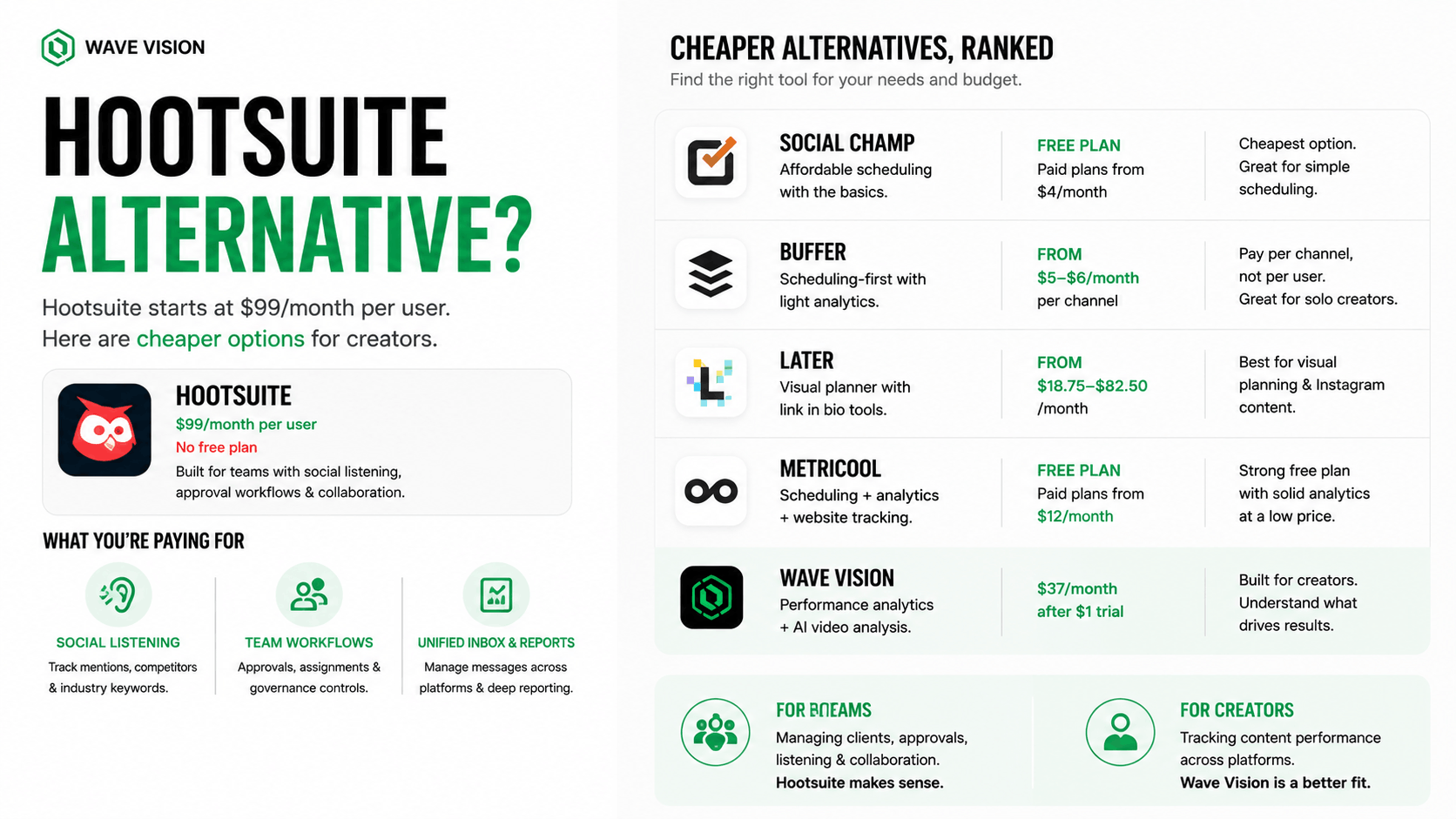
TL;DR: Hootsuite starts at $99 a month per user with no permanent free plan, and pricing is per seat, which makes it one of the more expensive options for a solo creator. Buffer, Social Champ, and Metricool all undercut it significantly on price for basic scheduling, while Wave Vision offers a cheaper, creator-focused alternative built around performance analytics rather than team scheduling. This post breaks down what Hootsuite actually costs, what you're paying for, and which cheaper alternative fits a creator's actual needs.
Why Hootsuite Is Expensive for a Solo Creator
Hootsuite removed its permanent free plan in 2023, and current pricing starts at $99 a month per user for the Standard plan, covering up to 10 social accounts, with the Advanced plan running $249 a month per user for unlimited accounts. Enterprise pricing is custom-quoted and typically runs into five figures annually for larger teams.
The per-seat structure is the part that catches solo creators off guard. Hootsuite's pricing is built around adding team members, not around how many accounts a single person manages. A solo creator paying $99 a month is paying the same seat price as a marketing coordinator on a five-person team, even though they're using a fraction of what the platform is built to do.
What You're Actually Paying For With Hootsuite
Hootsuite's higher price reflects real capability, just not capability most creators need. Its social listening tools, available on Business and Enterprise tiers, monitor brand mentions, competitor content, and industry keywords in real time, which is genuinely valuable for teams that need to know what their audience is saying about them, not just how their own posts perform.
Approval workflows, team assignments, governance controls, and a unified inbox for managing messages across platforms round out the rest of what you're paying for. These are legitimately useful features if you're coordinating a content calendar across multiple people or managing client accounts. For a solo creator posting their own content and checking their own numbers, none of that infrastructure gets used, which is exactly why reviewers consistently note the price is hard to justify for individual users who only need scheduling and basic analytics.
The Cheapest Alternatives to Hootsuite, Ranked
Here's how the budget options stack up if you're specifically looking to spend less than Hootsuite's $99-a-month entry point.
Social Champ is the cheapest true alternative, with a free plan available and paid tiers starting around $4 a month. It covers the scheduling basics well but trades away Hootsuite's deeper listening and reporting features to hit that price.
Buffer charges per channel rather than per seat, starting around $5 to $6 a month per channel, which works out far cheaper than Hootsuite for a solo creator managing two or three accounts. It's scheduling-first with lighter analytics.
Later runs $18.75 to $82.50 a month depending on tier, and leans into visual content calendar planning, which makes it a strong fit if your workflow centers on Instagram grid planning specifically.
Metricool offers a genuinely useful free tier and low-cost paid plans, covering scheduling plus broader analytics, including website traffic, at a fraction of Hootsuite's price.
Wave Vision takes a different approach from all of the above. At $37 a month after a $1 trial, it's priced well below Hootsuite's entry tier, but it isn't trying to replace Hootsuite's scheduling and team workflow features. Instead, it focuses on what a creator actually checks daily: engagement rate, completion rate, and AI-powered video feedback across TikTok, Instagram, and YouTube. If Hootsuite's core value to you was ever "seeing how my content is performing," not "coordinating a content calendar across a team," Wave Vision solves that specific problem at a lower price point.
Where Wave Vision Fits for Creators Specifically
Most of the alternatives above are trying to be a cheaper Hootsuite, meaning they still center on scheduling with analytics attached as a secondary feature. That's a reasonable trade if scheduling was the feature you actually used. But a lot of solo creators post manually anyway, in the moment, tied to trends, and were really only using Hootsuite (or considering it) for the reporting and performance side.
If that's your situation, Wave Vision is built around that exact use case: connecting your TikTok, Instagram, and YouTube accounts to show performance side by side, plus AI Video Analysis that explains what's actually driving a video's results, whether that's a weak hook or a pacing issue. We break down what that feedback actually looks like in our post on hook analysis tools for short-form video. None of the scheduling-focused alternatives above offer anything comparable on the content-feedback side, since that's simply not the problem they were built to solve.
If you're managing more than one platform and want a fuller breakdown of setting up cross-platform tracking specifically, our guide to tracking multiple social accounts in one dashboard covers that setup in more depth.
What You Give Up Going Cheaper Than Hootsuite
It's worth being honest about the tradeoff. None of the cheaper alternatives above include Hootsuite's real-time social listening or its enterprise-grade approval workflows and compliance features. If you're managing a team, coordinating with clients who need to approve posts before they go live, or specifically need to monitor brand mentions across the web, those are real gaps.
For a solo creator, though, those features were never the reason to pay $99 a month in the first place. The honest comparison isn't "which tool has every Hootsuite feature at a lower price," it's "which tool solves the specific problem I actually have," and for most creators that problem is either scheduling (covered well by Buffer, Social Champ, or Metricool) or content performance (covered by Wave Vision), not the full team-collaboration suite Hootsuite is priced around.
Conclusion
Hootsuite earns its price for teams that need social listening, approval workflows, and multi-user collaboration. For a solo creator, that's infrastructure you're paying for and not using. Whether the right move is a cheaper scheduler like Buffer or Social Champ, or a creator-focused analytics tool like Wave Vision, depends on which part of Hootsuite you actually relied on.
If scheduling wasn't the point and performance was, start your $1 trial with Wave Vision and see your TikTok, Instagram, and YouTube numbers side by side for a fraction of Hootsuite's entry price.
Frequently Asked Questions
**What is the cheapest alternative to Hootsuite?**Social Champ offers the lowest entry price with a free plan and paid tiers starting around $4 a month, followed by Buffer at roughly $5 to $6 a month per channel. Wave Vision, focused on performance analytics rather than scheduling, starts at $37 a month after a $1 trial.
**Does Hootsuite have a free plan?**No. Hootsuite removed its permanent free plan in 2023. It currently offers a 30-day free trial on paid plans, after which pricing starts at $99 a month per user for the Standard plan.
**Why is Hootsuite so expensive for solo creators?**Hootsuite prices per seat, which is built around teams adding multiple users rather than a single creator managing their own accounts. A solo creator ends up paying the same per-seat price as a team member on a larger organization's plan.
**What should I use instead of Hootsuite if I just want to track my content performance?**Creator-focused analytics tools like Wave Vision are a better fit than Hootsuite if your main need is understanding engagement rate, completion rate, and why specific videos perform differently, rather than scheduling posts across a team.
**Do cheaper Hootsuite alternatives include social listening?**Generally no. Budget scheduling alternatives like Buffer, Social Champ, and Metricool typically don't include Hootsuite's real-time social listening or brand monitoring features, which remain one of the stronger arguments for Hootsuite's higher-tier pricing if that's a genuine need.
Frequently asked questions
What is the cheapest alternative to Hootsuite?
Social Champ offers the lowest entry price with a free plan and paid tiers starting around $4 a month, followed by Buffer at roughly $5 to $6 a month per channel. Wave Vision, focused on performance analytics rather than scheduling, starts at $37 a month after a $1 trial.
Does Hootsuite have a free plan?
No. Hootsuite removed its permanent free plan in 2023. It currently offers a 30-day free trial on paid plans, after which pricing starts at $99 a month per user for the Standard plan.
Why is Hootsuite so expensive for solo creators?
Hootsuite prices per seat, which is built around teams adding multiple users rather than a single creator managing their own accounts. A solo creator ends up paying the same per-seat price as a team member on a larger organization's plan.
What should I use instead of Hootsuite if I just want to track my content performance?
Creator-focused analytics tools like Wave Vision are a better fit than Hootsuite if your main need is understanding engagement rate, completion rate, and why specific videos perform differently, rather than scheduling posts across a team.
Do cheaper Hootsuite alternatives include social listening?
Generally no. Budget scheduling alternatives like Buffer, Social Champ, and Metricool typically don't include Hootsuite's real-time social listening or brand monitoring features, which remain one of the stronger arguments for Hootsuite's higher-tier pricing if that's a genuine need.