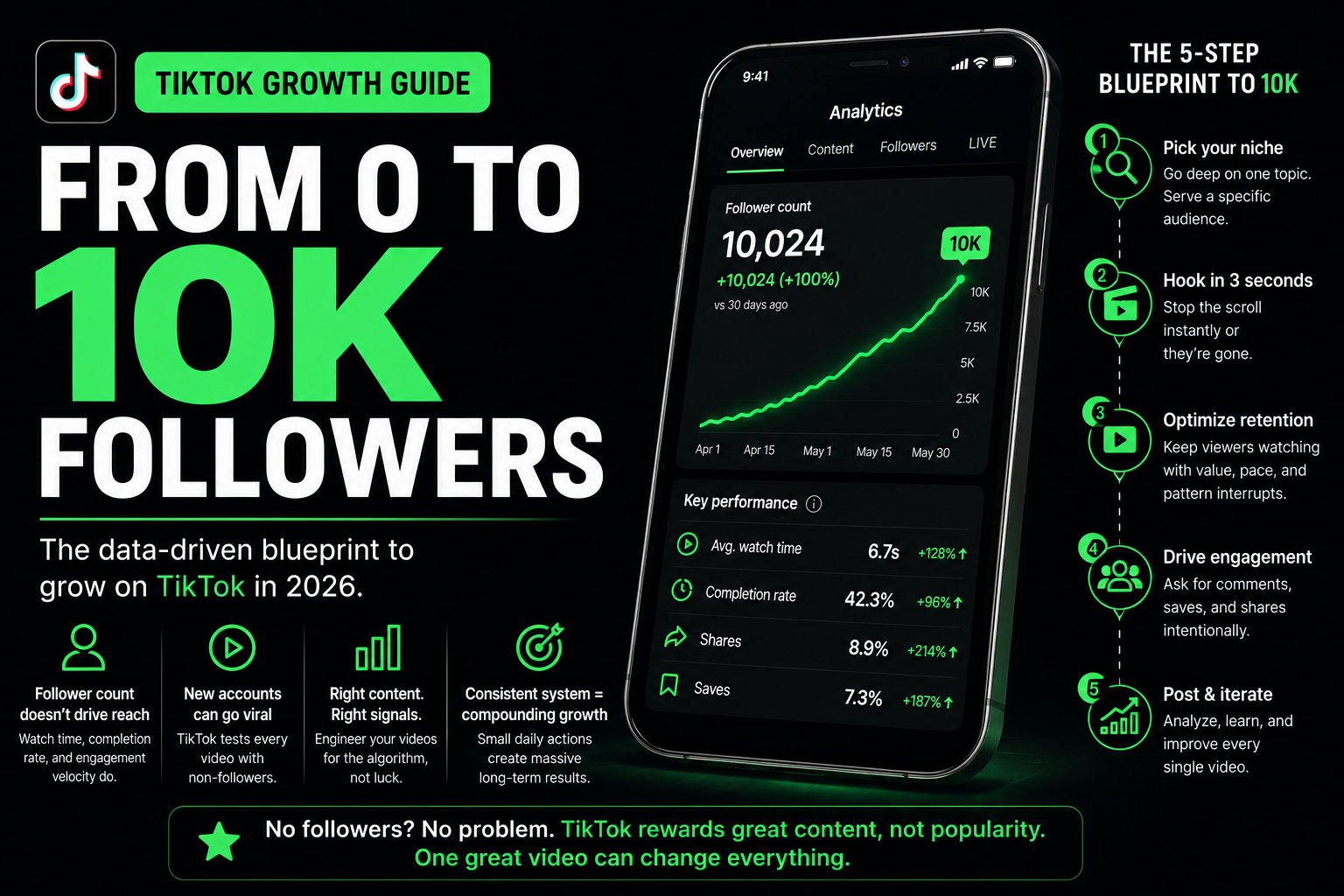
TL;DR: Growing from 0 to 10K followers on TikTok in 2026 is more achievable than most people think — but not for the reasons most guides tell you. Follower count has almost nothing to do with how far your content travels. TikTok's algorithm distributes content based on watch time, completion rate, and engagement velocity, which means a brand-new account with zero followers can reach thousands of people on the very first video. This guide covers the exact signals the algorithm rewards, the content structure that earns them, and the data-driven habits that turn early views into a compounding follower base.
Starting a TikTok account from zero feels like shouting into a void. No followers, no momentum, no algorithm history working in your favor. Most creators post five or six videos, get a few hundred views, and assume TikTok isn't for them.
Here's what they're missing: TikTok's FYP shows 70 to 80% content from accounts you don't follow. The platform was built for discovery. A brand-new account with zero followers can reach millions if the content passes the right signal tests. You don't need an existing audience to grow — you need to understand what the algorithm is measuring and engineer your content around it.
This guide covers exactly how to do that, from your first post to your 10,000th follower.
Why TikTok Is Still the Fastest Platform to Grow From Zero
TikTok is the fastest platform to grow from zero because it's the only major social platform where follower count is functionally irrelevant to individual video distribution. The TikTok algorithm in 2026 no longer uses follower count as a primary signal for reach. It uses behavior: watch time, completion rate, shares, and saves. This means a video from a zero-follower account competes on the exact same terms as a video from a million-follower account.
There's actually an advantage to starting with zero followers that most guides don't mention. In 2026, TikTok tests videos with existing followers first — but if you have zero followers, it skips that step entirely. Your video immediately goes to a small test audience of non-followers with similar interests. If they engage, distribution expands. You bypass the follower testing phase that can suppress reach for accounts with large but disengaged audiences.
TikTok has over 1.8 billion monthly active users, and the platform added 180 million more since the Oracle ownership transition closed. The audience is there. The algorithm is built to surface new content. The question is whether your content passes the early signal tests that trigger distribution.
How TikTok's Algorithm Actually Decides Who Sees Your Content
When you post a video, TikTok shows it to a small initial test group of 100 to 500 people based on your hashtags, captions, and content analysis. The algorithm measures specific engagement signals from this group in real time. If the signals pass the threshold, distribution expands to a larger audience. If they don't, the video plateaus.
The estimated signal weight hierarchy for TikTok's algorithm in 2026 puts completion rate and watch time at 40 to 50% of the total ranking weight. Rewatch rate comes second. Shares and saves follow. Likes are weighted significantly lower than most creators assume.
This has a direct implication for how you structure every video. Your primary job in the first three seconds is to prevent someone from scrolling past. Your job in the middle of the video is to keep them watching. Your job at the end is to make them want to watch it again or send it to someone. Every structural decision you make should be measured against whether it improves one of those three outcomes.
The TikTok algorithm in 2026 also prioritizes community-aligned content over random viral hits. Niche relevance matters more than broad appeal. A video that deeply resonates with 500 people in a specific niche will consistently outperform a vague video that gets passive views from millions. This is the principle that makes growing from zero faster for creators who pick one specific topic and go deep rather than covering everything broadly.
Step 1: Set Up Your Account for Discovery From Day One
Before you post a single video, three account-level decisions significantly affect how the algorithm categorizes your content from the start.
Choose a niche and commit to it. TikTok learns what your account is about by analyzing patterns across all your videos. An account that posts consistently about one topic gets categorized accurately and shown to people who are interested in that topic. An account that posts across multiple unrelated topics takes much longer to categorize and gets shown to less-targeted audiences. One mistake beginners consistently make is posting random content across too many categories. Pick your niche before your first video and hold it for at least your first 30 posts.
Optimize your bio for search. TikTok Search has become a significant content discovery channel in 2026. Your bio appears in search results and should include the specific keywords your target audience searches for. If you create content about social media growth, your bio should include those words literally — not clever phrases that avoid saying what you do.
Connect to your other platforms. A link in bio pointing to your website or other social accounts means every follower you gain on TikTok has a path to your broader ecosystem. For creators and entrepreneurs, this conversion path is what makes TikTok followers worth more than just a number.
Step 2: Master the Hook in the First Three Seconds
Growing from zero to 10K on TikTok starts and ends with what happens in the first three seconds of every video. 71% of TikTok users decide whether to continue watching within the first three seconds. If you lose them there, the algorithm records a skip and reduces distribution. If you hold them, the distribution waterfall opens.
There are four hook formats that consistently produce strong two-second retention in 2026:
The specific pain hook. Name a problem your viewer has right now, as specifically as possible. "If your TikTok views stopped at 300 for the last five videos" is more powerful than "struggling to grow on TikTok" because specificity makes the viewer feel like you're talking directly to them.
The curiosity gap hook. Make a statement that creates an open loop the viewer needs to close. "This is the mistake that's killing your reach even if your content is good" works because the viewer needs to know what the mistake is. The open loop keeps them watching.
The pattern interrupt hook. Start with something visually unexpected, an unusual camera angle, a surprising visual, or immediate movement that breaks the rhythm of a standard scroll. The brain notices pattern breaks automatically and pauses before the conscious decision to scroll happens.
The bold claim hook. Make a specific, counterintuitive claim in the opening line. "Posting more often is making your account grow slower" stops scrollers because it contradicts what they've been told. The impulse to find out if it's true generates watch time.
The fastest way to improve your hook rate is to write ten different hook options for every video concept and pick the strongest one rather than going with your first idea. Testing different hooks and formats consistently outperforms trying to perfect a single version. This one habit alone separates creators who plateau early from ones who hit 10K and keep going.
Step 3: Structure Every Video to Maximize Completion Rate
Completion rate is the single most predictive metric for whether a TikTok video gets pushed to broader audiences. A video with 80% completion from a 200-person test group will reach more people than a video with 20% completion from a 2,000-person group. The algorithm rewards retention, not reach.
The structure that consistently produces high completion rates on TikTok follows a simple pattern: hook that stops the scroll, open loop that creates tension, value delivery that resolves the tension, and a close that either prompts a rewatch or gives a clear next step.
The open loop is the most underused structural tool for new TikTok creators. Set up a question or promise early in the video that only gets resolved near the end. "I'll show you exactly what changed when I fixed this" creates forward momentum that pulls viewers through the middle of the video where most drop-offs happen. The viewer stays because they need the resolution.
Shorter videos with higher completion rates consistently outperform longer videos with lower completion rates on TikTok's distribution algorithm. For creators building from zero, starting with videos between 15 and 30 seconds is the fastest path to strong early completion data. As your account builds signal history, longer formats become viable. But in the early stages, every extra second is an opportunity for someone to leave before the algorithm registers a completion.
Step 4: Use TikTok SEO to Get Found Through Search
One of the most underused growth levers on TikTok in 2026 is Search. TikTok has evolved from a pure discovery platform into a significant search engine, especially for Gen Z audiences who use it to find answers the same way earlier generations used Google.
Video information like captions, hashtags, and sounds help TikTok categorize and recommend your content. Optimizing for search with relevant keywords in your captions increases your chances of being discovered by people actively looking for what you create. This is especially powerful for niche content — a video titled and captioned for a specific search query can surface in results for months after it's posted.
Use 3 to 5 targeted hashtags that are specific to your niche rather than broad viral hashtags. A hashtag like #instagramgrowth reaches a more relevant audience than #viral, even though #viral has more total posts. Relevance drives completion rate. Completion rate drives distribution.
Speak your keywords out loud in the video. TikTok's automatic captions now influence content categorization, which means the words you say contribute to how the algorithm classifies your video and which searches it surfaces in. If your video is about hook rate, say "hook rate" clearly in the first 15 seconds.
For tracking how your TikTok content performs across the key metrics that predict growth, the complete guide to analyzing social media performance covers the specific signals to watch as you build your account from zero.
Step 5: Post Consistently and Analyze What's Working
Consistency on TikTok does two things. It builds signal history that helps the algorithm categorize your account accurately. And it gives you more data points for understanding which content earns distribution and which doesn't.
Research shows that moving from one post per week to two to five posts per week leads to a strong lift in views per post. For creators building from zero, three to five videos per week is the right pace — enough to generate data quickly without sacrificing quality on each individual post.
Batch your filming sessions. Filming three or four videos in a single session keeps you in context and cuts your per-video production time in half. Use TikTok's native scheduling tool to space them out at your optimal posting times rather than publishing everything on the same day.
After every 10 videos, analyze patterns in your TikTok Analytics. You're looking for two things: which videos had the highest completion rate, and which had the highest share rate. Those two signals predict what the algorithm will distribute more broadly. Content that earns both high completion and high shares is the template for your next ten videos.
Wave Vision tracks these signals across your TikTok account alongside your Instagram and YouTube data in one dashboard, making it easier to spot patterns across your full content history without auditing each video manually. Understanding which hook formats, topics, and lengths produce the strongest completion and share data tells you exactly what to create more of.
The Realistic Timeline From 0 to 10K
Most guides on TikTok growth either wildly overstate how fast it happens or ignore the timeline question entirely. Here's a realistic breakdown based on how the algorithm actually works.
Weeks 1 to 4: You're building signal history. The algorithm is learning what your account is about. Most videos in this period will reach 200 to 500 people. This is normal and not a sign the strategy isn't working. Your job in this phase is to post consistently, test different hooks, and study your completion rate data.
Weeks 5 to 8: If your completion rates are strong, the algorithm starts expanding distribution. Videos that would have plateaued at 500 views in week two start hitting 1,000 to 5,000. You may get your first breakout video in this window. Follower growth accelerates as more people discover your content through the FYP.
Weeks 9 to 16: With consistent posting and improving signal data, reaching 10K becomes a matter of when, not if. Accounts that post three to five times per week in a defined niche with strong hook hold rates and solid completion typically cross 10K in this window. The ideal engagement rate for accounts building from zero is 7 to 10%, meaning if 1,000 people see your video, you want 70 to 100 meaningful interactions.
The variable that most affects this timeline isn't talent or luck. It's how quickly you identify and fix the signals that are holding your distribution back. For a deeper look at how those signals connect to the same algorithm mechanics that apply across Instagram and YouTube, the guide to why your Reels are flatlining covers the structural patterns that apply across all short-form platforms.
The Habits That Separate Accounts That Hit 10K From Ones That Don't
Most creators who don't reach 10K aren't failing because their content is bad. They're failing because they're not tracking the right things and adjusting quickly enough when something isn't working.
The specific habits that consistently separate growing accounts from plateauing ones are: reviewing completion rate after every video rather than just checking view counts, writing multiple hook options before filming rather than going with the first idea, posting in the same niche consistently rather than chasing unrelated trends, and treating the first 30 posts as a testing and learning phase rather than expecting every video to perform immediately.
Tracking performance with analytics and adjusting your strategy based on data is what separates consistent growth from one-off wins. Every creator who hits 10K did it by finding a formula that works and then repeating it deliberately. The formula is different for every niche and every creator, but the process of finding it is always the same: post, measure, adjust, repeat.
Wave Vision's $1 trial gives you the cross-platform analytics to run that process across your TikTok, Instagram, and YouTube accounts simultaneously. Connect your accounts and start identifying which content signals are driving your growth and which ones are holding it back.
Conclusion
Getting from 0 to 10K on TikTok in 2026 is not about finding the right viral trick, posting at some secret optimal time, or gaming the algorithm with hacks. It's about understanding what the algorithm actually measures — completion rate, watch time, shares, and saves — and engineering your content to earn those signals consistently.
Start with a defined niche. Write better hooks than your first instinct. Structure every video to maximize completion. Use TikTok Search to get found over time. Post consistently and track what's working. And adjust fast when something isn't.
The algorithm gives every account, even brand-new ones with zero followers, a genuine shot at reaching the right audience. The creators who reach 10K fastest are the ones who learn the fastest. Data makes that learning faster.
Frequently Asked Questions
**How long does it take to get 10K followers on TikTok from zero?**With consistent posting of three to five videos per week in a defined niche, most creators with strong completion rates and hook hold rates reach 10K followers within 9 to 16 weeks. The timeline depends primarily on how quickly you identify and improve the signals the algorithm weights most heavily: completion rate, watch time, and share rate. Accounts that test multiple hook formats early and adjust based on analytics data consistently reach 10K faster than those who post without analyzing performance patterns.
**Does TikTok favor new accounts?**In a specific way, yes. TikTok tests videos with existing followers first before expanding distribution — but if you have zero followers, it skips that step. Your video immediately shows to a small test audience of non-followers with similar interests. This means a new account with strong content can actually reach new audiences faster than an established account with a large but disengaged follower base, because it bypasses the follower engagement test entirely.
**How many times per week should I post on TikTok to grow to 10K?**Research shows that posting three to five times per week produces the best balance of growth and content quality for creators building from zero. Fewer than three posts per week slows down signal accumulation and makes it harder for the algorithm to categorize your account. More than seven posts per week often leads to declining quality and lower completion rates on individual videos. Three to five high-quality videos per week, batched in filming sessions and scheduled strategically, is the sustainable pace that compounds fastest.
**What is the most important metric to track when growing a TikTok from zero?**Completion rate is the most important metric for new TikTok accounts. The algorithm weights completion rate and watch time at an estimated 40 to 50% of its total ranking signal. A high completion rate from a small test group triggers wider distribution. Likes and follower count are secondary signals. When auditing your early content, look specifically at which videos had the highest completion rate and study what those videos had in common — hook format, length, topic, pacing — and replicate those patterns.
**Can you really go viral on TikTok with zero followers?**Yes. Because TikTok's FYP shows 70 to 80% content from accounts you don't follow, every video has a chance to reach non-followers regardless of how many followers the creator has. A brand-new account with zero followers can reach millions if the video passes the algorithm's early signal tests. The algorithm does not use follower count as a primary distribution signal in 2026. It uses watch time, completion rate, shares, and saves — all of which are available to a first-time creator posting their debut video.