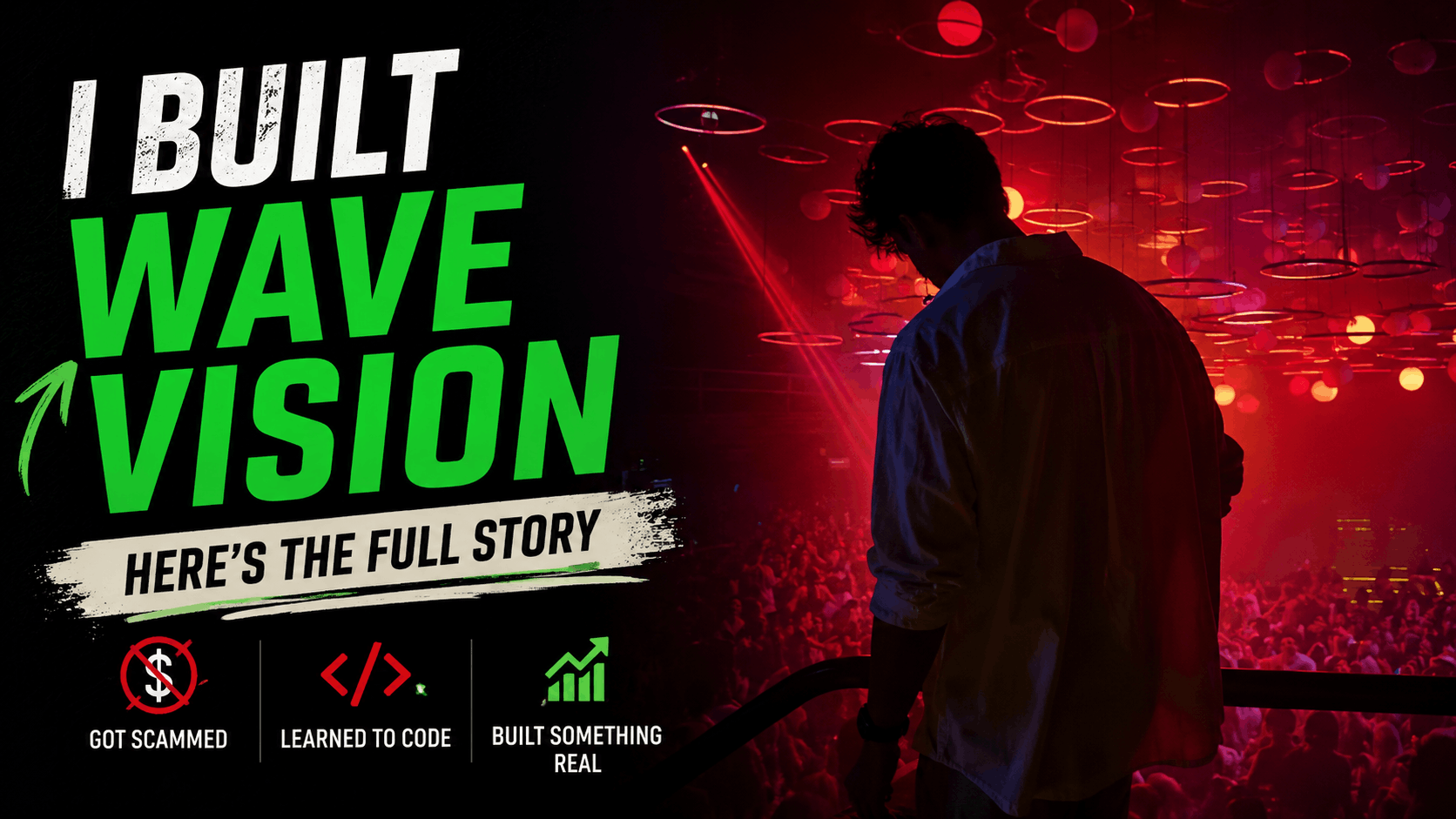
TL;DR: Wave Vision is an AI-powered social media analytics platform that predicts whether your content will perform before you post it. I built it myself after getting scammed by a developer, teaching myself to code from scratch, and spending six months manually analyzing over 10,000 viral videos. This is the full story of how it got built, what went wrong, and why I'm still building it.
Most people who build software have a computer science degree, a co-founder, or at least a few years of coding experience. I had none of those things when I started building Wave Vision.
What I had was a problem I couldn't stop thinking about. I'd spent serious money on content that got 200 views. I'd watched videos I knew were weaker than mine get millions. I'd tried every piece of advice on the internet about posting times, hashtags, trending audio — and still couldn't reliably predict which content was going to land. After generating over 100 million views across platforms and running a creative agency, I knew the difference between content that worked and content that didn't. What I couldn't do was explain it systematically.
That gap between gut feel and data is what Wave Vision is built to close.
The Problem I Couldn't Ignore
Before Wave Vision existed, I ran a creative agency. We were doing around $50,000 in revenue, working with brands on content strategy and production. I knew how to make things go viral. I'd grown Instagram theme pages to 100,000 followers in high school. I understood hooks, formats, pacing, and what made people stop scrolling.
But I couldn't bottle it. Every time a client asked me to explain why a certain video would perform, I was working off instinct and pattern recognition, not data. And the tools that existed — native platform analytics, basic scheduling dashboards — only told you what happened after you posted. Nobody was telling creators what would happen before they posted.
That asymmetry bothered me. The data existed. The patterns were real and repeatable. Someone just needed to build the tool that surfaced them.
Getting Scammed and Deciding to Build It Myself
I didn't start Wave Vision intending to code it myself. My first move was the obvious one: hire a developer.
That decision cost me. The developer took my money, delivered almost nothing useful, and disappeared. I was out the investment with nothing to show for it except a hard lesson about trusting the wrong person with something I cared about.
Most people would have stopped there. Found a different developer, or moved on entirely.
Instead I got angry in a productive way. If I couldn't trust someone else to build what I needed, I was going to learn to build it myself. I started learning to code from scratch, documenting the process on TikTok while working as a wildland firefighter during the summers. The firefighting gave me long stretches of time between shifts to study. The TikTok documentation kept me accountable. The combination of those two things, building in public while literally working in the mountains, became part of the story that eventually helped Wave Vision find its first users.
According to Stripe's 2024 Indie Founder Report, over 44% of profitable SaaS businesses are now run by solo founders, many of whom taught themselves to code the same way I did: by building something real and figuring it out as problems appeared.
The Six Months of Manual Research Nobody Talks About
Before I wrote a single line of production code for Wave Vision, I spent six months doing something nobody tells you to do: I manually analyzed over 10,000 viral videos.
I watched them frame by frame. I tracked hook types, visual composition, pacing patterns, emotional triggers, and the structural differences between videos that hit 1 million views and videos that hit 1,000. I built spreadsheets. I identified patterns. I developed a scoring framework based on what I was seeing consistently in content that spread.
Then I tested it on my own content. Videos that scored 9 or 10 on my framework averaged 2.3 million views. Videos that scored 3 or below averaged around 800 views. The correlation wasn't perfect, but it was real and consistent enough that I knew I was onto something.
That manual research became the foundation of Wave Vision's AI. The patterns I identified by hand are the same patterns the model was trained to detect. The Vision Score, Wave Vision's core feature that predicts content performance before you post, is built on that data.
Building the Product as a Full-Time Student
I was studying Information Systems and Business at Cal Poly SLO while building Wave Vision. That meant I was writing code between classes, debugging late at night, and shipping features during the same weeks I was studying for exams.
The technical stack came together piece by piece. React and TypeScript on the frontend. FastAPI on the backend. Supabase for the database. Railway and Vercel for deployment. Each piece was chosen because it let me move fast without a team.
The hardest parts weren't the algorithms. They were the infrastructure problems that only show up when real users are in the product. Stripe billing edge cases that caused silent failures. Webhook gaps that let cancelled users keep accessing the platform. Cancellation flows that didn't work the way they were supposed to. Every one of those bugs was a lesson in how different "working in development" is from "working in production with paying customers."
I fixed each one as it appeared. That iterative process, build, break, fix, improve, is still how Wave Vision gets better every week.
What Wave Vision Actually Does
Wave Vision is an AI-powered content analytics platform built for creators on Instagram, TikTok, and YouTube. It connects to your social accounts and does two things that native platform analytics don't: it predicts how content will perform before you post it, and it surfaces the specific signals that explain why past content underperformed.
The Vision Score is the core feature. It analyzes your content idea or draft against the patterns the AI has learned from thousands of high-performing and low-performing videos, then gives you a score and specific feedback on what's working and what needs to change before you hit publish. Instead of posting and hoping, you post with data.
The analytics dashboard covers the metrics that actually predict growth: hook hold rate, retention drop-off by timestamp, DM share rate, and reach-to-follower ratio. These are the numbers the algorithm uses to decide whether to distribute your content beyond your existing audience. Most creators have never seen them clearly laid out in one place.
Wave Vision launched on September 30, 2025. It's priced at $37 per month with a 30-day $1 trial so creators can test it against their real content before committing.
For more on the specific metrics Wave Vision surfaces and why they matter for growth, the guide to predicting Instagram story views covers the signal framework in detail.
The Moment I Knew It Was Worth Building
There's a specific moment when a side project stops feeling like a project and starts feeling like a company. For me it happened when I ran my own content through the system and the predictions matched reality with a consistency that couldn't be explained by luck.
I had nine videos that scored high on the Vision Score framework. They averaged 2.3 million views. I had three that scored low. They averaged 800 views. That gap wasn't a coincidence. It was evidence that the patterns I'd spent six months documenting manually were real, and that the AI was learning to detect them reliably.
That moment changed everything. It meant the tool wasn't just useful for me. It was useful for any creator who was tired of guessing which content would work and which wouldn't. It meant there was a real product here, not just a personal tool I'd built to solve my own problem.
Solo founders who build tools to solve their own real problems consistently outperform those who build for hypothetical users. Nathan Barry built ConvertKit because he understood creators' frustrations with email tools firsthand. I built Wave Vision because I'd lived the frustration of posting content blind for years. That proximity to the problem is the unfair advantage that a well-funded team without the experience can't replicate.
What's Next
Wave Vision is a live product with paying users, a roadmap of features already in development, and a content strategy now built around the same SEO and analytics principles that the product teaches. The goal is $30,000 MRR by graduation.
Getting there means continuing to do what the first months of building taught me: ship fast, listen to users, fix what breaks, and keep the feedback loop tight. The product gets better every week because of what real users show me about what they need.
If you're a creator who's tired of posting and hoping, Wave Vision's $1 trial is the fastest way to see whether your content data tells a different story than you think it does.
And if you're a founder thinking about building something yourself after getting burned by a developer or a broken tool, the lesson from my experience is straightforward: the fastest path to a product you trust is often the one where you build it yourself, one problem at a time.
Frequently Asked Questions
**Who built Wave Vision?**Wave Vision was built by Spencer Karlson, a 21-year-old Information Systems and Business student at Cal Poly SLO. Spencer taught himself to code after being scammed by a developer he hired to build the original version. He spent six months manually analyzing over 10,000 viral videos before writing the first line of production code, using that research to train the AI that powers Wave Vision's Vision Score feature.
**What problem does Wave Vision solve for creators?**Wave Vision solves the prediction gap in content creation: most analytics tools only tell you what happened after you posted. Wave Vision tells you what's likely to happen before you post, using an AI trained on thousands of viral and low-performing videos to score your content and surface the specific signals that determine whether the algorithm will distribute it widely or suppress it.
**When did Wave Vision launch?**Wave Vision launched on September 30, 2025. It's built on a React and TypeScript frontend, FastAPI backend, Supabase database, and is deployed on Railway and Vercel. It connects to Instagram, TikTok, and YouTube accounts and is priced at $37 per month with a $1 trial for the first 30 days.
**What is the Vision Score?**The Vision Score is Wave Vision's core AI feature. It analyzes a content idea or draft against patterns the AI has learned from thousands of high-performing and low-performing videos and produces a score with specific feedback on what's working and what to change before publishing. Spencer's own testing showed that videos scoring in the top range averaged 2.3 million views, while low-scoring videos averaged around 800 views.
**How is Wave Vision different from native platform analytics like Instagram Insights?**Native platform analytics show you what happened after you posted: views, likes, and basic reach data. Wave Vision surfaces the metrics that actually predict whether your content will get algorithmically distributed, including hook hold rate, retention drop-off by timestamp, DM share rate, and Vision Score predictions before publishing. It also covers Instagram, TikTok, and YouTube in one cross-platform dashboard instead of requiring you to check three separate tools.