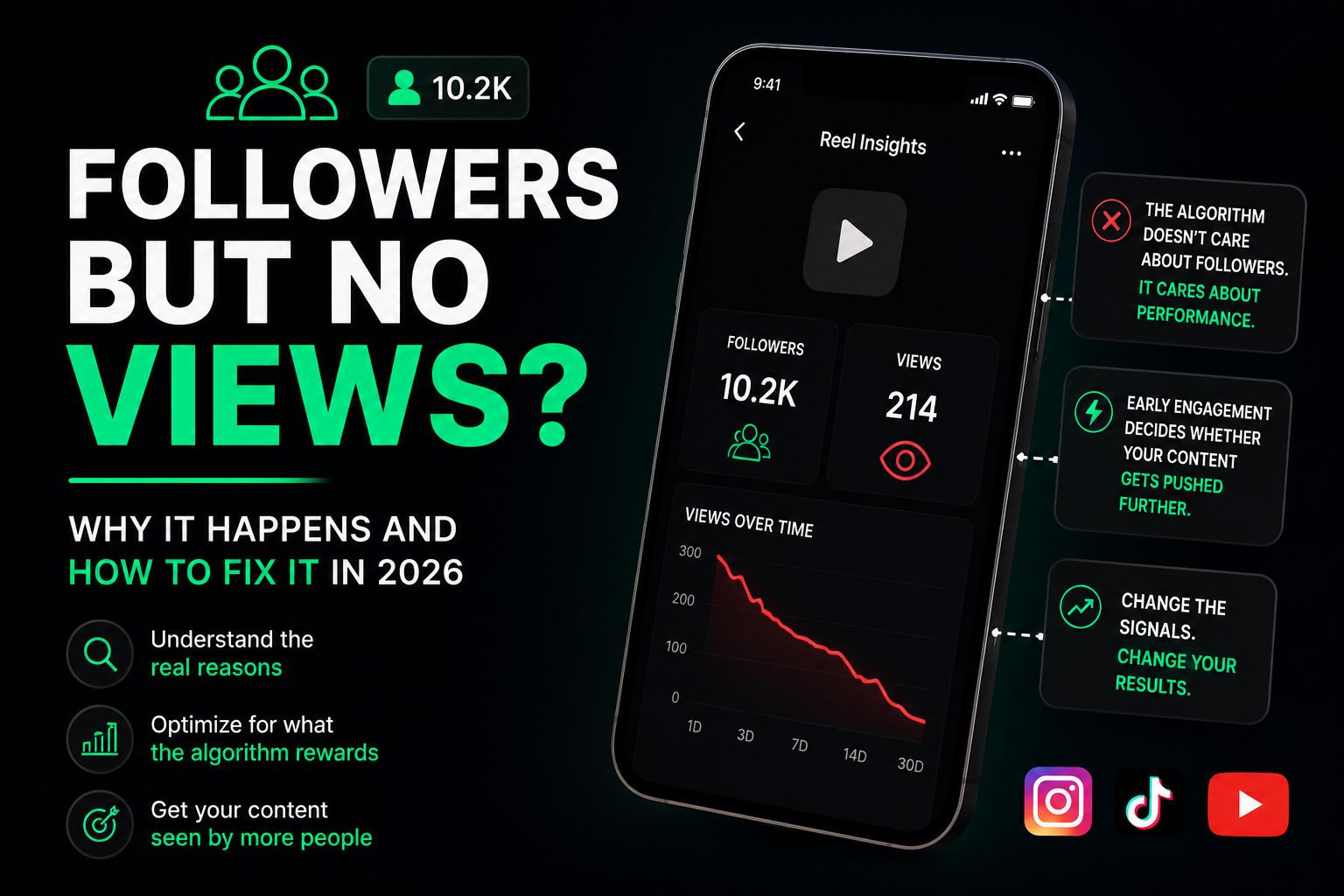
TL;DR: Having followers but no views isn't a glitch. It's the algorithm telling you something specific: your content isn't passing the early signal test it needs to earn wider distribution. In 2026, follower count is almost irrelevant to how far your content travels. What matters is engagement velocity, watch time, and content signals in the first hour after posting. This guide explains why the disconnect happens and exactly what to change.
You built the audience. You did the work. You hit 5,000 followers, or 10,000, or even 50,000. And now you're posting to what feels like an empty room.
The views don't match the follower count. Your content reaches maybe 200 people on a good day, and most of them are already following you. New audiences aren't finding you. You're not growing. And the number sitting on your profile feels completely disconnected from your actual reach.
This isn't a bug, and it isn't Instagram or TikTok personally suppressing your account. It's the result of a fundamental shift in how every major platform distributes content in 2026, and once you understand the mechanism, the fix becomes much clearer.
Why Followers No Longer Guarantee Views
Followers no longer guarantee views because social media platforms have shifted from social graph distribution to interest graph distribution. In the old model, your followers were your audience. The platform showed your content to people who followed you. In the current model, your followers are just a testing sample. The platform shows your content to a slice of them first, measures how they respond, and then decides whether to push it further based on those early signals.
All major platforms have moved from follow-graph ranking to interest-graph recommendation. Your followers no longer guarantee reach. The content itself has to earn distribution through watch time, engagement velocity, and content signal matching. A creator with 5,000 followers and consistent high engagement will out-reach an account with 500,000 followers and low engagement almost every time.
Follower count is functionally irrelevant to individual video reach on TikTok. Every video is evaluated cold against a small test audience, then progressively expanded if performance signals clear each threshold. On Instagram, the dynamic is similar. Instagram operates on a hybrid model that uses follower relationships as a starting mechanism, but behavioral modeling drives large-scale discovery. Your followers get you in the door. Your content quality determines how far you actually travel.
This is why the follower count on your profile can look impressive while your actual reach per post feels invisible. The two numbers measure completely different things in 2026.
The Distribution Waterfall: How Reach Actually Works Now
When you post a video, the algorithm doesn't show it to all your followers at once. It uses a staged process that marketers call the distribution waterfall, and understanding how it works explains exactly why the followers-but-no-views problem happens.
When you hit publish, the AI drops your content into a seed group: a small pool of roughly 100 to 500 people who share a hyper-specific interest. Your own followers make up most of this initial group. If that seed group watches past the first few seconds, saves it, or shares it, the waterfall opens up to the next level: similar interest groups beyond your followers. If they scroll past, distribution stops immediately.
Content performance now depends less on follower count and more on engagement velocity within the first 30 to 60 minutes of posting. A post that earns saves and shares in the first hour gets pushed to wider audiences. A post that lands in silence stays inside your follower bubble, or reaches even fewer people than that.
The cruel irony is that a large but disengaged follower base actually works against you. When engagement is disproportionately low relative to follower count, the algorithm may interpret content as less relevant and reduce distribution below what a smaller but more engaged account would receive. You built the audience, but if they don't engage, they become a liability in the algorithm's model rather than an asset.
Why Your Followers Might Not Be Engaging
Understanding why your followers aren't engaging is as important as understanding the algorithm. There are three common reasons, and each has a different fix.
Audience mismatch from early growth. How you acquired your followers matters enormously. If you grew through viral content that had nothing to do with your current niche, through follow-for-follow tactics, or through giveaways and promotions, your follower base may not actually be interested in what you normally post. They followed for something specific, that thing isn't showing up anymore, and now they scroll past. The biggest 2026 shift is from network-based distribution to interest-based distribution, which means a mismatched audience punishes you more than it ever did before.
Inactive followers dragging down your metrics. Every account accumulates inactive followers over time, bots, ghost accounts, people who haven't opened the app in months. These inactive followers increase your total audience count without contributing engagement. When the algorithm tests your content with a seed group that includes a high percentage of inactive accounts, the engagement rate looks terrible even if your genuinely active followers liked it. The ratio is what the algorithm sees, not the raw count.
Content drift without audience alignment. If your content style, topic, or format shifted significantly from what originally attracted your followers, you have an alignment problem. Your followers signed up for one thing. You're delivering something different. The algorithm is interest-based now, which means the people most likely to engage with your new direction may not be following you yet. The fix requires either re-aligning content with what your audience actually wants, or explicitly creating content designed to attract a new, more aligned audience.
The Signals That Actually Control Your Reach in 2026
If followers don't control reach, what does? The answer is a specific set of engagement signals the algorithm weights much more heavily than likes or follower-based distribution.
Saves are the ultimate indicator of content utility or long-term value. When someone saves your post, they're telling the algorithm this content is worth returning to. The algorithm treats saves as a high-trust quality signal and consistently expands distribution for content with strong save rates.
DM shares are the strongest growth trigger in 2026. When someone sends your video to a specific person in a private message, they're essentially making a personal recommendation. This signal carries enormous weight because it's the hardest to fake and indicates a deeper level of genuine engagement than any public interaction.
Completion rate and watch time determine whether the distribution waterfall opens at all. If viewers scroll past in the first two seconds, the algorithm kills reach before it ever reaches the broader interest graph. A video that holds 70% of viewers past the midpoint consistently gets wider distribution than one that holds 20%, regardless of how many followers either creator has.
Engagement rate has replaced follower count as the primary success metric, because engagement is what tells the algorithm a post deserves wider distribution. An account with 3,000 followers and a 6% engagement rate reaches a larger real audience than an account with 100,000 followers and 0.3% engagement.
For a full breakdown of how to track these signals across your Instagram, TikTok, and YouTube accounts, the complete guide to analyzing social media performance walks through exactly which metrics to pull and what the numbers mean.
How to Fix the Followers-But-No-Views Problem
The fix depends on which of the three root causes applies to your account. Here's how to address each one.
If your audience is mismatched: Stop optimizing for follower count and start optimizing for follower quality. Create content that's extremely specific to one topic, one audience, and one value proposition. This will likely reduce your reach temporarily as the algorithm recalibrates who your content is for. But the followers you attract through niche-specific content will actually engage, which restores your engagement rate and starts the distribution waterfall working again. The short-term dip is worth the long-term compound.
If inactive followers are dragging your metrics: You can't easily remove inactive followers, but you can outgrow their weight in your ratios by consistently producing content that attracts highly engaged new followers. Focus on formats that earn saves and DM shares specifically, since these signals trigger distribution to new audiences rather than recirculating among existing followers. As engaged followers grow as a percentage of your total, your engagement ratio improves and distribution follows.
If your content doesn't have the right signals: Audit your last 20 posts and look at saves, DM shares, and watch time separately from likes and total views. Identify which posts had the strongest save and share rates even if total view counts were low. Those posts are outperforming on what actually matters. Study what they had in common — hook format, topic, length, how they opened — and weight your production toward those patterns.
Wave Vision pulls this diagnostic data across your Instagram, TikTok, and YouTube accounts in one dashboard, surfacing hook hold rate, DM share rate, and save rate alongside total views so you can see exactly which posts are earning distribution signals and which ones are just getting passive views that don't compound. The difference between those two things is the entire answer to the followers-but-no-views problem.
Why a Smaller Account Can Outgrow a Larger One
One of the most counterintuitive realities of the 2026 algorithm is that a creator with 2,000 followers and high engagement regularly outperforms one with 200,000 followers and low engagement, in terms of actual people reached and actual new audience growth.
High-quality content from a small account can now easily outperform low-effort content from a massive one because the distribution waterfall is driven by signal quality, not audience size. The algorithm is predicting who will engage before it serves the content. If your track record shows high save rates, strong completion, and frequent DM shares, the algorithm distributes your new content more generously regardless of follower count.
This is actually good news if your follower count is lower than you'd like. It means the path to reach doesn't require accumulating a massive audience first. It requires creating content that earns the right signals consistently, and then the algorithm does the distribution work.
The inverse is also true, and this is the warning: a large follower count built on weak signals is a trap. It looks impressive, the algorithm uses it as a testing ground, it consistently fails that test, and reach never expands. The follower number grows (slowly, through inertia) while real reach stays flat or declines.
For creators who want to understand how their current follower engagement compares to reach, the guide to predicting Instagram story views covers the relationship between follower quality and distribution signals in detail.
Conclusion
Lots of followers and no views is one of the most common and most solvable problems in content creation right now. The mechanism is clear: follower count stopped driving distribution, interest graph signals took over, and accounts built on quantity rather than engagement quality got stranded.
The fix isn't to post more. It's to identify which signals your content is currently failing to generate — saves, DM shares, completion rate — and deliberately create content that earns those specific behaviors.
Wave Vision's 30-day $1 trial gives you the data to run that audit in one session. Connect your Instagram, TikTok, or YouTube account, pull your last 30 days of content, and find out exactly which signal is the gap between your follower count and your actual reach.
Frequently Asked Questions
**Why do I have a lot of followers but get no views?**Followers no longer guarantee views because all major social platforms shifted from social graph distribution (showing content to your followers) to interest graph distribution (showing content based on engagement signals) in 2025 and 2026. When you post, Instagram and TikTok show it to a small sample of your followers first. If that group doesn't watch past the first few seconds, save it, or share it, distribution stops. A large but disengaged follower base can actually hurt your reach because low engagement relative to follower count signals to the algorithm that your content isn't relevant.
**Does follower count matter at all for reach in 2026?**Follower count has minimal direct impact on how far individual posts travel. Platforms use your followers as a testing audience for new content, but if those followers don't engage meaningfully, the algorithm reduces distribution regardless of the total count. Engagement rate, watch time, save rate, and DM share rate are what actually predict reach in 2026. A creator with 3,000 engaged followers consistently reaches more real people than one with 100,000 passive followers.
**How do I fix low views despite having followers?**Start by identifying which root cause applies to you. If your audience is mismatched (you grew through tactics that attracted people not interested in your content), narrow your content to one specific niche. If inactive followers are dragging your engagement ratio down, focus on creating content that earns saves and DM shares to attract new engaged followers. If your content lacks the right signals, audit your last 20 posts to find which ones had the strongest save and DM share rates, then produce more content in those patterns.
**What engagement signals matter most for getting views in 2026?**Saves and DM shares are the highest-weight signals on Instagram and TikTok in 2026. Saves signal that content has long-term value. DM shares signal a personal recommendation and trigger the algorithm to expand distribution to similar audiences. Completion rate and watch time determine whether the distribution waterfall opens at all. Likes are still counted but are weighted as low-value signals compared to these deeper engagement behaviors.
**Can a small account get more views than a large account?**Yes, consistently. The 2026 algorithm uses a distribution waterfall system that expands reach based on signal quality, not audience size. An account with 2,000 followers and high save and share rates regularly outreaches an account with 200,000 followers and low engagement because the algorithm is predicting engagement quality, not rewarding follower volume. Building a smaller but highly engaged audience is a more reliable path to reach than accumulating a large passive one.