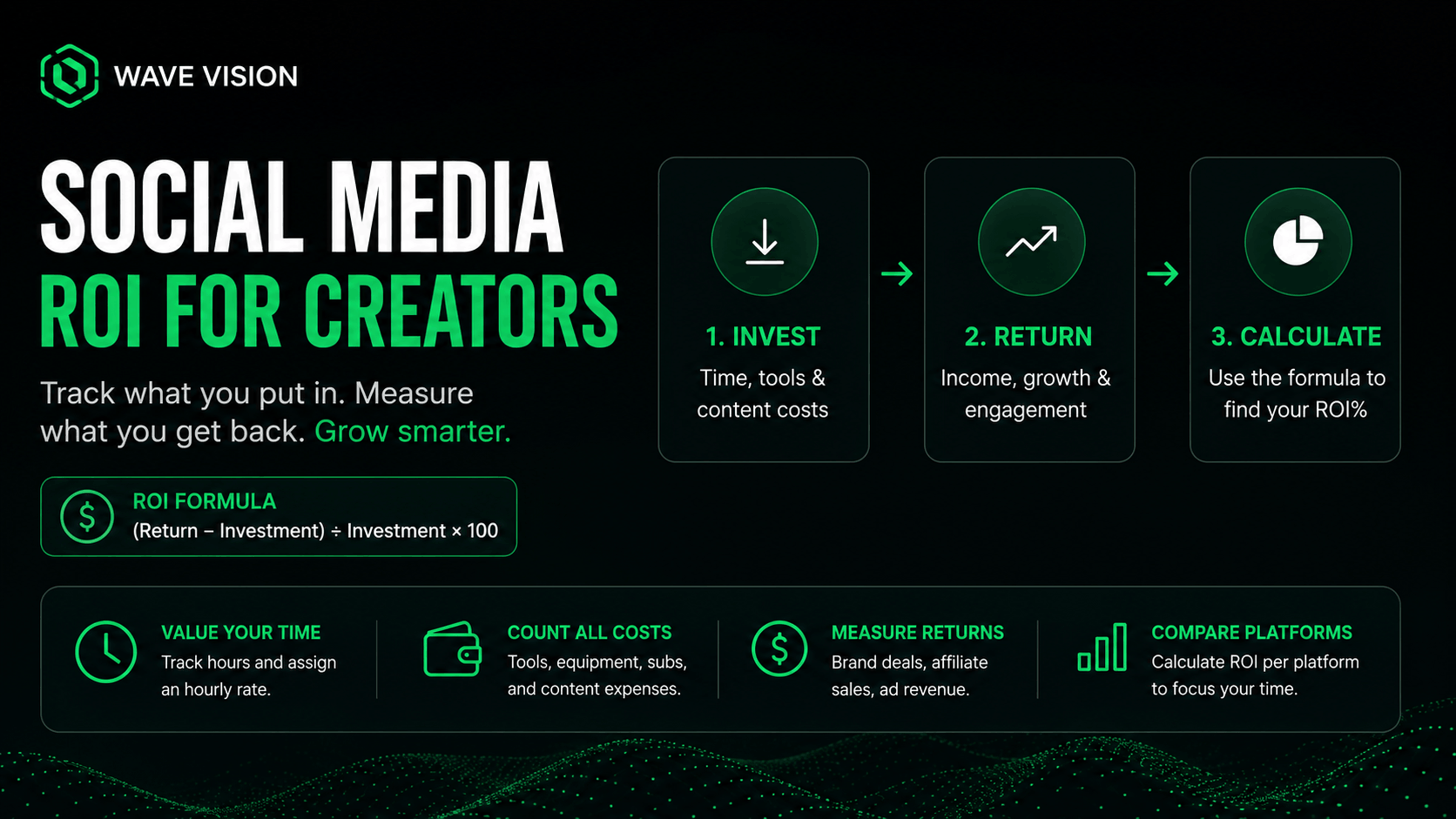
TL;DR: Measuring social media ROI as a creator means comparing what you put into content, your time, tools, and effort, against what comes back, whether that's brand deal income, ad revenue, affiliate sales, or audience growth. The formula is simple: (Return minus Investment) divided by Investment, times 100. The hard part is tracking the right numbers consistently. This post breaks down what counts on both sides of that equation and how to track it without losing hours to spreadsheets every week.
What "ROI" Actually Means for a Creator
ROI gets thrown around like a corporate buzzword, but for a creator it boils down to one question: is the time and money you're putting into content actually paying you back. That's a different question than a brand asks when it measures social media ROI, since brands are usually tracking ad spend against sales. You're tracking your own hours and tools against your own income and growth.
This distinction matters because a lot of creator advice borrows formulas built for ad campaigns, where the only investment is a media budget. Your biggest investment isn't money, it's time. Filming, editing, posting, and engaging with comments all cost hours you could have spent elsewhere, and any honest ROI calculation has to account for that.
The Simple Formula for Calculating Your Content ROI
The core formula for social media ROI is straightforward: subtract your total investment from your total return, divide that by your investment, then multiply by 100 to get a percentage.
(Return − Investment) ÷ Investment × 100 = ROI%
Say you spent $200 on editing software and equipment upkeep this month, plus roughly 40 hours of your time valued at $20 an hour, for a total investment of $1,000. If that month generated $1,450 in brand deal income and affiliate commissions, your ROI would be 45%. That's a clear, positive number you can track month over month and use to decide where to spend your next block of time.
The formula only works if you're honest about both sides of the equation. Most creators are good at tracking the return side, since income is easy to notice. The investment side, especially time, gets skipped far more often, which quietly inflates ROI numbers and leads to bad decisions about where to focus.
What Counts as Your "Investment" as a Creator
Your investment as a creator has three real components: time, tools, and content production costs, and all three need a number attached before your ROI calculation means anything.
Time is the biggest and hardest to track honestly. Estimate your hourly worth (what you could earn doing something else with that time) and multiply it by the hours spent filming, editing, posting, and engaging each week. Tools are simpler to track since they show up as recurring charges: editing software, scheduling tools, analytics platforms, and any equipment upkeep. Production costs cover anything spent directly on a piece of content, like props, locations, or paid collaborators.
Once you have a real number for investment, you can compare it against your return honestly instead of just looking at income in isolation and assuming it's all upside.
What Counts as "Return" Beyond Direct Cash
Direct income is the easiest return to measure, but it's not the only one, and treating it as the only one undercounts what your content is actually doing for you.
Direct cash return includes brand deal payments, affiliate commissions, and platform ad revenue. This is the number most creators default to, and it's a fair starting point since it converts cleanly into dollars. But platform-specific payouts vary wildly: YouTube RPM typically runs $1 to $5 for general content while TikTok's Creator Fund pays a fraction of a cent per view, which means a platform with lower direct payout can still be your best-performing platform once brand deals are factored in.
Audience growth is a leading indicator rather than direct cash, but it's not nothing. Growing your following on a platform where brands are actively spending increases your future earning power, even in a month where that growth didn't convert to a check. The mistake is treating growth as the only metric that matters, since a creator can grow steadily while their actual monetization stays flat if they're not converting attention into income streams.
Engagement rate and completion rate sit somewhere in between. They don't pay you directly, but they predict which platform and content type will convert best once you do pursue brand deals, since brand deals account for roughly 68 to 70% of total creator income for most creators, far more than ad revenue alone.
Why You Should Calculate ROI Per Platform, Not Just Overall
Lumping all your platforms into one ROI number hides where your time is actually paying off. Calculating ROI separately for TikTok, Instagram, and YouTube almost always reveals that one platform is quietly carrying the others.
This split matters because time investment doesn't scale the same way across platforms. A 60-second TikTok might take an hour to film and edit, while a 10-minute YouTube video with the same core idea could take six hours. If the YouTube video isn't earning proportionally more, its ROI is actually worse, even though the view count and comments might look more impressive.
Once you split ROI by platform, you often find one channel is your strongest driver of brand deal interest even if it's not your biggest audience. That's exactly the kind of insight that should shape where you spend your next month of content time, not just which platform has the most followers.
How to Track the Numbers Without Losing Hours to Spreadsheets
The honest problem with ROI tracking isn't the formula, it's the data collection. Pulling engagement rate, completion rate, and growth numbers from three separate native dashboards every week is exactly the kind of manual work that eats into the "time invested" side of your own ROI calculation.
This is the gap we built Wave Vision to close. Instead of manually copying numbers out of TikTok Studio, Instagram Insights, and YouTube Analytics every week, you get engagement rate, completion rate, and account growth from all three platforms in one dashboard. We covered the mechanics of setting that up in our post on tracking multiple social accounts in one dashboard.
The AI Video Analysis feature adds the other half of the picture: instead of just seeing that a video's completion rate dropped, you see why, whether that's a weak hook or a pacing issue. We broke that down in our post on hook analysis tools for short-form video, and it matters for ROI specifically because fixing a specific, identified problem is a much better use of your time investment than re-shooting content and hoping the next one performs better.
If you're pursuing brand deals or UGC work alongside your own content, our guide to analytics for UGC creators covers the exact metrics that translate directly into pitch-ready proof of ROI for a brand.
Common ROI Mistakes Creators Make
A few patterns consistently throw off a creator's ROI calculation, and most of them come down to leaving something out rather than calculating wrong.
The most common mistake is leaving time out of the investment side entirely. Counting only cash spent on tools and props makes almost any content look profitable, since your biggest cost, your own hours, never shows up in the math.
The second is measuring ROI only in the month a video posts. Some content, especially on YouTube, keeps earning ad revenue and driving brand interest for months after it's published, so a single-month snapshot can undersell your best-performing pieces.
The third is treating every platform's numbers as equally comparable. A high view count on one platform with a low RPM can look more impressive than a smaller audience on a platform with stronger brand deal interest, even though the second is the better use of your time.
Conclusion
Measuring social media ROI as a creator isn't about chasing a single perfect number, it's about being honest with yourself about what your time and tools actually cost, and tracking what comes back closely enough to see the pattern. Once you split that out by platform and stop treating growth as the only metric that matters, it becomes obvious where your next month of content time should go.
If you want to see your engagement rate, completion rate, and content performance across TikTok, Instagram, and YouTube in one place, start your $1 trial with Wave Vision and get a real baseline before you calculate your next ROI number.
Frequently Asked Questions
**What is the formula for social media ROI?**The basic formula is (Return minus Investment) divided by Investment, multiplied by 100, which gives you a percentage. For creators, investment should include the value of your time, not just money spent on tools or production.
**What counts as investment when calculating creator ROI?**Investment includes the estimated dollar value of your time spent filming, editing, and posting, plus recurring tool subscriptions and any direct production costs like equipment or paid collaborators. Leaving time out of the calculation is the most common mistake creators make.
**Should I calculate ROI for each platform separately?**Yes. Lumping all platforms into one ROI number hides which platform is actually paying off relative to the time it takes to post there, since content formats and payout rates vary significantly between TikTok, Instagram, and YouTube.
**Does audience growth count as ROI even without direct income?**Audience growth is a leading indicator of future ROI rather than direct return, since a larger, engaged audience increases future brand deal potential even in a month where it didn't convert to income. It shouldn't be your only ROI metric, but it's not meaningless either.
**How often should creators check their social media ROI?**Checking monthly is usually the right cadence for most creators, since it's frequent enough to catch patterns without adding the daily tracking overhead that eats into the time side of your own ROI equation.
Frequently asked questions
What is the formula for social media ROI?
The basic formula is (Return minus Investment) divided by Investment, multiplied by 100, which gives you a percentage. For creators, investment should include the value of your time, not just money spent on tools or production.
What counts as investment when calculating creator ROI?
Investment includes the estimated dollar value of your time spent filming, editing, and posting, plus recurring tool subscriptions and any direct production costs like equipment or paid collaborators. Leaving time out of the calculation is the most common mistake creators make.
Should I calculate ROI for each platform separately?
Yes. Lumping all platforms into one ROI number hides which platform is actually paying off relative to the time it takes to post there, since content formats and payout rates vary significantly between TikTok, Instagram, and YouTube.
Does audience growth count as ROI even without direct income?
Audience growth is a leading indicator of future ROI rather than direct return, since a larger, engaged audience increases future brand deal potential even in a month where it didn't convert to income. It shouldn't be your only ROI metric, but it's not meaningless either.
How often should creators check their social media ROI?
Checking monthly is usually the right cadence for most creators, since it's frequent enough to catch patterns without adding the daily tracking overhead that eats into the time side of your own ROI equation.