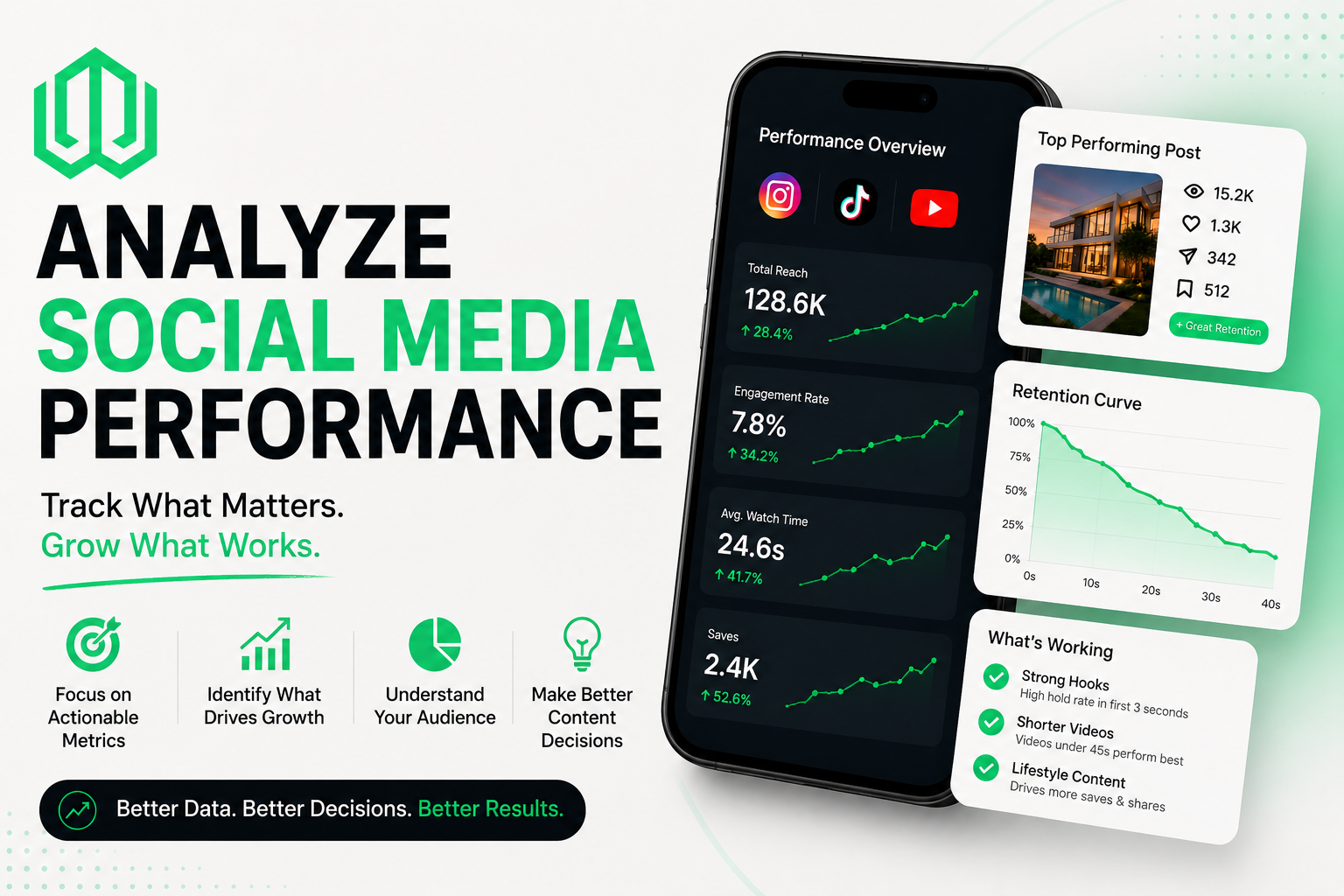
TL;DR: Most creators and marketers track the wrong metrics. Likes and follower counts feel good but rarely tell you what's actually working. Analyzing social media performance the right way means separating vanity metrics from actionable ones, tracking the signals that predict growth, and using that data to make better decisions before you post — not just after. This guide covers exactly how to do it, step by step, across every major platform.
You've posted consistently for months. You check your analytics after every post. And yet you still can't answer the most important question: why did that video get 10,000 views when the one before it got 300?
That gap between posting and understanding is where most social media strategies fall apart. It's not a content problem. It's a measurement problem.
According to the 2025 Sprout Social Index, 65% of marketing leaders say they need to prove how social media supports business goals just to get leadership buy-in for their strategy. And yet most of the numbers they're tracking — follower counts, total likes, impressions — don't actually connect to those goals at all.
Analyzing social media performance correctly means knowing which numbers drive decisions and which ones just look good in a screenshot. Once you know the difference, everything else gets clearer: what to post next, what to stop doing, and where your actual growth is coming from.
Here's how to do it.
What Does It Mean to Analyze Social Media Performance?
Analyzing social media performance means systematically reviewing your content data to understand what's working, what isn't, and why, so you can make better decisions about what to create and post next. It's the process of turning raw platform numbers into specific, actionable changes to your content strategy.
Done right, performance analysis answers four questions: Are the right people seeing my content? Are they engaging with it in a meaningful way? Is that engagement leading to real outcomes (followers, clicks, signups, sales)? And which specific content formats, topics, or hooks are driving the best results?
The key word is "actionable." A metric is only useful if it answers a decision question, such as: should I change my content format, shift my posting time, or focus on a different topic? If a number you're tracking doesn't change what you do next, it's not worth tracking.
Vanity Metrics vs. Actionable Metrics: What's the Difference?
Vanity metrics are numbers that look impressive but don't tell you whether your social media is actually working. Actionable metrics are the ones that directly connect to growth, engagement quality, or business outcomes and change how you make decisions.
Follower count is the most common vanity metric. A large audience that doesn't engage, click, or convert doesn't help your content reach new people or drive real outcomes. In 2026, distribution depends on content performance, not audience size. Accounts with smaller followings regularly outperform larger ones because the algorithm cares about retention and relevance, not raw numbers.
Total likes and impressions fall into the same category. They measure volume without context. A post with 5,000 likes and zero conversions is a loss dressed up as a win. The actionable version of those metrics asks: what percentage of people who saw the post took a meaningful action?
Here's a quick comparison of vanity metrics versus their actionable equivalents:
Vanity: total followers. Actionable: follower growth rate month over month.Vanity: total likes. Actionable: engagement rate by reach (likes + comments + shares divided by reach).Vanity: total impressions. Actionable: reach-to-follower ratio and profile visit rate.Vanity: total views. Actionable: completion rate and average watch time.
Marketers who track actionable metrics are 30% more likely to increase their social media budgets because they can prove ROI in terms their leadership understands. That's the real business case for doing this right.
The Core Metrics That Actually Predict Growth
The metrics that actually predict whether your social media is growing fall into four categories: reach, engagement quality, content retention, and conversion signals. You don't need to track everything. You need to track the right things consistently.
Reach and distribution signals tell you whether the algorithm is pushing your content beyond your existing audience. The key metric here isn't total impressions — it's what percentage of your reach comes from non-followers. A high non-follower reach percentage means the algorithm is actively distributing your content as discovery content, which is how accounts actually grow. Industry-average organic follower growth sits around 1-2% monthly in 2026, so if your growth rate is below that, your content isn't getting distributed widely enough.
Engagement quality metrics go deeper than likes. The metrics that signal genuine engagement are saves, shares, and DM shares. Saves tell you that a viewer found your content worth returning to. Shares tell you they wanted someone specific to see it. DM shares, where someone sends your content to another person in a private message, are the strongest distribution signal in Instagram's algorithm in 2026 because they indicate a level of trust the algorithm can't manufacture with paid reach.
Content retention metrics are the most important for short-form video creators specifically. Watch time, completion rate, and hook hold rate (the percentage of viewers who stay past the first three seconds) tell you exactly how your content is performing at each stage of the viewing experience. TikTok's internal data shows that videos with 50%+ completion rates receive 3x more algorithmic distribution than videos with lower completion rates. For creators, this single metric is more predictive of growth than any other number on the dashboard.
Conversion signals tie your social activity to real outcomes. These include profile visits per post, link clicks, and for creators, DM volume from content. A piece of content that drives 50 profile visits and 20 link clicks is more valuable than one that gets 5,000 views and zero downstream action.
For a detailed breakdown of how these signals work on Instagram specifically, the guide to predicting Instagram story views covers the same engagement signals that apply across Reels, stories, and the Explore feed.
How to Build a Simple Performance Analysis Workflow
A performance analysis workflow is the repeatable process you use to review your metrics, spot patterns, and make decisions. Without a structured process, analytics becomes a habit of checking numbers without knowing what to do with them.
Here's a simple workflow that works for creators and small teams alike.
Step 1: Set your baseline. Before you can measure improvement, you need to know where you're starting. Pull your last 30 days of data across all platforms and calculate your averages for the five metrics that matter most to your goals: engagement rate by reach, completion rate (for video), follower growth rate, profile visit rate, and link clicks. These are your benchmarks. Everything you measure going forward gets compared to these numbers, not to other accounts.
Step 2: Audit your top and bottom performers. Look at your 5 highest-performing posts and your 5 lowest-performing posts from the last 30-60 days. Don't just look at view counts. Look at which posts had the highest engagement rate, the highest save rate, and the highest completion rate. Then ask: what do the top performers have in common that the bottom performers don't? Common patterns include hook style, topic category, video length, posting time, and caption structure. Patterns across multiple posts are where real strategic insight lives, not individual viral moments.
Step 3: Identify your primary bottleneck. Based on what your data shows, find the single biggest problem holding your growth back. If your reach is low despite solid engagement, your hook isn't stopping enough scrolls. If your reach is high but your engagement rate is low, your content isn't delivering on what the hook promises. If your engagement is high but your follower growth is flat, you're not giving viewers a clear reason to follow. Fix the biggest bottleneck first. Changing multiple things at once makes it impossible to know what actually worked.
Step 4: Test one change and measure. Make one specific change based on your analysis. Post five pieces of content with that change applied. Compare the results to your baseline. If the metrics improve, you've found a lever worth pulling. If they don't, try a different change. This test-and-measure loop is what separates creators who grow consistently from creators who grow randomly.
Wave Vision runs this analysis automatically across your Instagram, TikTok, and YouTube accounts. Instead of manually pulling data from three separate platform dashboards and building your own spreadsheet, you get a cross-platform view of which content is performing and why, surfaced in one place. For creators managing content across multiple platforms, that time saving adds up fast.
Platform-Specific Metrics You Need to Know
Each platform surfaces different metrics and rewards different signals. Knowing which metrics matter most on each platform is essential for making good decisions with your data.
Instagram rewards watch time, DM shares, and saves above other signals in 2026. Instagram's algorithm in 2026 prioritizes watch time as the top-weighted factor in Reels distribution, followed by DM shares and likes per reach. The retention curve (available in Instagram Insights since 2025) shows you the exact second viewers drop off, which tells you whether your problem is the hook, the middle section, or the close.
TikTok is the most retention-focused platform of the three. Average view duration, completion rate, and the re-watch rate are the signals the For You Page algorithm weights most heavily. TikTok's algorithm evaluates four major signal categories: video information, user interaction, device settings, and account performance. Of those, user interaction signals, specifically watch time and completion rate, carry the most weight for distribution.
YouTube cares about click-through rate on thumbnails and titles, average view duration as a percentage of total video length, and subscriber conversion rate (how many viewers subscribe after watching). For YouTube Shorts specifically, the swipe-away rate and completion rate function similarly to TikTok's algorithm signals.
For a comprehensive look at how the best analytics tools compare across all three platforms, the best Instagram analytics tools guide for 2026 covers the full landscape of what's available.
How to Turn Analysis Into Better Content Decisions
Data without action is just noise. The point of analyzing your social media performance is to make better decisions about your next piece of content, not to produce a detailed report that nobody reads.
The most practical way to close the loop between analysis and content is to build a simple decision rule for each of the metrics you track. If your hook hold rate drops below 50%, your next five posts lead with a different type of hook. If your completion rate is below 40%, your next five posts are shorter. If your save rate is below 1%, your next five posts include more actionable information that people want to reference later.
Sustainable social media growth is built on patterns, not spikes. A single viral post that doesn't reflect anything you did intentionally is actually the least useful data point in your analytics history. What you want to find is the quiet, consistent pattern: the hook style that holds 65% of viewers, the topic category that drives 3x the save rate, the posting time that consistently produces higher engagement velocity in the first hour.
Those patterns compound. Every post you make informed by real data is slightly better than the last one. And over months of consistent analysis and iteration, that compounding effect is what actually builds an audience.
For creators who want to understand how social media analytics connects to broader business decisions, the guide on how social media analytics can help a business covers the strategic layer in more depth.
Conclusion
Analyzing social media performance isn't about tracking more numbers. It's about tracking the right ones and knowing what to do with them.
Stop reporting on followers and likes. Start measuring engagement rate by reach, completion rate, save rate, and DM shares. Audit your top and bottom performers monthly. Find the one bottleneck holding your growth back. Fix it. Measure again.
That loop, repeated consistently, is how creators and brands build audiences that keep growing rather than plateauing at the same number month after month.
Wave Vision makes this process fast. It pulls your performance data across Instagram, TikTok, and YouTube into one dashboard, surfaces the signals that matter most, and shows you exactly which content is working and why. Start your 30-day $1 trial and run your first performance audit today.
Frequently Asked Questions
**What is social media performance analysis?**Social media performance analysis is the process of reviewing your content metrics to understand what's working, what isn't, and why, so you can make better decisions about what to create next. It involves separating vanity metrics (likes, follower counts) from actionable ones (engagement rate by reach, completion rate, save rate, DM shares), identifying patterns across your best and worst-performing content, and using those patterns to improve your next post before you publish it.
**What are the most important social media metrics to track in 2026?**The most important metrics to track depend on your platform and goals, but the ones that consistently predict growth across Instagram, TikTok, and YouTube are: completion rate and average watch time (for video), engagement rate by reach (not by followers), save rate, DM share rate, and non-follower reach percentage. These metrics directly reflect how the algorithm distributes your content and whether your audience finds genuine value in what you're posting.
**What is the difference between vanity metrics and actionable metrics?**Vanity metrics are numbers that look impressive but don't connect to real outcomes, such as total followers, total likes, and total impressions. Actionable metrics are ones that inform decisions and connect to growth or revenue, such as engagement rate by reach, follower growth rate, completion rate, and link clicks. The test is simple: if a metric doesn't change what you do next, it's a vanity metric. If it does, it's actionable.
**How often should I analyze my social media performance?**A weekly check of core metrics (completion rate, engagement rate, reach) keeps you aware of short-term trends. A deeper monthly audit that compares your top and bottom performers, identifies patterns, and adjusts your content strategy is what drives long-term improvement. Checking analytics daily without a structured review process leads to reactive decisions based on individual posts rather than the consistent patterns that actually predict growth.
**What tools are best for analyzing social media performance?**Native platform tools (Instagram Insights, TikTok Analytics, YouTube Studio) are free and accurate for single-platform analysis but require you to manually compare data across platforms. Third-party analytics tools like Wave Vision aggregate data from Instagram, TikTok, and YouTube into one dashboard, surface patterns you'd miss manually, and show you the specific signals that drive algorithmic distribution. According to Influencer Marketing Hub research, 76% of serious creators use at least one third-party analytics tool because native analytics alone don't provide enough data to improve consistently.