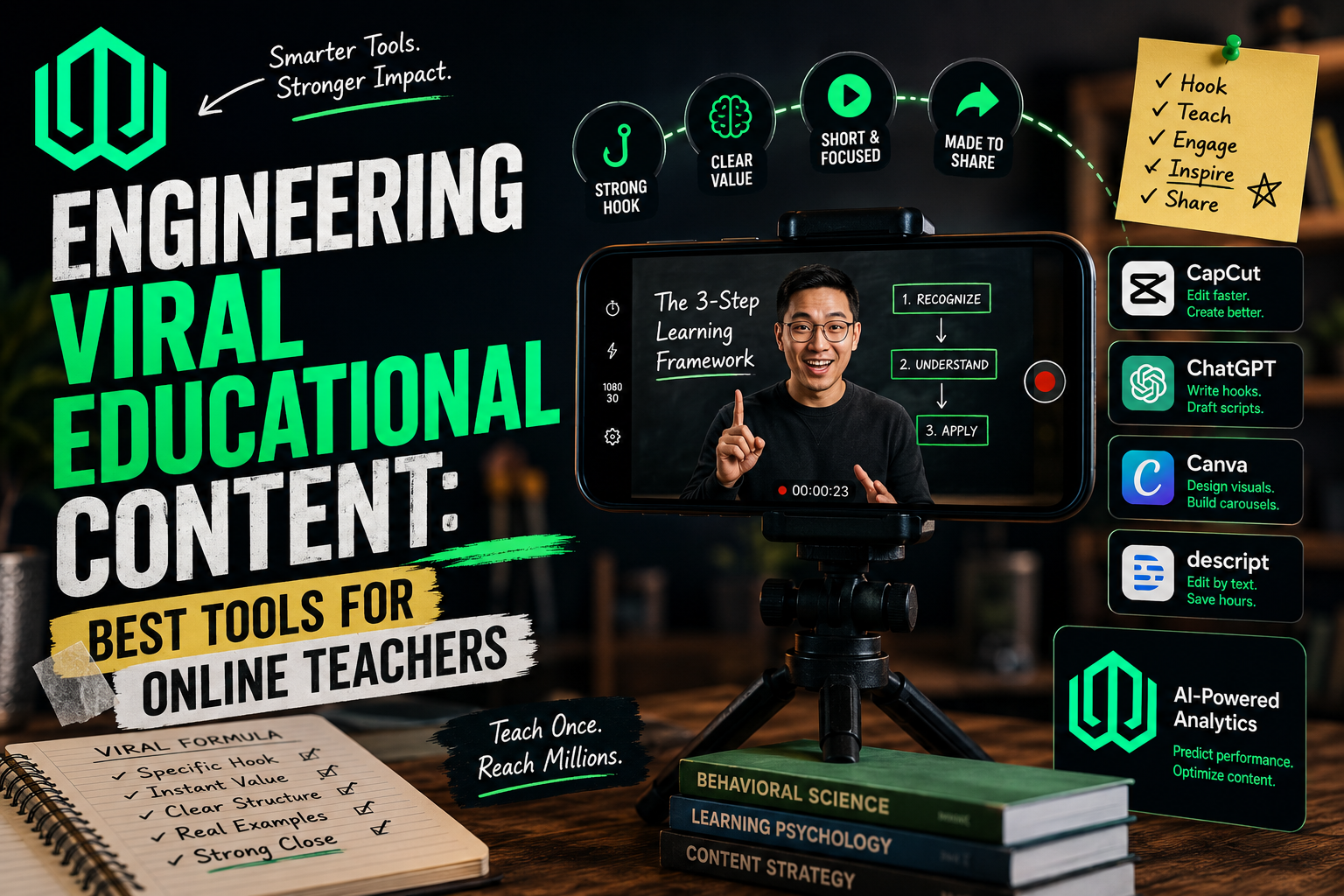
Engineering Viral Educational Content: Best Tools for Online Teachers
TL;DR: Most online teachers create great content that nobody sees. The problem isn't the quality of your knowledge — it's the structure of how you deliver it. Viral educational content is engineered, not accidental. This guide covers the exact framework for building lessons that spread, the best AI tools for online teachers in 2026, and how to use data to stop guessing which content will perform before you post it.
You know your subject inside and out. You've spent years learning it, teaching it, and refining how you explain it. And yet your Reels cap at 300 views, your YouTube Shorts barely reach your own subscribers, and you watch creators who know half as much as you rack up millions of views per video.
Here's the uncomfortable truth: going viral as an educator has almost nothing to do with how much you know. It has everything to do with how you package what you know.
In a 2025 study, 52% of viewers admitted they skip videos longer than 60 seconds even when the topic interests them. Your audience isn't rejecting your content because it's bad. They're rejecting how it's structured. The hook doesn't stop them. The middle loses them. The payoff doesn't come fast enough.
The good news is that viral educational content follows a repeatable formula. And in 2026, AI tools give online teachers the ability to implement that formula at scale, without a production team, without expensive equipment, and without starting over from scratch every time you post.
Here's how to engineer it.
What Makes Educational Content Go Viral?
Viral educational content spreads because it delivers a genuine insight in the shortest possible time, packaged in a format that makes sharing feel obvious. It's not about dumbing things down. It's about removing friction between your audience and the "aha moment" you're trying to create.
The three structural elements that separate viral educational content from content that flatlines are: a hook that promises a specific transformation, a body that delivers it without padding, and a close that makes the viewer want to send it to someone specific.
Content creators using a hook-in-first-3-seconds strategy report a 58% increase in average video watch time. For educators, this means your opening line can't be "today we're going to talk about" or "hi everyone, welcome back." It needs to be the answer to one question: why should this specific person keep watching right now?
The most reliable hook formats for educational creators in 2026 are: the specific misconception ("most people think X, but actually Y"), the surprising stat ("68% of students make this mistake in their first year"), and the direct promise ("here's how to do X in under 2 minutes"). Each one creates an immediate reason to watch without requiring the viewer to already trust you.
The body of your content needs to deliver on exactly what the hook promised — nothing more, nothing less. The most reliable viral structures are transformation narratives (challenge to outcome), conflict resolution (problem to solution), and revelation content (misconception to truth). Pick the one that fits your concept and cut everything that doesn't serve it directly.
Why "Edutainment" Outperforms Pure Education Online
The most shareable educational content in 2026 sits at the intersection of education and entertainment, a format creators call edutainment. It teaches something real and useful, but it delivers that lesson with the pacing, energy, and personality of entertainment content rather than a lecture.
Educational content performs 40% better than purely promotional content across most niches, and edutainment takes that advantage further by adding the shareability of entertainment. The combination of genuine value and engaging delivery is what makes viewers feel compelled to send it to someone else. That sharing behavior is the strongest distribution signal in the algorithm in 2026.
For online teachers, this doesn't mean becoming a comedian or abandoning your credibility. It means treating your content like a story with stakes rather than a lesson with bullet points. Set up a problem your viewer recognizes. Create tension around it. Deliver the resolution in a way that feels satisfying and slightly surprising. The educational substance is the same — the structure is what changes.
86% of viewers say they use YouTube regularly to learn new things when content is presented the right way. That "right way" is almost always edutainment: educational value delivered with entertainment structure, not the other way around.
The Best AI Tools for Online Teachers in 2026
The right tool stack for educational creators depends on what part of the production process is slowing you down most. Here are the tools that move the needle for teachers specifically.
CapCut remains the best free video editing tool for educational content. The auto-caption feature is fast and accurate, which matters because roughly 70% of viewers watch short-form video without sound. Bold, readable captions aren't optional for educational content — they're how most of your audience receives the information. CapCut handles this automatically and exports cleanly to Instagram, TikTok, and YouTube Shorts.
Descript is the tool most educational creators upgrade to once they're posting consistently. It edits video by editing the transcript, which means you can remove filler words, cut sections, and restructure your explanation without touching a timeline. For teachers who film long takes and then tighten them down, this cuts editing time dramatically.
ChatGPT or Claude handles the scripting layer. The most efficient workflow for educational creators is to prompt the AI with your concept and ask for three different hook variations, then choose the one that best matches your voice and your audience's specific pain point. Testing different hooks consistently outperforms trying to perfect a single version. Most educators script their entire first 10 seconds using AI, then go off-script for the body where their actual expertise shines.
Canva covers all the static visual content: carousel posts, quote graphics, and cover images for your videos. For educational creators, carousels are especially powerful. In 2025, carousels drove higher saves, shares, and conversion actions than Reels for educational and tutorial content. A well-structured carousel that teaches one concept across 6–8 slides often outperforms a Reel on the engagement metrics that drive long-term account growth.
Wave Vision is the analytics layer that ties everything together. It connects to your Instagram, TikTok, and YouTube accounts and surfaces the specific signals that determine whether your content gets distributed or suppressed: hook hold rate, retention drop-off by timestamp, and DM share rate. For educational creators posting across multiple platforms, Wave Vision's cross-platform analytics show you which content format is actually driving growth on each platform so you stop applying the same strategy everywhere and expecting different results.
How to Use Analytics to Engineer Better Educational Content
Most online teachers treat analytics as a report card: they check the numbers after posting, feel good or bad about them, and move on. That approach makes analytics reactive. The goal is to make them predictive.
Here's the difference in practice. A reactive analytics workflow looks like: post a Reel, check views after 48 hours, decide whether to make more like it. A predictive workflow looks like: analyze your last 15 posts to find which hook types hold attention past 3 seconds, which topics drive saves and shares, and which formats cause drop-off in the middle — then use those patterns to engineer your next post before you film it.
According to research on creator tools, 76% of serious creators use at least one third-party analytics tool specifically because native platform analytics don't surface the data needed to improve consistently. Instagram Insights shows you how many people saw your post. It doesn't show you that your retention drops at second 8 every time you transition from your hook into your first point — which is the actual problem you need to fix.
AI analytics tools do show you that. And for educational creators who are posting consistently but not growing, that timestamp data is almost always where the answer lives. Your hook is working. Your middle section is losing people before the payoff arrives. Knowing that takes your fix from "try different content" to "tighten the bridge between hook and explanation" — a specific, testable change.
For a deeper look at how the Instagram algorithm evaluates educational content specifically, the guide to predicting Instagram story views covers the engagement signals that apply across every content format on the platform.
The Educational Content Format That Gets the Most Shares
The content format that consistently drives the most shares for educational creators isn't the most polished Reel. It's the one that makes a viewer think "I need to send this to someone specific."
That trigger almost always comes from one of two things: content that validates something the viewer already believes but couldn't articulate clearly, or content that corrects a misconception they've been operating under without realizing it. Both formats work because they create a social motivation to share — "I've been saying this for years" or "you need to see this, you're making this mistake."
The misconception correction format is particularly powerful for teachers because it directly aligns with your expertise. You know what your students get wrong. You know the belief they carry in that most people in your subject area hold incorrectly. That's not just educational content. That's the seed of a viral video. Frame the misconception clearly in your hook, validate that it's a common belief, and then deliver the correction with enough specificity that it feels like a genuine revelation rather than generic advice.
Carousels using this revelation structure — misconception to truth to application — consistently drive saves, which is one of the strongest signals for Feed distribution in 2026. A viewer who saves your carousel is telling the algorithm this content is worth revisiting. That save signal compounds over time in a way that likes never do.
If you want to understand which of your content formats is generating the most saves and shares versus just views, social media analytics tools break that data down by post so you can identify your highest-leverage format and replicate it deliberately.
Turning One Lesson Into a Multi-Platform Content System
The most efficient educational creators in 2026 don't create separate content for each platform. They create one core lesson and systematically adapt it across formats.
A single strong educational concept becomes: a 30-second Reel with the hook and core insight, a 6-slide carousel that expands the same lesson in more depth, a 3-minute YouTube Short that walks through the full explanation with examples, and a caption on any of those posts that adds context and drives saves. Same concept, four pieces of content, four distribution opportunities.
AI tools make this repurposing fast. Once you've filmed your core explanation, tools like Descript and CapCut handle the editing across formats. ChatGPT or Claude can rewrite the same concept as a carousel script in under two minutes. The content strategy is one decision. The execution is mostly automated.
The missing piece for most educational creators is knowing which format to lead with on each platform. That's where platform-specific analytics become essential. What performs on Instagram often doesn't translate directly to TikTok, because the audience behaviors and algorithm signals are different. Wave Vision surfaces those differences across your accounts so you're leading with the right format on the right platform from the start, not discovering it three months into a strategy that wasn't working.
Conclusion
Viral educational content isn't about luck or follower count. It's about structure, packaging, and data. The knowledge you already have is enough. What most online teachers are missing is the framework to deliver it in a way that makes the algorithm want to share it, and the analytics to know which version of that framework is actually working.
Start with the misconception correction format for your next piece of content. Nail your first 3-second hook. Cut everything in the middle that doesn't serve the payoff. Then measure what actually happened in your retention data.
Wave Vision's 30-day $1 trial gives you the analytics to run that feedback loop properly. Connect your accounts, audit your last 30 days, and find out exactly which structural change will move the needle on your next post.
Frequently Asked Questions
**What makes educational content go viral on social media?**Viral educational content combines a hook that promises a specific transformation, a body that delivers it without padding, and a close that makes viewers want to share it with someone specific. The most effective formats are misconception corrections (debunking a common wrong belief), transformation narratives (showing a before and after), and revelation content (turning a complex idea into a surprising insight). Content creators using a hook-in-first-3-seconds strategy report a 58% increase in average video watch time.
**What are the best AI tools for online teachers creating social media content in 2026?**The most effective stack for educational creators combines CapCut for video editing and auto-captions, Descript for transcript-based editing that speeds up the tightening process, ChatGPT or Claude for scripting hook variations, Canva for carousels and static educational content, and Wave Vision for analytics that show which content formats are actually driving growth across Instagram, TikTok, and YouTube. Each tool solves a different part of the production and distribution problem.
**How long should educational videos be for maximum reach?**For short-form platforms, Reels and TikToks between 15 and 60 seconds tend to have the highest completion rates and widest distribution. In a 2025 study, 52% of viewers admitted skipping videos longer than 60 seconds even when the topic interested them. The goal is to deliver the full insight in the shortest time possible. A 20-second video with 80% retention consistently outperforms a 90-second video with 30% retention for algorithm distribution.
**Do carousels or Reels perform better for educational content?**Both have a role, but they serve different goals. Reels drive reach and new audience discovery because the algorithm pushes them to non-followers. Carousels drive saves and deeper engagement from your existing audience. In 2025 and 2026, carousels consistently outperformed Reels on educational and tutorial content for saves, shares, and conversion actions. The best strategy is to use Reels to attract new viewers and carousels to deepen their understanding of your subject matter.
**How do I know which educational content is actually working?**Native platform analytics show basic reach and engagement but don't reveal the specific signals that determine distribution: hook hold rate, retention drop-off timestamps, and DM share rate. Third-party analytics tools surface that data so you can identify exactly where viewers are leaving your content and which formats are generating the shares and saves that drive algorithmic growth. According to research from Influencer Marketing Hub, 76% of serious creators use at least one third-party analytics tool because native analytics don't provide enough data to improve consistently.